
Tag Archive for: Business

How To Manage High Performance at Work

Have you ever asked the question in your workplace – what do we mean by high performance?


High performance is defined as ‘able to operate to a high standard or at a high speed’ (Cambridge, 2025) but what does this look like in the workplace?


Last week, we shared a story about a well-known coffee shop, reflecting on how the employees worked together to problem solve.


This led us to consider:

  • When is high performance enough?
  • When does it become over-servicing?
  • Can high-performance reduce productivity?


Can the very definition of high performance actually lead to poor customer service? After all, receiving a coffee at high speed and to a high standard – is that high performance? Or is the experience, the conversation, and the feeling of connection the real measure of high performance in a coffee shop? It all depends on the customer’s purpose in visiting the coffee shop in the first place.


Think about your favourite coffee shop—whether a local boutique, a large chain, or, like my friend, your own home coffee station. What does high performance look like to you as the customer?


The Performance Curve: Balancing Challenge & Support
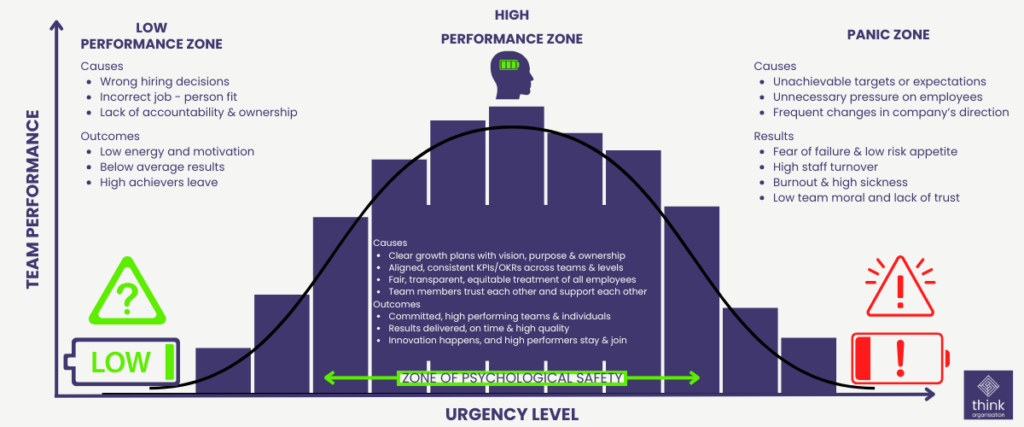
 

Performance Curve


Psychological theory tells us that performance follows a curve (which is often referred to as the Yerkes-Dodson Law – shown above). This principle suggests that moderate levels of stress and challenge can enhance performance, but too much pressure leads to diminishing returns and, in some cases, eventual burnout.


A high-performing team needs to operate at an optimal point on this curve, where there is sufficient challenge to drive motivation but not so much pressure that it leads to disengagement or exhaustion. Leaders play a key role in balancing these factors, ensuring their teams are stimulated but not overwhelmed.


The Role of Psychological Safety in Sustained Performance


For high performance to be sustainable, psychological safety is critical. Psychological safety, as defined by Amy Edmondson, is the belief that one can take risks, make mistakes, and express ideas without fear of humiliation or punishment. When employees feel psychologically safe, they are more likely to contribute ideas, collaborate effectively, and recover quickly from setbacks.


Without psychological safety, teams may hesitate to challenge poor decisions, leading to group-think and stagnation. Conversely, fostering an environment where diverse thoughts are encouraged ensures innovation and resilience, which are both crucial elements for long-term success.


Defining High Performance in Your Workplace

As psychologists, we often work to understand the lens through which people view performance and success. Assumptions, biases, and habitual thinking all shape the way human decisions are made – some are practical, some emotional, some time-bound, and others context-specific. In many cases, there is no conscious thought process involved in decision-making.


Think back to the last time you were in a coffee shop, what was the process of your decision-making about what your ordered? Can you write it down in detail? Explaining all the options you discounted?


If I asked you to explain why the person standing next to you made their decision about their coffee choices – what would you say? Would you know? You may if you knew them well, or you may not have any idea. But imagine if their definition of success was different to yours?


To define high performance for your team, consider these key questions:


  1. What does success look like for our team? – Is it efficiency, creativity, collaboration, or something else entirely?
  2. What is critical to our success? – Are there key behaviours, skills, or processes that underpin high performance?
  3. What behaviours or ways of working are crucial to our success? – Do we prioritise speed, precision, customer experience, or continuous improvement?
  4. What does failure look like for our team? – Understanding what ineffective performance looks like helps avoid missteps and course-correct effectively. Whilst it is important not to dwell on the negative looking at the opposite of success can be extremely helpful and insightful.


Rethinking High Performance: It’s More Than Just Speed

Going back to our coffee shop analogy. . .


High performance is not just about fast service. It’s about the right service, at the right time, in the right way.


In the workplace, high performance isn’t just about productivity metrics. High performance at work is about sustainable, meaningful, and impactful ways-of-working that align with organisational goals, whilst ensuring employees thrive and grow.


By considering the performance curve and psychological safety, organisations can redefine what high performance truly means which benefits everyone.


Organisations who create environments where both individuals and teams thrive, are proven to be more profitable. Repeatably, time and time again after all – Money Matters But People Matter More.


More about Workplace Psychology

There’s more about Workplace Psychology in this Think Organisation Post: Integrate Psychology Into Training to Deliver Optimal Results

Alternatively, copy and paste this link into your browser: https://cortex.clyq.co.uk/how-to-integrate-psychology-into-training-to-deliver-optimal-results/

Understanding Others: How To Drive Business Success

In today’s fast-paced, interconnected world, the ability to understand another persons point of view has never been more important. With diverse cultures, perspectives, and beliefs coming into closer contact than ever before, taking the time to genuinely understand others’ viewpoints is a critical skill. Understanding fosters collaboration, reducing conflict, and promoting empathy. Yet how often is this prioritised in your workplace? And if it is not, what can organisations do to improve this understanding?

The first is to understand what personality is, and what it is not. Next, is to understand emotions and how these can influence behaviour. These are then combined with promoting inclusion. With the use of empathy and effective communication also being critical in creating cultures where understanding others is an innate, and the go-to, way of working. So what do leaders need to know?

1. Understanding Personality

Everyone has a personality. Every human being possesses a distinct combination of qualities that form their character. Companies invest millions in trying to select the right person for a role, and as Culture Consultants, we often find that personality is misunderstood, overlooked, or measured using tools that are unreliable, inaccurate, and ineffective. Sadly, this misunderstanding can significantly impact the success of individuals, teams, and organisations.

Understanding personality goes beyond basic assessments; it involves recognising how different traits influence behaviour, communication styles, and workplace dynamics. When organisations make the effort to truly understand the personalities of their people, they can place individuals in roles that align with their strengths. This leads to better performance, higher job satisfaction, and a more harmonious work environment.

2. Understanding Emotions

Emotions are different to personality. An emotion is a feeling derived from a situation, experience, thought or physiological reaction. Emotions are complex, and a fundamental part of the human experience, influencing how we think, behave, and interact with the world around us. Emotions can be powerful drivers of action, shaping our decisions and responses to various situations. Whether positive or negative, emotions provide valuable insights into our internal states, helping us navigate relationships, work, and personal challenges.

Chalk blocks on an orange background showing different emotions which can help in understanding others

Recognising and understanding our emotions, as well as those of others, is key to developing effective relationships. This understanding enhances our ability to communicate effectively, build stronger connections, and maintain mental well-being. Understanding how emotions can impact people’s perceptions of the world is critical, as well as being able to embrace our emotions and the emotions of others when they are displayed. Embracing our emotions, rather than suppressing them, allows us to lead more authentic and fulfilled lives so it is vital emotions are not overlooked in the workplace in our quest to understand others.

Emotional intelligence (EQ) is the ability to recognise, understand, and manage our own emotions while being attuned to the emotions of others. One of the key components of EQ is empathy, and trying to understand another person’s point of view directly enhances this skill. High emotional intelligence is associated with better interpersonal relationships, leadership capabilities, and overall wellbeing. By understanding the feelings and motivations behind someone else’s perspective, we become more emotionally intelligent and adept at navigating social dynamics. This helps build success for individuals, teams and organisations.

3. Empathy, Connection & Conflict

Understanding Others is based on cultivating empathy, which is defined in this image as the ability to feel and understand the emotions of others

Understanding another person’s perspective allows us to cultivate empathy—the ability to feel and understand the emotions of others. Empathy is the foundation of meaningful relationships, both personal and professional. When we try to see the world through someone else’s eyes, we acknowledge their experiences, emotions, and challenges. This recognition helps build a sense of connection, trust, and mutual respect. People feel more valued and heard when their viewpoints are genuinely considered.

Being able to create meaningful connections, through understanding others, helps improve communication across organisations. Diverse perspectives lead to improved problem-solving and higher levels of innovation. Organisations that promote a culture which prioritises listening and seeking to understand different viewpoints empowers psychological safety. It allows employees to expand their own thinking and opens up new solutions to drive forward innovation.

In reality, most conflicts arise from misunderstandings or miscommunications. When individuals focus solely on their own perspectives, they may disregard the reasons or feelings that motivate someone else’s actions or beliefs. By taking the time to understand another person’s viewpoint, we gain insights into their reasoning, which can defuse potential tensions. Understanding doesn’t necessarily mean agreeing, but it creates space for constructive conversations rather than reactive arguments. This further fuels psychologically safe workplaces.

Effective communication is a two-way street, and understanding another person’s viewpoint is essential for meaningful dialogue. When we focus on understanding others, we become better listeners – an essential skill for clear and compassionate communication. Rather than waiting for our turn to speak or counter-argue, we actively engage with what the other person is saying, leading to more thoughtful and constructive conversations. This further fuels empathy and connection, reducing potential conflicts.

4. Inclusion, Diversity & Belonging

Inclusion is about creating an environment where everyone feels valued and respected. Diversity is about have a wide range of people who have different backgrounds, experiences, preferences some of which may fall into protected characteristics. Creating a sense of belonging for people is critical for diversity and inclusion to flourish. Reams of research highlight the benefits of diversity in organisations. But at the heart of this is understanding someone else’s viewpoint. This plays a crucial role in building inclusive spaces.

Inclusion, diversity and belonging is vital whether in the workplace or in social settings. Having the tools and empathy to understand the different backgrounds, experiences, and opinions of others contributes to a culture of respect and belonging. When people feel heard and understood, they are more likely to engage fully, share ideas, and collaborate. This strengthens teamwork and engagement across organisations.

For leaders and team members alike, the ability to understand different viewpoints is vital for fostering collaboration and unity. Leaders who seek to understand their team members’ perspectives are more likely to build trust, loyalty, and engagement. They create environments where employees feel valued, which boosts morale and productivity. In teams, when everyone feels heard and respected, collaboration becomes more fluid, and the group can work more effectively towards shared goals.

Conclusion

In a world that often feels divided, the act of trying to understand another person’s point of view can make a profound difference. Whether it’s building stronger personal relationships, enhancing creativity and innovation, or promoting peace in society, the benefits of empathy and understanding are immense.

Moreover, acknowledging the importance of personality and emotions, especially in the workplace, ensures individuals are supported and organisations are more successful. The next time you’re faced with a differing opinion, pause, listen, and consider the perspective of the person in front of you – you might just find common ground where you least expect it.

Are you ready to

start your joruney?

Take the first step to transform your workplace.

Call us on 07123 456 789
Email us at sarah@cortexworx.com

© Copyright Cortex Worx LTD. All rights reserved. | Website by Clyq