
Can a Great Workshop Change Behaviour at Work?

In most organisations, change begins with a meeting, not a workshop.


It might be an idea, a frustration or someone coming up with a new way of doing things. It could be a directive from your boss. But things need to change, and often this starts with a meeting. A group of people talking about what needs to change, why and how it is going to happen.


This is why a workshop is a vital meeting.


In the last 30 years, no matter when any of the Think Organisation team lead or facilitated change, which actual meeting it started in can be very hard to identify. It can also be the seed which decides whether change is successful or unsuccessful.


Leaders talk about collaboration, resilience and great communication, but in the real world, real behaviour change doesn’t happen in the meeting room. It happens after the meeting. It happens in the way people behave when no one is watching, or the way in which people are driven. Real change happens when people experience something that reshapes how they think, feel, and relate to others.


In our opinion, a meeting is so often where people talk about work, but often little changes post meeting. In fact, from our extensive experience it is a professionally facilitated workshop, where people are empowered to actively solve problems and work together that real change, including behaviour changes can be sparked.


This is why workshops remain one of the most powerful tools for changing behaviour at work, especially when they blend science, creativity, and experience.


Even the name “workshop” highlights the importance of working with your hands to learn practical skills through doing. So the next time you are in a workshop at work – is it really a workshop? And will it really facilitate behaviour change?


Why Behaviour Change Needs Experience, Not Just Information

Traditional training often focuses on transferring knowledge: slides, models, frameworks. But the brain doesn’t change through knowing, the brain changes through doing.

Neuroscience shows that learning sticks when it engages multiple regions of the brain simultaneously. This includes the prefrontal cortex (thinking and planning), the limbic system (emotion and memory), and the motor cortex (movement and coordination). When we involve the body, we involve the whole brain.


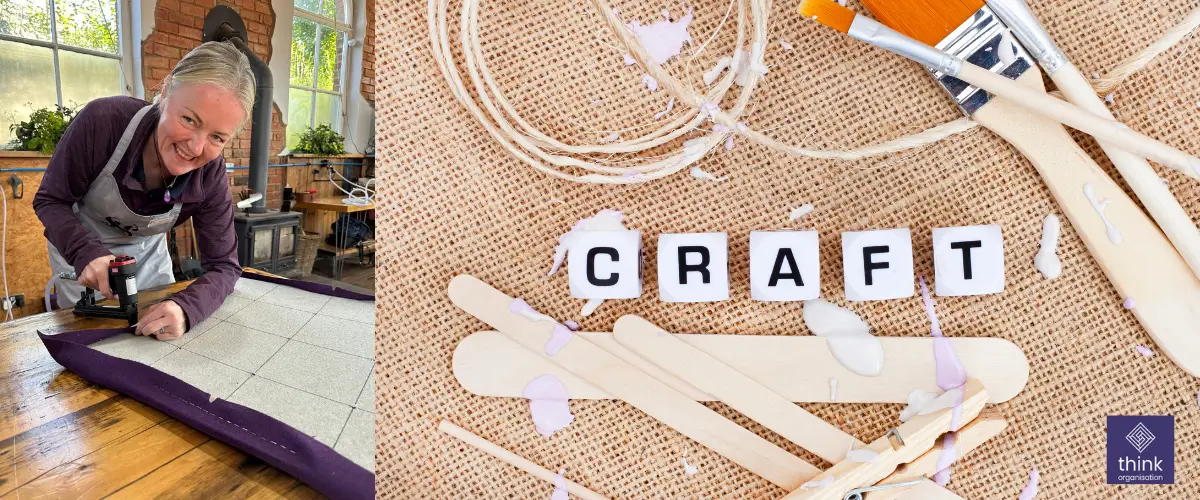
That’s why creative, hands-on workshops, such as leatherwork, paracord weaving, building or woodcraft, can transform learning into something far more meaningful. They anchor abstract ideas in physical experience, helping people feel what collaboration, patience, or focus actually mean.
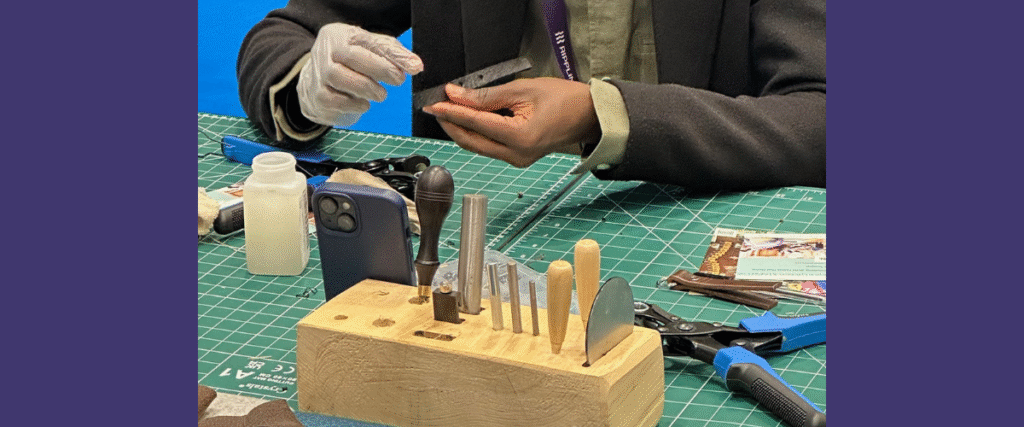
 

A person changing a piece of leather into a creative keyring


The Power of Working Together, Alone

In group workshops, each person often works on their own creation. It may be a piece of leather, or a paracord bracelet, or a noticeboard. They are absorbed in their own process, yet surrounded by others doing the same.


This balance, working together, alone, activates a fascinating blend of brain activity.


The default mode network (DMN), responsible for self-reflection and creativity, comes online during solitary, mindful tasks. But at the same time, the social brain network remains engaged because of the shared environment. As humans we are subconsciously attuned to others’ presence, rhythm, and energy.


The result is a state of quiet connection. Individuals find focus and flow, while the group synchronises emotionally and cognitively, which is a phenomenon psychologists call interpersonal neural synchrony. This shared state builds trust, empathy, and belonging without a single “team-building” exercise in sight.


So no more awkward role plays where you just want the ground to swallow you up as your try to solve team communication challenges.


Why Hands-On Change Activities Work

Take leatherwork. It requires patience, precision, and acceptance of imperfection which are all qualities that mirror the emotional regulation and adaptability needed in leadership.


Or paracord weaving, this is a practical metaphor for resilience and connection. Each strand alone is weak. However, woven together, they form something far stronger.


As teams reflect on that process, the metaphor becomes tangible. As does the paracord bracelet they leave with at the end of the activity.


From a neuroscience perspective, such tactile activities release dopamine, reinforcing learning through pleasure, and oxytocin, deepening social connection. This blend of chemistry and cognition is the foundation for long-term behavioural change.


From Awareness to Action – Why Workshops Matter

Workshops that blend reflection, creativity, and science follow the natural stages of behavioural change:


    1. Awareness – understanding what needs to shift.
    2. Experimentation – trying new approaches in a safe, supported space.
    3. Commitment – translating insight into action back at work.


By engaging the senses, emotions, and intellect, creative workshops can help enable these changes to stick.


Think Organisation workshops don’t just tell people to change, they let them experience change in a way they want to do it again and again – because it feels positive.


As experts in culture, the Think Organisations team knows that culture doesn’t shift because of a strategy document. Culture shifts because people start to behave differently together.


This is why, for the last three decades we have created spaces where teams can explore, create, and connect. It might be lego, spaghetti bridges or something more tangible like leatherwork. Because, whether through conversation or craft, we ensure teams activate the very systems in the brain that underpin trust, learning, and collaboration.
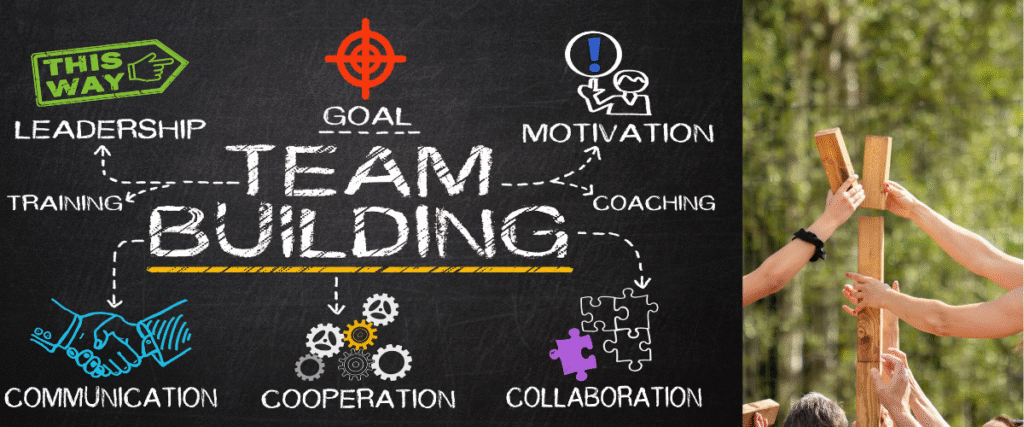
 

Team building helps create behaviour change


Workshops like these remind us that change isn’t always loud or linear. Sometimes, it begins quietly, in the rhythm of hands at work, the calm of focused attention, and the simple act of working together, alone.


Our Expert Change Takeaways Include:

    • Behaviour change begins with experience, not instruction. Because people remember what they feel and create more than what they are told.

    • Working together, alone creates a powerful neurological balance building both individual reflection and social connection, whilst providing opportunities to explore team dynamics

    • Hands-on activities like leatherwork and paracord weaving embody core leadership qualities: patience, precision, resilience, and collaboration. Everyone needs to be open to learn.

    • Emotional engagement and sensory learning drive dopamine and oxytocin release, both key ingredients for trust, motivation, and memory.

    • Culture is learned through doing. When teams experience new ways of working together, they carry those behaviours back into everyday life. It is much easier to liken how a team builds a flat pack ikea bookcase together and give feedback to each other than it is when it is a complex business problem, shrouded in emotion.


If you are ready to explore how creativity and neuroscience can unlock new ways of thinking, feeling, and leading then please join us.


🧠 Think Organisation partners with Semper Hopkins to design immersive, evidence-based workshops that help teams reconnect, refocus, and reimagine how they work together. We also work with travel agencies, outward bound and other immersive venues to provide innovative and suitable workshop experiences which deliver ROI for your organisation.
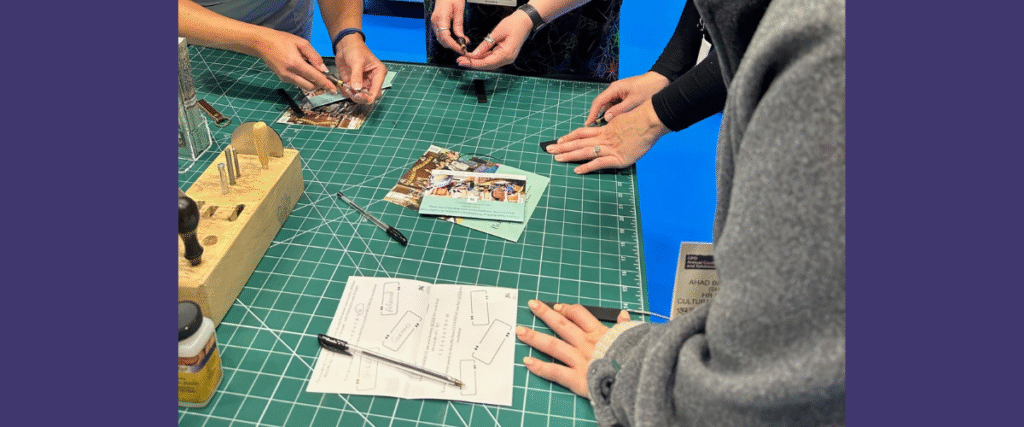
 

Learning how to craft and change leather using a skiver tool


📩 Book time with Sarah Clarke to explore how a bespoke workshop could help your team build stronger habits, deeper trust, and lasting behavioural change or read our package offerings with Semper Hopkins here.


More about Workplace Psychology

There’s more about Workplace Psychology in this Think Organisation Post: Using psychometrics is proven to add value to your business

Alternatively, copy and paste this link into your browser: https://cortex.clyq.co.uk/why-using-psychometrics-is-proven-to-add-value-to-your-business/

Think Better, Not Faster: The Science of Pausing for Innovation and Growth

In a world that celebrates productivity, it’s easy to mistake motion for progress. How often do you take a breath or pause at work? Innovation happens when we deliver something new and useful to our customers, organisation or even society as a whole. But with innovation constantly declining, how can pausing help us innovate faster?


Think about your average week at work. . . .meetings roll into more meetings, inboxes refill faster than they empty, and reflection feels like a rare luxury.


For psychologists, leaders, and anyone guiding people through change, there is a growing scientific evidence that pause, which is a deliberate, reflective space, is not wasted time. In fact, it is this time to think which is the birthplace of creativity, clarity, and sustainable innovation (Kline, 1999).


When Doing Less Creates More

The paradox of creativity is that our best ideas often emerge when we stop trying to have them. Stepping away from active problem-solving allows the mind to reorganise information, draw unexpected connections, and reveal insights that relentless focus can obscure.


Pause Button


Scientists refer to this as incubation. It is a recognised stage in the creative process first described by Graham Wallas in 1926 and now well supported by neuroscience research.


During incubation, the brain quietly continues to process information beneath our awareness, in our subconscious. It explains why solutions appear in the shower, or clarity strikes whilst we are on a quiet walk. We may not look like we are doing anything. However, this does not mean we have stopped thinking. In fact, it is because we’ve stopped forcing ourselves to think, that we allow our brains to really think.


Ask yourself, where am I when I have my best ideas? For some it may be on walks, for others in the bath, the shower or even in the gym. Giving our brains time to pause and think, deeply and subconsciously, is crucial. Yet why do organisations seem to promote motion for progress?


Tomorrow, many HR leaders, people experts and inspiring leaders and experts will be descending on the CIPD Conference 2025, aptly focusing on championing people to transform work. Our Co-Founder, Sarah Clarke, is supporting the Semper Hopkins team to deliver 6 interactive sessions we call the Creative Pause in the Relax & Rewind area of the conference but this is about anything but relaxing and rewinding. This is about helping people use the power of their brain to become more innovative, more productive and improve their own, and others, well-being through creativity and allowing time to think.


The Neuroscience Behind the Creative Pause

Our Co-Founder undertook extensive research which transformed her misconceptions and understanding of creativity whilst completing her MSc dissertation. One element is that creativity is not down to a single area of the brain. Current research shows there is not a single “creative region” of the brain that sparks ideas, but it is the interaction between three key networks which drives creative thoughts in our brains. These are referred to as:


  • The Default Mode Network (DMN), which is active when we daydream or reflect inwardly, responsible for imagination and association thoughts.
  • The Executive Control Network (ECN) which is active during focused problem-solving, analysis, and decision-making.
  • The Salience Network (SN) which acts as a switch, guiding attention between inner reflection and external focus.


Based on studies by Beaty and colleagues (2015 & 2019) research shows that creativity depends on how fluidly we move between these networks. It was based on this research that the creative pause sessions were first designed. Because, focusing on something else, allowing our brain to be creative helps allow this shift.


Fuelling and releasing the brain from the narrow beam of focused attention and enabling it to diffuse and move to more associative thinking that can, and often, fuels originality of thought.


In other words, pausing isn’t doing nothing. It is allowing your brain to do what it does best: integrate, imagine, and make connections. Many of which you will be unaware of, that is until the idea or solution pops into your conscious thought.


During her research, our Co-Founder’s supervisor was Dr Mark Batey, an innovation and creativity guru who worked at the University of Manchester. His seminal research highlighted that creativity doesn’t exist in isolation. In fact, it can operate across four levels. The person, the process, the environment (refereed to as the press) and the product. These levels interact, which makes measuring creativity so difficult as it is vital to decide which lens is being used (Batey, 2012).


This heuristic model focused on the following elements:


  • The person brings motivation, mindset, and self-belief.
  • The process involves divergent (idea-generating) and convergent (idea-selecting) thinking.
  • The press, or environment, either nurtures or constrains creative behaviour and innovation.
  • The product is what emerges, this can be tangible innovation or a new understanding.


Based on this, the suite of Creative Performance workshops were designed. In addition, our creative pause sessions touch on all four levels within an hour.


Join us to allow yourself time to reconnect with the person, understanding your intrinsic motivations, where we will support you in the process of reflection, and help you understand the elements of the pressures which impeded or fuel creativity and innovation.


As Batey notes, creativity thrives when people feel psychologically safe, valued, and given permission to think differently. The pause, therefore, is as cultural as it is cognitive. How often do you pause to think in your work?


Why Psychologists and Leaders Should Model the Pause

Psychologists and leaders are often at the centre of complexity. That is certainly how the Think Organisation team operate. Every week we are helping teams adapt, shifting cultures, and navigating uncertainties with the businesses we support. Yet constant responsiveness can come at a cost.


Pause


When we don’t pause, we lose access to deeper intuition, empathy, and perspective. These are the very capacities that make us effective in human systems. That’s why some of our great thoughts come whilst we are on holiday, well away from the office and constant motion of being at work.


So how can leaders embed creative pauses into their organisational and team cultures?


Embedding pauses into professional and organisational practice isn’t indulgent; it is strategic.


Research shows that reflective time improves problem-solving, boosts wellbeing, and enhances collective learning.


In cultures that reward speed, modelling stillness is an act of ultimate leadership.


Designing the Pause Into Organisational Life

To make the creative pause part of daily practice, Think Organisation recommends small, intentional shifts:


  • Micro-pauses: Take 5–10 minutes before key decisions or during meetings to ask, What assumptions are we holding? What might we be missing? A quick walk to gain some fresh air is often all the time that is needed.
  • Reflection rounds: Begin or end meetings with space for sense-making rather than updates.
  • Thinking time: Schedule undisturbed blocks in calendars and protect them as fiercely as client time. If these are the first elements of time to be sacrificed what does this say about your commitment to innovation?
  • Creative spaces: Build environments that signal reflection is valued in your organisations. Areas such as quiet zones, promoting walking meetings, off-site thinking days or booking creative performance workshops all empower employees to be more creative.
  • Model curiosity: Leaders who share their reflective practices give permission for others to pause too.


We know it is difficult, which is why at Think Organisation, we work with leaders who understand that the future of performance is not about doing more, but about thinking better.


Whether you need an ICF accredited executive coach, leadership development or an organisational culture review. The science is clear: creativity, innovation, and resilience all depend on our ability to pause, to step back, connect ideas, and reimagine what’s possible.


So, next time you feel the urge to rush from one task to another, take a breath.


The most important thing you could do might not be the next thing, it might be the pause before it.


Reach out to the Think Organisation for more support. More information about our Creative Performance Workshops can be found here or for your own bespoke onsite solution, reach out.


References

More about Innovation

There’s more about Innovation in this Think Organisation Post: How to Create a Culture of Innovation

Alternatively, copy and paste this link into your browser: https://cortex.clyq.co.uk/how-to-create-a-culture-of-innovation/

Create Team Motivation When You Have No Payroll Budget

When resources are tight, motivation can feel like an impossible luxury. You can’t tell someone to be more motivated. In fact, it is difficult to tell yourself to feel more motivated when you are not. Yet some of the most inspired teams Think Organisation have helped create weren’t driven by bonuses or financial incentives they were powered by purpose, trust, and recognition. All of which was inspired by leaders who knew how to lead.


It is vital to acknowledge a truth often overlooked in these conversations: motivation cannot be built on an unfair foundation. No amount of purpose or positivity can compensate for people not being paid enough to live well. No amount of inspiring leadership can boost motivation when people know they are not being treated fairly. But what is fairly?


As a minimum, paying the Real Living Wage and aligning with frameworks like the Good Employment Charter, isn’t just ethical, it’s essential for long-term engagement, retention, and trust.


All organisations need to get the basics right, so as we wait for a looming budget, struggle with ever increasing NI costs and find payroll budgets squeezed, the first step for any organisation, or leader, who mentions the importance of culture in their organisation is to be transparent about your commitment to fairness and your plan to meet those standards.


Motivation thrives in cultures where integrity takes precedence over superficial incentives.


But what do leaders really need to understand about motivation when it comes to balancing budgets?


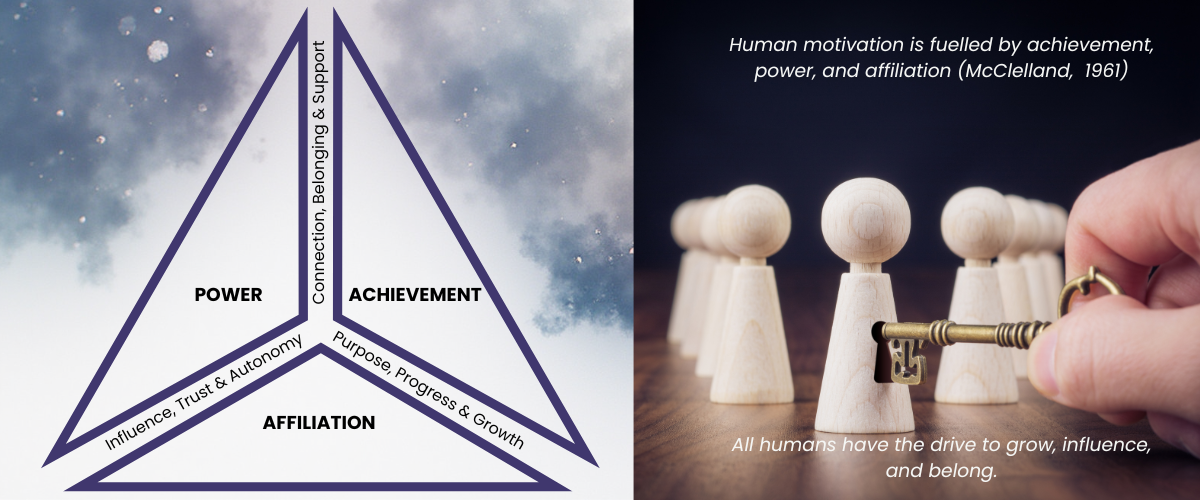
Maslow’s Hierarchy of Needs has gained popularity in recent years, and  Psychologist David McClelland’s model proposed that three core drivers shape human motivation at work, which is much more practical for many leaders to utilise in terms of delivering an impact on performance.


The first need is achievement, the second is power and the third is affiliation which are outlined below.


1️⃣ Achievement – the desire to excel, improve, and see results.


2️⃣ Power – the drive to influence, make an impact, and feel trusted.


3️⃣ Affiliation – the need for connection, belonging, and positive relationships.


Leaders can draw on these three drivers to energise their teams in meaningful ways, tapping into intrinsic human needs.


Remember some people are driven equally by all three, whereas others may have higher preferences for one or two of the different needs. Leaders can help utilise these three drivers, or needs by taking the following steps.


1️⃣ Reconnect People to Purpose (Achievement)

When people feel disconnected, money rarely fixes it. Meaning does. A small bonus may improve performance momentarily, if at all, but creating connection is what taps in to our innate needs for achievement. This is that warm feeling you get when you deliver something exceptional, or complete something which matters for someone.


Leaders need to remind teams why their work matters. Not just to the organisation, and the individuals, but to customers and communities.


Allowing these stakeholders to show how much they value what the employee is delivering for them is even more powerful. Allow employees to listen to, and hear, real stories of impact, not just performance metrics.


People with high achievement motivation as a driver thrive when they see tangible progress and purpose in their work.


2️⃣ Create Psychological Safety (Affiliation)

All humans need to feel like they belong. Employees with strong affiliation needs will be driven by being connected, being part of a group and having strong relationships with other employees.


Those with lower affiliation preferences, which never means no affiliation preferences, may be less focused on connections.


However, as we have seen with DEI initiatives – everyone needs to feel included and that they belong.


A team where people don’t feel they belong often masks fear or frustration. Employees are disengaged. And to overcome this leaders need to create safe spaces for honest conversations.


Asking supportive questions such as “What is currently hindering you, or getting in the way of you, doing your best work?”, or “What would make the biggest positive difference to how you feel at work today?” can both help identify what is needed.


And then leaders must act. When people feel listened to and included, their need for affiliation is met, but they also need help resolving challenges and to see improvements which restores trust and belonging.


3️⃣ Give Autonomy and Responsibility (Power)

Leaders who can’t let go will undermine their teams and take away any power. This can be difficult as some individuals have a higher need, or driver, for power. If these people become the leaders it is vital to manage this driving need, especially when others in the team may also have this as a preferred need.


Micromanagement kills motivation faster than any pay freeze or lack of bonus.


People need to feel trusted and know what they can control. Giving people more control over how they deliver outcomes is the first step.


Empower people to make decisions and lead projects. This satisfies the need for power. The ability to see how they have the power to decide their own destiny.


Leaders need to set employees up for success. Power is a need, but it is not about dominance or control. This needs is a positive kind that comes from influence and ownership as if this turns negative then the other needs, achievement and affiliation quickly suffer and everyone needs all three to some degree to feel motivated.


4️⃣ Recognise, Often and Authentically (Affiliation + Achievement)

People like to feel noticed. Many leaders we have worked with fail to recognise the hard work of their teams.


Changing goal posts, or moving what is required when someone has already invested time. effort and resources quickly creates frustration and often leads to people stepping back and becoming disengaged.


It is important to remember that recognition doesn’t have to be financial. But it does need to mean something.


Say “thank you” publicly can be extremely motivativational for some, and cringeworthy for others. Celebrating milestones not completions (as progress is vital) and little and often has a much bigger impact on performance.


Acknowledge both outcomes and effort. When recognition connects to team values and shared purpose, it fuels both achievement and affiliation needs.


Individuals have other drivers, e.g. to be affiliated with their family so recognition which supports the whole of their life can be a double driver so think creatively.


5️⃣ Develop Without a Budget (Achievement)

Growth opportunities don’t always mean expensive courses. Especially in todays world where growth, development and learning from others is about time more than financial investments.


Leaders can offer the following:


  • Offer stretch assignments or cross-team projects aligned to what the individuals are interested in
  • Promote peer mentoring or job shadowing, bringing people in on opportunities
  • “Lunch and Learn” sessions led by team members can be invaluable to both the deliverer and the attendees


Those with a higher need for achievement will thrive when challenged and supported to grow, and everyone needs this to some extent.


Monotony or complacency occurs when people are not developed and stretched in their roles.


A Culture of Motivation

People become disengaged when they feel kept in the dark. Whereas camaraderie fuels team dynamics and builds individual and group resilience.


Leaders need to encourage connection beyond the task list. This is how cultures of motivation are truly created. So that when times get tough, people come together, not apart.


Many companies promote volunteering, use this as time to spend together as a team. Shared coffees or “win of the week” check-ins help people feel part of something bigger than themselves.


Importantly, don’t just focus on the positives. Humans like to be part of the solutions. This brings all three needs and drivers together. Share openly current challenges and progress, ask for help and support in ensuring your organisation is a good employer.


Leadership presence, shown by listening, being empathetic and demonstrating fairness, signals integrity and builds the kind of trust-based power that motivates others to follow. Which becomes a self-sustaining culture of motivation.

Motivation is psychological, emotional, and moral. It is not just financial.


When you can’t offer more money, offer more meaning, autonomy, and belonging.


When you can’t expand budgets, expand trust.


And when you can’t promise change overnight, promise fairness and transparency and deliver what you say you will.


Progress is crucial. That’s what fuels motivation.


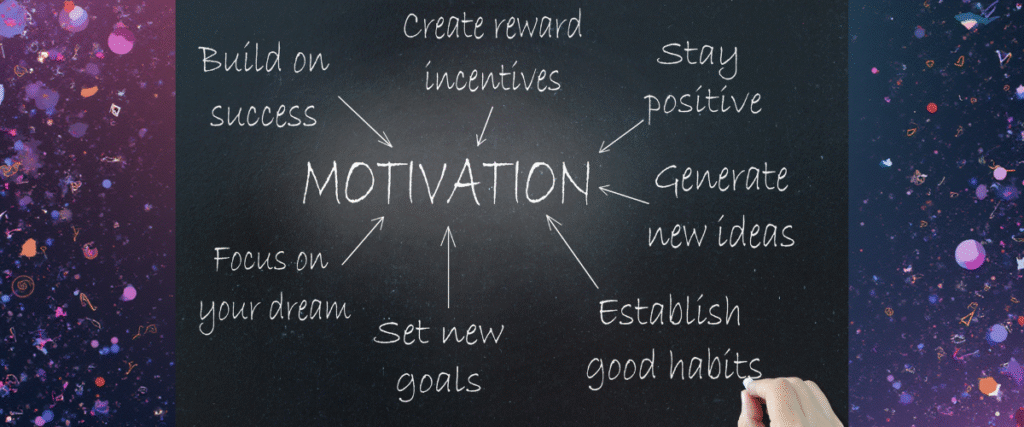
Motivation is about generating new ideas, establishing good habits and understanding the needs of others and ourselves such as affiliation. achievement and power.


More about Motivation

There’s more about Motivation in this Think Organisation Post: Top Trends in Work Motivation

Alternatively, copy and paste this link into your browser: https://cortex.clyq.co.uk/staying-ahead-of-the-game-top-trends-in-work-motivation/

Put Your Thinking Hats On: Use De Bono’s Model To Unlock Better Ideas & Results

How we make decisions, come up with ideas, solve problems or approach challenges is all down to how we think. Imagine if you could change how you think based on the thinking hats you decide to put on your head.


Thinking defines the mental processes of generating, organising or evaluating ideas, information and experiences to understand, reason, make decisions and solve problems.


As Psychologists, we often call it cognitive processing because thinking involves functions such as perception, memory, imagination, reasoning and judgement.


Everyone’s mind manipulates information differently, whether it is words, images or abstract symbols, our minds use this information to make sense of the world and guide our behaviour. Because of this we often get asked, is there a tool or model which can help us think better, deeper or differently?

The answer is yes, because one model, in our opinion, which can help reduce the bias, emotions or rigid thinking patterns is Edward de Bono’s Six Thinking Hats. This tool is a simple framework, which when used correctly, can help transform decision making, by helping teams think more clearly and make better decisions.


What Are the Six Thinking Hats?

Developed by Dr. Edward de Bono, a pioneer in creative and lateral thinking, the Six Thinking Hats model is designed to help individuals and groups look at problems from multiple perspectives, by deliberately and systematically using each “hat” to represent a distinct mode of thinking:


    • White Hat: is all about facts & information, this hat focuses on data, evidence and objective information. Questions such as what do we know? Or what do we need to find out? What does the data show us?

    • Red Hat: is about feelings and intuition, bringing emotions and gut instincts into discussions. Questions such as how do we feel about this idea? What is our immediate reaction? Is this emotional?

    • Black Hat: is more about critical judgement, and to some extent caution. This hat identifies risks, weaknesses and potential problems it is about asking what could do wrong?

    • Yellow Hat: is about the benefits, and optimism. It is about looking at the positives, the opportunities and the positive values which could be added. Why might this work well?

    • Green Hat: is about creativity and possibilities, in terms of encouraging new ideas, alternatives and fresh perspectives. This is about seeing if there is another way of looking at this?

    • Blue Hat: focuses on process and control, in terms of the step by step process itself. This hat manages the process itself in terms of how should we organise the discussion? What is the next step?


Is There Psychology Behind The Thinking Hats?

At its core, the Six Thinking Hats approach is rooted in psychology, because it acknowledges that humans often think reactively, or emotionally, or logically.


It appreciates that people may have different preferences in terms of how they think, and that cognitive biases can distort decision-making.


Using De Bono’s model can help us separate thinking into clear, structured modes, helping people become aware of how they think, not just what they think.

Thinking about thinking, is called metacognition. This psychological shift, thinking about one’s thinking, consciously adopting different hats helps people step outside of habitual thought patterns and consider viewpoints they might otherwise dismiss.


Supporting others to utilise the hats, either as a collective, or as individuals can help foster empathy, reduce conflict, and builds psychological safety. This model is about giving permission for all perspectives, from cautious to creative, to give equal weight to different ways of thinking.


How De Bono’s Thinking Hats Can Add Value to How People Work

The Six Thinking Hats create a shared language for thinking, which can be used across teams and organisations. Instead of clashing opinions, teams explore ideas sequentially.


With a recent client, everyone wore the Yellow Hat to discuss positives, then the Black Hat to assess risks, each hat being used in turn. This structured approach help resolve personal conflicts and improves clarity. Instead of one person always being seen as critical, and another as overly positive.


This in turn helps improve decision-making quality, by removing some of the potential emotions and ensuring all perspectives are covered. It ensures no one perspective it overly focused on. and helps create more informed and balance decisions.


In boardrooms, this can he used to remove the risks of group think, which can happen when risks and opportunities are not equally considered.


A productive meeting may start and end with a blue hat, to frame and close the discussion. Using the white hat early on can help gather facts, and alternating between yellow, black, green and red hat can help balance optimism, caution, creativity and emotion.


Being able to balance free thinking, and experimentation, without immediate judgement is crucial in organisations which need increased innovation. Using the green hat to overcome a fear of failure in organisations can be extremely helpful.

Just as leaders who use the red hat intentionally, to help teams to acknowledge emotions in decision-making, can strengthen empathy, motivation and trust. It is important that when everyone knows there are different modes of thinking, they are valued, and utilised. Individuals who may have different preferences can feel safer, knowing about the different styles of thinking. And businesses can use this model to help in multiple situations such as: strategic planning, innovation workshops, conflict resolution and performance coaching.

In an era where adaptability, empathy, and critical thinking define organisational success, De Bono’s Six Thinking Hats offer more than just a brainstorming tool, they provide a psychological framework for better collaboration and smarter decisions.


By learning to wear each hat with intention, teams move beyond bias and ego, unlocking a culture of curiosity, balance, and shared purpose. Because ultimately, when people learn to think together, not just talk together, the quality of both their work and their workplace transforms.

Below are some questions which may help you utilise the thinking styles of the hats:


🎩 White Hat – Facts & Information

Focus: Data, evidence, and what is known or unknown.


Use these questions to establish the factual foundation:


    • What do we know for certain about this situation?

    • What data or evidence do we have?

    • What information is missing, and how can we get it?

    • What trends or patterns can we identify?

    • Are there any assumptions being made that need to be checked?

    • What do the numbers, reports, or research say?


❤️ Red Hat – Feelings & Intuition

Focus: Emotions, gut reactions, and instinctive responses.


Encourages people to share what they feel, not just what they think.


    • How do you feel about this idea or situation right now?

    • What’s your gut instinct telling you?

    • Does anything about this make you uncomfortable or uneasy?

    • What excites you about this possibility?

    • Are there any emotional reactions from others we should consider (e.g. staff, customers)?


Black Hat – Caution & Critical Judgment

Focus: Risks, weaknesses, and potential problems.

Helps identify pitfalls and prevent poor decisions.


    • What are the potential risks or downsides?

    • What could go wrong if we proceed this way?

    • What obstacles might we face?

    • Are there any compliance, ethical, or reputational concerns?

    • Is this idea practical and sustainable long term?

    • What evidence do we have that this might not work?


💛 Yellow Hat – Optimism & Benefits

Focus: Positives, value, and potential gains.

Balances caution by highlighting why an idea could succeed.


    • What are the benefits of this idea or decision?

    • How could this create value for the business or team?

    • Why might this approach work well?

    • What opportunities could come from this?

    • Who would benefit the most?

    • How could we make this idea even more effective?


💚 Green Hat – Creativity & Alternatives

Focus: Innovation, new ideas, and alternative approaches.

Encourages divergent thinking and brainstorming.


    • What are some new ways we could approach this issue?

    • How else could we achieve the same goal?

    • What if we had no limitations — what would we try?

    • Could we combine ideas to create something better?

    • What unconventional options haven’t we explored yet?

    • How could technology or partnerships help us innovate here?


🔵 Blue Hat – Process & Control

Focus: Managing the thinking process itself.

Used to guide the meeting, maintain structure, and summarise outcomes.


    • What is the main goal or question we’re addressing today?

    • Which hat should we be using right now?

    • Are we spending too much time on one perspective?

    • What have we learned so far?

    • What’s our decision or next step?

    • How will we track progress or follow up on this discussion?

More about Coaching

 
There’s more about Coaching in this Think Organisation Post: Coaching in Adversity

Alternatively, copy and paste this link into your browser: https://cortex.clyq.co.uk/individuals-teams-and-organisations-need-coaching-in-adversity/

Can Understanding Social Identity Unlock Productivity In Your Team?

Leaders of teams cannot afford to overlook the science of human behaviour – which can provide evidence-based solutions to common people challenges – including identity.


Organisational success is not only driven by strategy and resources but also by the unseen impact of individual and group behaviour.


Group behaviours are the patterns of interaction, attitudes and actions that emerge when individuals come together as a team or unit within a workplace. They reflect the shared norms, roles, values and dynamics that shape how the group operates and performs.


These behaviours can be formal (aligned with organisational policies, goals, and processes) or informal (driven by unwritten rules, social bonds, or cultural influences).


Culture change is all about changing the ‘way we do things around here‘ is often unsuccessful, because leaders or change makers miss some fundamentals about human behaviour. Which is why we want to share an overview of Social Identity Theory and provide some powerful insights for leaders to harness the power of psychology to make a real difference.


In a theory originally developed by Henri Tajfel and John Turner, this theory, their research highlights some key messages:


Why People Think of ‘Us’ Versus ‘Them’

Because Social Identity Theory explains how people define themselves by the groups they belong to. These groups could be a department, profession or organisation as a whole.


These groups could also be anything from the eight protected characteristics to a football team which people choose to support because:


1. Identity is through Membership

This means you are part of a group, which may be by choice or by circumstance, and employees derive pride, motivation and meaning from their in-groups.


It means that people, either visibly or invisibly, belong to a group which can be identified as different to others e.g. we are in finance, or we work at X company. This leads to different dynamics between people, depending on whether you are in a group or out of a group.


2. In-group & Out-group Dynamics

Loyalty to one group, can intentionally or unintentionally, fuel competition or division. Think of football team supporters.Wearing shirts, waving scarves or flags. This is all intentional behaviour to identify with a certain group. Competition is fuelled through performance, and identity stretches ‘off’ the pitch.


With people in work (e.g. in Manchester where Think HQ is based where a question of are you red or blue is often second only to “how are you?” when people meet) becoming linked through which team they support.


3. Emotional Connections

Being in a group, or out of a group, can provide strong emotional connections and explain people’s identities.


With a recent client there was a clear disconnect between regional offices versus the head office. This led to polarised opinions and divisions when one group (the regions) felt unfairly treated compared to the other (head office).


Despite many people experiencing fair treatment, the perceptions soon grew based on the stories being circulated, which led to a growing “them versus us” group mentality which quickly became divisive when resources became scarce.


How Does Our Board Balance The Power Of Team Identity With The Need For A Cohesive Culture?

Organisational cultures often hinge on in versus out groups. They deliberately promote the group of one organisation over another, enticing employees to join their business over others because ‘their culture is better’.


In fact,  organisational culture and engagement hinge on fostering a strong, inclusive “one company” identity.


But what is the risk to this?


And how do leaders utilise the psychological theories which underpin human behaviour?


Social Identity During Mergers & Acquisitions

Restructures, mergers and acquisitions often fail to realise the predicted benefits due to identity clashes, not just strategy missteps. This is because people don’t just work for organisations, they identify with them.


Employees derive part of their concept of self from their organisations brand, history, values and culture. Then when two companies, or teams, come together they can feel that their identity is being challenged, lost or replaced.


This can lead to disengagement, and negative behaviours, as when people don’t recognise themselves in this new organisation they no longer feel like ‘themselves’.


Resistance and then attrition can follow, which leads to further division, as groups often blame each other for negative events which happen.


This categorisation of ‘us’ versus ‘them’, shows up during M&A through the acquirer versus the acquired, or the new company versus the old.


Behaviours and expectations are often different and without an aligned culture plan to create a new cohesive vision built up from the best elements of both groups, employees begin to vie for their ‘way of working’ to win.


This dynamic fuels siloed behaviours and internal competition then undermines integration efforts.


Culture Clashes Are Identity Clashes

Research, history and the teams experiences of M&As show failures are rarely about the financials or strategy.


They usually stem from cultural misalignment. Symbols, rituals, language and even leadership styles all represent identity markers of different groups. When these conflict, employees resist adopting the new way because it threatens their sense of belonging.


And all humans need to feel like they belong, that is how we have survived.


Leadership behaviours often signal whose identity ‘wins’, which causes greater unrest. Especially if leaders only promote or highlight one ‘sides’ history, practices and talent.


Employees from the other side may feel erased, or under-valued, which causes further ‘in’ group and ‘out’ group conflict.


However, when leaders consciously blend identities, honouring the best of both and co-creating a shared ‘new we’ then integration succeeds, and the two groups become a new improved group with a new identity.


The Cost of Culture

Losing our sense of identity leads to higher employee turnover, especially with top talent, however there are many other costs of culture clashes.


Employees who are disengaged contribute less in terms of discretionary effort, as well as lower productivity and outputs. Customers can also pick up on internal pressures, fractures between teams or organisations creating a weakening of brand trust. Especially when customers may be feeling a similar loss of identity – like when Somerfield and the Co-op merged. Many customers had chosen to shop at Somerfield stores over Co-ops, but then they became one. Taking choice away for many customers.


Steps Leaders Can Take

Whether change is needed, teams are merging or there are large-scale acquisitions, all leaders can take the following steps to harness the psychology behind humans needing to be in groups, and our social identities.


1. Acknowledge Identity & Identities

Culture is not a soft issue, or something which is ‘fluffy’. It is measurable and strategic and belonging is a fundamental need of all humans.


Taking steps to acknowledge identities, support people to be unique, whilst embracing what makes us similar is crucial. Many DEI strategies are all about bringing people together, but some have actually increased divisions and failed to deliver improvements.


Whatever, your thoughts or experiences it is vital to engage with all employees. Ensuring employees are diverse, representative of our global society and ensure that they’re involved in creating shared values and stories.


Learning, listening and being curious is the first step in this journey.


2. Embed & Signal Inclusivity In The EveryDay

Many people acknowledge, or join, groups which speak to their own identity. LGBTQ+ is an example of this.


It is vital that everyone feels included, whether it is a protected characteristic or just for being awesomely unique.


Two organisations joining together need to celebrate the legacies of both organisations, while building a new vision for the new one.


Progress needs to be measured, but this is about day-to-day interactions, not a set of boxes to tick.


In some organisations, even over a decade later, the legacies of individuals being from one or another organisation can often still exist.


The culture gaps need to be measured, social identities measured and then a strategy put in place to deliver the alignment over 12-18 months.


3. Monitor Integration Health

Being internal and part of the transition can be difficult, especially as it’s difficult to see the bigger picture when looking out from the inside.


Financial KPIs are always measured and tracked at a board level, yet often integration indicators are overlooked.


Understanding and having visibility of predictive indicators is critical, after all if you don’t measure it, it can often result in it not mattering.


Tracking employee perceptions, behaviours and expectations are critical alongside other cultural alignment KPIs.


Social Identity

At the heart of whether people belong is social identity. Ignore it, and you risk culture wars, disengagement and talent fights and flight.


Understanding, embracing and harnessing social identity can allow leaders, and employees, to create truly integrated cultures.


If you build a stronger, unified identity then integration can be accelerated and ROI can be delivered.

More about Culture

There’s more about Culture in this Think Organisation Post: Football as a Metaphor for Organisational Culture

Alternatively, copy and paste this link into your browser: https://cortex.clyq.co.uk/why-football-is-a-great-metaphor-of-organisational-culture/

Discover the Secrets of Business Psychology Models

A business can tap into a vast array of models depending on whether its focus is strategy, operations, people, innovation, change or culture. Some of these were highlighted in last week’s insights.


Yet, many management and board consultants have limited, or even no, awareness of the hundreds of models grounded in psychological theories, research and most importantly proven scientific methods.


Psychology is vital for businesses because it helps you understand how people think, feel and behave. It is a science which can help you make better decisions, build stronger teams and create workplaces where everyone can do their best work.


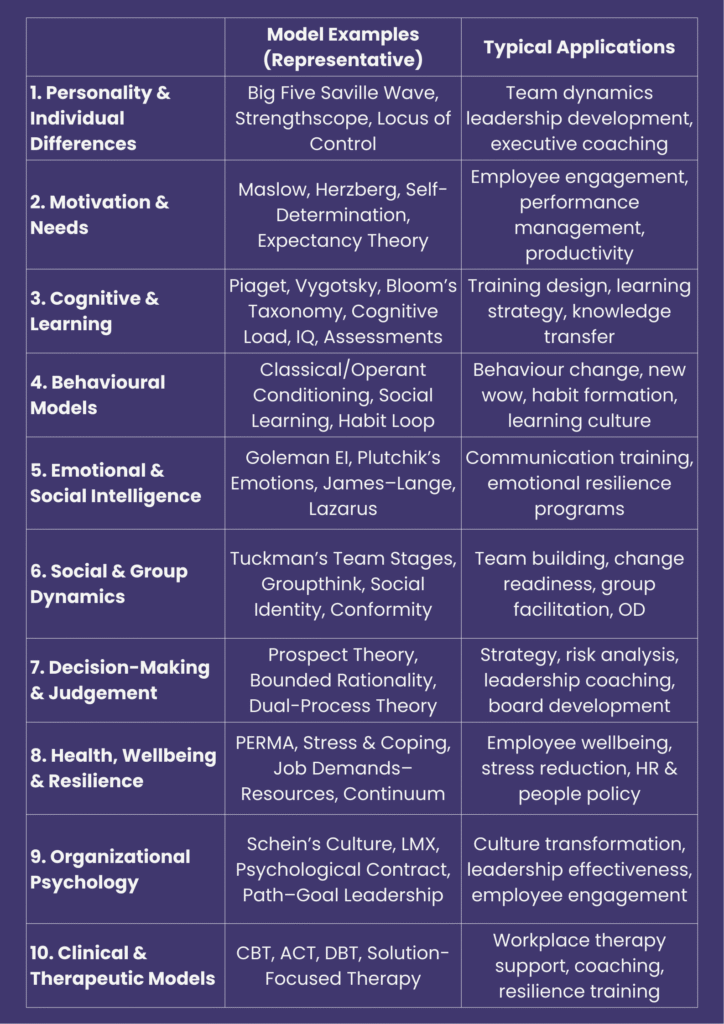
The table below provides a high level overview of some of the models that have been developed:


Psychology in Business


Forward thinking businesses can tap into over a century of psychological research to improve leadership, teamwork and performance.


Personality Models

One of the main areas which businesses focus on, often to the detriment of other areas, is personality & individual differences.


Personality is the unique combination of traits, behaviours and patterns of thinking and feeling that consistently shape how a person interacts with the world.


Various models, like the Big Five (OCEAN), Cattell’s 16 factors, Saville Wave or Strengthscope can help leaders and organisations, understand more about their employees.


Personality is one element of what makes us human, and every individual is unique so understanding traits can help enhance performance. Utilising models such as Locus of Control can help coach people, and teams, in how to respond effectively to challenges.


Models of Motivation & Needs

Motivation is the internal drive or external influence that initiates, guides and sustains goal-directed behaviour, or indeed any behaviour. This can be conscious or unconscious. The basics of Maslow’s Hierarchy or Herzberg’s Two-Factor Theory, to Self-Determination Theory can help leaders understand what drive people to perform at their best.


Other factors may influence this performance, such as culture, situation, time or wellbeing but understanding human needs is key to ensuring effort is spent in areas which deliver results. There is no point in spending money on development, when organisations aren’t meeting basic needs – such as paying a fair wage so people can live.


Cognitive & Learning

Cognitive relates to the mental processes involved in acquiring knowledge and understanding, such as thinking, learning, memory and problem-solving.


Theories, such as Kolb’s Learning Cycle or Bloom’s Taxonomy, reveal how we process and apply knowledge which is crucial when understanding how to train and develop employees, or leaders for today and tomorrow. The effectiveness of training courses, online or face to face, and induction programmes is often overestimated and can cause various challenges in organisations when leaders report ‘no change in behaviour’ as a result of training and development.


Learning is the process of acquiring, modifying or reinforcing knowledge, skills, behaviours or attitudes through experience, study or instruction.


Ironically, instruction is one of the least effective methods for helping change behaviours, despite it being the preferred option for many trainers. In fact, behavioural models can provide much more insight into how to embrace new ways of working (wow).


Behavioural Models

How we think, feel, respond physically and then behave, is all inter-linked and cross-linked. Behavioural models like Operant Conditioning or Social Learning Theory explain how habits and workplace behaviours form.


Using these behaviour models, which can be frameworks or theories to explain, predict and guide how individuals or groups act in specific situations can help leaders by identifying factors that influence those actions.


The social impact of culture on behaviour in business is the way shared values, norms and beliefs shape employees’ actions, decisions and interactions, ultimately influencing organisational performance and reputation as a whole.


Humans learn from watching other humans, not just doing what they say.


Modelling Emotions

Emotional intelligence is the ability to recognise, understand and manage your own emotions and those of others to guide thinking, behaviour and relationships effectively.


Social intelligence is the ability to understand and navigate social situations effectively by perceiving, interpreting and responding appropriately to the behaviours, emotions and dynamics of others.


Frameworks such as Goleman’s EI or Plutchik’s Wheel of Emotions can help explain away some of the complexity which equips leaders to manage emotions and relationships effectively.


Group Dynamics

Group dynamics is the study of how people interact, influence and behave within a group. This includes the patterns, roles, and relationships that shape how groups function. These include things such as Tuckman’s Stages and Social Identity Theory.


These theories explain how individuals form, maintain and function within groups based on shared goals, identities, and social structures that exist. Closely connected are group dynamics which examine the patterns of interaction, influence, and relationships within those groups.


Together, both are vital to organisational success because they affect collaboration, communication, decision-making and overall team effectiveness. This impacts performance, innovation and workplace culture and whilst complex, it measurable, and can help leaders ensure teams form, cooperate and succeed. They can also explain why groups sometime fail.


Decision-Making & Judgement Models

Decision-making models are structured frameworks that guide individuals or organisations through a systematic process to evaluate options and choose the most effective course(s) of action.


Often human thinking can create biases, assumptions and lead to ineffective decision making so models like Prospect Theory or Dual-Process Theory can help explain why people make the choices they do under uncertainty.


Tools such as RACI or RAPID, many of which are trade-marked, can help empower effective decision making by helping take out some of the emotion and provide more objective clarity.


However, effective team performance is often an outcome of using a suite of theories and psychological models, unique to the who, what, when, where, when and how success will look.


Health & Well-being

In many ways, the health continuum is the main model for this category but in reality individuals are predisposed to health, or poor health, based on physical, genetic and psychological factors.


Frameworks such as PERMA, Job demands-resources and burnout models can help provide insights but often it is multifaceted what causes stress and unsustainable performance in organisations.


Organisational leaders who promote health and wellbeing at work, need to strive for a holistic state in which employees are physically, mentally and socially supported to thrive, perform effectively and sustain long-term productivity.


Often surface level efforts can have detrimental effects, or mask deeper challenges which is where organisational psychology becomes paramount.


Organisational & Work Behaviour

An organisation is an entity formed by people working together in a structured way to achieve shared goals or purposes through coordinated activities and resources.


In many ways, organisations are a living breathing entity.


In terms of the thoughts, feelings and emotions, people can connect with organisations or brands. Organisations are more than just a physical object, in that they exist because people agree on the structure, purpose and rules which make that organisation.


There may be tangible elements, like buildings or equipment, products or services, but organisations are all unique and successful organisations harness this for commercial gain.


Schien’s culture model, or leader-member exchange theories, help explain how it feels to be part of an organisational entity. There is no right or wrong as such, but alignment, consistency and direction anchored to a purpose is fundamental.


Unlike therapeutic psychologists, organisational psychologists are not registered medical practitioners with the HCPC. However, it is important that they hold an MSc in Occupational Psychology or a Psychology degree, along with accreditation from the British Psychological Society and ideally the Association of Business Psychology.


Clinical & Therapeutic Interventions

Whilst many workplaces offer counselling via employee assistance programmes (EAPs), therapeutic approaches are generally reserved for outside workplaces.


Yet, increasingly, managers are being called upon to help deal with mental health challenges, or other more serious blockers to performance.


Often therapeutic interventions come when employees are experiencing mental health challenges, such as stress, anxiety, depression, trauma or burnout, which have become serious, and visible, affecting their wellbeing, performance, or workplace relationships.


Often early intervention, confidential support or structured treatment can help them recover and function effectively, and a proactive approach delivers significant benefits and ROI.


Cognitive behavioural therapy (CBT) is a common intervention which if understood and utilised when people are well can be much more beneficial as a preventative tool. CBT coaching can also help individuals overcome blocks and thrive.


Psychology offers businesses a vast, evidence-based toolkit to understand and influence how people think, feel and behave.


By tapping into proven models, from personality and motivation to decision-making, group dynamics and wellbeing, leaders can make better decisions, build stronger teams and create workplaces where employees thrive.


Forward-thinking organisations that integrate these insights don’t just improve performance, they foster a culture where people can do their best work, every day – sustainably.


Contact sam@cortex.clyq.co.uk to get our Top 100 Models or book a free 30-minutes insights session with us.

Evaluating Emotional Intelligence In Your Boardroom

Does your board practice emotional intelligence in meetings?


Boardroom evaluations are a vital part of good governance and are a legal requirement for many organisations (e.g. UK listed businesses). Yet how many evaluations measure emotional intelligence around the boardtable?


A boardroom evaluation helps identify whether a board is performing effectively, making sound decisions and fulfilling the boards strategic, financial and legal responsibilities. But the effectiveness of board evaluations has often been questioned, particularly in recent years following a number of high profile scandals (e.g. Carillion, Post Office) where one of the ‘big 4’ had given both these organisations a clean bill of health following their board evaluations (IOD, 2024).


In our opinion, and based on our team’s extensive exposure to a diverse range of boards across 30+ industries there is one crucial factor that many board evaluations overlook: emotional intelligence, measured by their emotional quotient (EQ).


You can have a boardroom full of brilliant minds, but if emotional intelligence is lacking, performance, relationships, and ultimately, organisational outcomes can suffer. One of the most critical elements of emotional intelligence is self-awareness and its absence often shows up in subtle but extremely dangerous and powerful ways in the boardroom. How self-aware are your board?


Our latest insights explore the role of emotional intelligence in board effectiveness, with a particular focus on self-awareness and why it should be a central item in your next boardroom evaluation. No matter what size your business, having a boardroom evaluation can be critical in protecting your organisation and your board.


Why Boardroom Evaluations Are Imperative

Boardroom (or board effectiveness) evaluations are structured reviews of how well a board functions. Whilst some organisations (e.g. listed PLCs) are legally required to conduct independent evaluations we recommend every board has an independent review to help protect organisations and society as a whole.


How else do you know how your directors are performing?


Evaluations assess governance, decision-making, skills, relationships, all critical elements linked to the board’s effectiveness and impact on organisational culture.


Evaluations can be conducted internally (by the Chair or Company Secretary), or externally (by an independent governance expert), or by an independent third party such as a non-executive director.


The challenge with the Chair, or even Company Secretary conducting the reviews it is is a bit like marking your own homework – it is difficult to see things when you are part of them. Because perceptions, power dynamics and expertise are critical when deciding on how, who, when, why, where and what feeds into a board evaluation. Typically evaluations explore:

    • Board composition, diversity, and skills

    • Clarity of roles and responsibilities

    • Meeting dynamics and decision-making processes

    • Oversight of risk, compliance, and strategy

    • Relationships between board members and executives

    • The culture and tone set by the board, and chair


Which, in reality, many boards would struggle to do without external expertise and an independent eye.


One of the most critical elements of any evaluation is often missing. Because Psychologists are often not part of the assessment. Psychologists are experts in human emotions, motivations and behaviours, so the value they can add is phenomenal. As experts in behavioural insight (the human dynamics that truly shape how a board really operates) their input can, and has, significantly impacted board performance across a wide range of our clients because of their impact on decision making, focus and the ability to work collectively.


Emotional Intelligence – Is This The Hidden Driver of Board Success?

All humans are influenced by their emotions. An emotion is a strong feeling, often instinctive or intuitive, derived from a person’s circumstances. 


Emotional intelligence refers to a person’s ability to recognise, understand and manage their own emotions, and is linked to their ability to empathise with and influence others. It is not about shutting down or closing emotions, but recognising they exist. 


In the boardroom, emotional intelligence (which is measured by the emotional quotient) enables:


    • Directors to remain calm under pressure

    • Professional constructive challenge

    • Stronger relationships across the board and the executive team

    • Improved decision-making as individuals and a collective

    • Better conflict resolution

    • Inclusive, psychologically safe dynamics


Boardrooms are not just places of strategy, where leadership theory prevails. They are spaces where high-stakes conversations, conflicting priorities and large personalities often converge. Which is why technical skill alone isn’t enough. This is only one half of the coin. 


When our consultants are working with emotionally intelligence boards, the Directors tend to:


    • Ask better questions

    • Listen more deeply

    • Challenge without creating defensiveness

    • Adapt their approach to meet the needs of different stakeholders

    • Prioritise legal and governance requirements protecting self, employees and organisation


In a boardroom where there is a lack of emotional intelligence, even the best-intentioned boards can become risk-averse, disengaged or divided. 


So how can this be avoided?


Self-Awareness: Is The Cornerstone of Boardroom Effectiveness

In our opinion, based on over 30 years of experience across numerous industries, the most important (and often most overlooked and underestimated) component of boardroom effectiveness is self-awareness. 


Think about the Post Office scandal. There were over 900 sub-post masters wrongfully convicted of theft under the stewardship of over 50 directors. The one thing that was missing was self-awareness. If the directors had been self-aware, or even open to listening the scandal could have been avoided. The investigation and enquiry is uncovering how Directors refused to publish information they didn’t like, or agree with – the very opposite of being self-aware.


Self-awareness is the ability to:


    • Understand your own thoughts, emotions and behaviours

    • Recognise how your actions affect others

    • Acknowledge blind spots, biases and limitations

    • Accept feedback and adapt constructively


Directors who are not prepared to feel uncomfortable, or listen and seek to understand, with a curious mindset, help create and fuel scandals such as the Post Office or Carillion. 


In the boardroom, self-awareness supports:


✅ Better Relationships

Because self-aware directors are more likely to recognise when they’re dominating, interrupting or shutting down conversation and they are able to course-correct in the moment.


✅ Constructive Challenge

Directors need to challenge, but self-awareness helps them do so thoughtfully, ensuring professional approach without ego, reactivity or point-scoring. Helping promote psychological safety.


✅ Better Decisions Under Pressure

When emotions run high, self-aware leaders can pause, reflect and most importantly choose a response suited to the situation, rather than reacting on impulse or defaulting to groupthink.


✅ Growth and Improvement

A board is only as strong as its willingness to learn. Self-aware directors invite feedback, acknowledge when they’re wrong, and model the continuous improvement they expect from others creating and leading a culture of growth across their organisation.


Self-awareness missing?

In reality, there are two types of people those who think they are self-aware (95%) and those that really are self-aware (10-15%). Tasha Eurich explains more, because for many of us we don’t do introspection well, especially when we ask “why we do things“.


When self-awareness is missing, then the loudest voices dominate while the others stay silent, creating a culture which doesn’t foster growth. 


Egos get in the way of objectivity, with individuals needing to be heard for their own reasons, as opposed for that of the organisation or business.


Over time, if not checked, then meetings become performative, not productive, and there is an increasing risk of the board potentially missing its role in understanding organisational issues.


On the surface a board may look (much like the Post Office board) as if they are high performing and meeting their requirements. Because many of these issues often sit below the surface, they can be difficult to spot in tradition evaluations.


Because unless psychological safety, emotional intelligence and the quality and productivity of relationships is evaluated then board evaluations fall short. Much like the board evaluations produced by one of the big 4 for Carillion and the Post Office, giving them a clean bill of health shortly before the scandals broke.


How Do We Embed Emotional Intelligence into Board Evaluations?

Any Director can assess their own emotional intelligence (EI), but real transformation happens when EI is assessed and developed collectively across the board.


In a rapidly changing world, boards that embed emotional intelligence into their evaluation processes are better equipped to lead with empathy, adaptability, and strategic clarity.


If you’re ready to future-proof your board, it’s time to put emotional intelligence in the spotlight.


If you’d like support, reach out to Sarah Clarke for a free 30-minute Emotional Intelligence consultation. In the meantime, here are four practical ways to bring EQ into your board evaluations:


1) Undertake Behavioural Feedback

Traditional board evaluations often focus on technical competencies or industry-specific insights. But to truly understand a board’s effectiveness, you need behavioural feedback on how directors interact, communicate and challenge one another.


To do this gather insights from across the organisation to capture how board members are perceived, especially in relation to trust, collaboration, empathy and self-regulation.


Employees at various levels often see what goes unseen in formal evaluations such as relationship tensions, unspoken power dynamics, or emotionally unintelligent behaviours.


Prioritise behavioural data to get a true picture.


2) Facilitate Board Reflection

One of the most effective ways to build emotional intelligence is through guided reflection. Creating space for directors to explore how they behaved in key moments, what they said, how they said it, and why they said it, can unlock deeper self-awareness and team growth.


Psychologically safe, professionally facilitated workshops enable directors to reflect without judgement.


This encourages openness, surfaces hidden motivations, and builds stronger alignment. Reflection transforms individual insight into collective improvement.


3) Observe Board Dynamics

Boards are more than the sum of their members. Because boards are shaped by unspoken norms, power plays, and interpersonal dynamics.


Inviting an independent observer, such as a Business Psychologist, to study how your board operates in real time can be hugely revealing.


Because it is not always about what is said, but how it’s said and who is (or isn’t) heard.


Observing tone, body language, timing, and patterns of contribution provides invaluable data which can help improve boardroom dynamics.


The goal isn’t to judge, but to understand and enhance the relational health and effectiveness of the boardroom. This is what a Business Psychologist is an expert in.


4) Assess Culture Fit & Influence

Boardroom culture is more than policy, because it is the lived experience of “how we do things around here”. Each director contributes to, and is shaped by, and also helps shape their organisational culture.


Understanding how individual behaviours align with or influence the board’s shared norms is essential.

By assessing both fit (how well a director embodies the board’s desired values and behaviours) and influence (how their presence shapes the wider organisational culture), boards can ensure alignment, inclusivity, and long-term effectiveness. Afterall, a successful organisation is sustainable.


Emotional intelligence isn’t a “soft” skill but, when understood and embraced, it is a strategic asset.


By embedding EQ into your board evaluations, you will unlock stronger collaboration, better decision-making and a healthier sustainable organisational culture.


Book your free 30-minute consultation with Sarah Clarke to explore what this could look like for your board.


It’s time to treat emotional intelligence as a core boardroom competency, not a soft skill. The future of governance demands it.

How To Help People Be Humans At Work To Drive Profits

Have you ever considered how the world is becoming more artificial? How people at work are becoming less human? More like automated machines.


Artificial is when something is made by humans, and does not occur naturally.  Increasingly as humans, we are creating more and more imitations of nature. Think synthetic fibres, artificial flowers in offices – what is the impact of this in our workplaces?


In the age of rapid automation, AI and increasing performance pressures – the question is no longer, “How can we be more efficient?” but “How can we be be more human?”, because research shows us that this drives profit – repeatedly (HBR, 2023).


Workplaces have been designed around processes, productivity and predictability for many years now. Machines increasing our profitability through more efficient production methods, but in today’s world people are where the opportunities lie.


People are not machines. To be human at work means more than showing up and doing the job, it means showing up as a whole person. Being innovative, creative, happy and fulfilled at work, which in turns drives profits.


What does it mean to be human at work?

Being human at work means embracing the full spectrum of what makes us people. Because that is where the magic happens. Decades of leadership theory, team development and billions on training budgets, highlight how businesses have spent years trying to harness to the power of being human at work. But what does this mean?


It means that people’s feelings, ideas, imperfections, relationships, values and ambitions all come into the workplace. So people can feel connected, part of a team and work together to solve problems and make the world a better place.


However, for a manager of a leader there needs to be a different approach to leading – because we are not machines.


This includes:

1. Feeling, not just Functioning

Understanding how people feel and think, ensures that managers can help their teams to function effectively. Employees bring emotion into the workplace. Machines do not.


So it is time we stop managing people like machines. Whether emotions are positive or negative, it is vital that individuals, and teams, understand them.


Managing someone who is feeling frustrated, excited, apprehensive, angry or proud needs to be very different depending on the situation, and the individuals involved.


Understanding emotions, feelings and moods is vital, especially as moods tend to be less intense, but more persistent, than emotions or feelings.


2. Connecting is more than collaborating

We have all been there. A manager tells us we need to work more collaboratively. Or poor results or profit levels get marked down due to a lack of communication between teams. Like an assembly line in manufacturing, which goes wrong if elements aren’t connecting and working in unison – people are the same.


Genuine human interaction goes beyond team meetings, and project updates. It includes empathy, humour, trust and most importantly, difficult conversations, to ensure that connections are deep, meaningful, open and honest.


Humans thrive on meaningful connections, especially in times of high pressure, and this take work – to ensure authentic and meaningful connections where everyone lives up to expectations and works well together.


3. Learning from mistakes together

No human is free from mistakes. Making “faux pas”.


Feeling uncomfortable in new or unfamiliar situations. All humans make mistakes, and having a culture where people work together, learn from each other and take the time to reflect, adapt and improve is crucial.


Organisations need psychological safety across teams and businesses, just like a machine needs oil. Often you can’t see the work the oil is doing, much like psychological safety, however you do know when it is not there or has run out.


People who fear mistakes, hide mistakes and don’t reflect openly about what could have been better, are all behaviours suggesting a lack of psychological safety.


When this happens, fear leads to a lack of ideas or innovation and learning ceases. No one benefits, least of all the profitability of the business.


4. Purpose, plans & progress

People get bored. People become despondent. People want to make a difference.


Any work which becomes repetitive, mundane or lacking in purpose or the ability of someone to add value or use their brain can begin to create stale, unproductive environments.


Work isn’t just about hitting targets. It is about the quality of the work. The speed of the work. The difference which is made to others because of the work.


People need to know their contribution matters and aligns with something much bigger than themselves.


Think about when you have realised that you have wasted some time, effort or resources. The emotions and disappointment can be palpable.


Because humans want to make a difference. It is part of our DNA.


5. Fairness, respect & a sense of belonging

Humans need to feel like they belong. People need to feel like they are treated equitably.


Explaining why can overcome most examples of when an unfairness is perceived. People want to be heard, seen and supported.


When organisations fail to meet this basic human need, then people’s trust and engagement begins to erode. Discretionary effort tends to dwindle and the psychological contract begins to erode.


Initially, organisations or managers may not be aware of the erosion of the psychological contract but in time it becomes apparent. Either through someone leaving an organisation, or through the reduced productivity, dedication and belief the people have.


What employees say about an organisation on a Friday night is linked to how they feel when they get up on a Monday morning.


Why does being human matter for organisations?

Because treating people like human beings isn’t just the right thing to do – it is the smart thing to do.


Humans are not machines. So we shouldn’t treat people as such. Organisations that embrace humanity in the workplace see measurable benefits including, but not limited to:


  • Higher retention: People don’t leave jobs, they leave poor managers, in fact 2 out of 3 people cite a poor manager as the reason they leave a job (People Management, 2022)
  • Increased engagement: Human-centred workplaces foster motivation and loyalty (HBR, 2018)
  • Better performance: When people feel safe, seen and supported, they do their best thinking and work together
  • Greater innovation: Creativity thrives where difference is welcomed, not suppressed, and people belong (Forbes, 2023)
  • Stronger culture: A human workplace builds resilience, adaptability and trust which are all essential in a changing world and required more than ever for success tomorrow (WEF, 2025)


How To Help People Be More Human at Work

If you want to create a workplace where people can be human and thrive, then here are a few tips to get you started:


1. Design for belonging

Organisations have often evolved into what they are today. Investing in an organisational design review, to understand how to maximise the current people, skills, resources and expertise can add significant value.


Designing organisations, to utilise current technology and digital advances, whilst ensuring companies are designed for belonging, is critical – so people can feel safe to be themselves – and not just superficially fit in.


2. Involve people in plans

Employees usually have the answers, especially those who are closest to customers. Giving people agency, where they can ask, query and suggest ideas is crucial to ensuring effective plans which can be delivered.


A leader may have an overarching purpose, or plan, but it should be down to employees to design the detail because co-creating solutions ensures that ownership is built and resilience is reduced.


Creating spaces for honest conversations, feedback, leading with vulnerability and the ability to set a tone where people can all be vulnerable, have all be shown to create high performing cultures.


Yes there are “non-negotiables”, but when explained why these should make sense, or at least be understood as involving people with plans, can drive innovation and further improvements.


3. Invest in human skills & development

Leaders need to be developed so that they are equipped with emotional intelligence, and have the skills to be able to listen effectively, but it is not just their role which needs investment.


Teams need to understand each other, and the quicker the better. Coaching, development and behavioural insights help people understand themselves and others.


Ensuring all employees understand what it is to be human, and how to help develop each other, through effective communication are all critical to developing the foundations of strong teams.


This investment is not just training, it is real experiential development which occurs at an individual level to benefit the collective.


Why is being human at work more important today?

A decade ago workplaces were much less complex. Organisations were following well trodden paths which competitors had forged for them.


Being human wasn’t always an advantage, because work was about effectiveness and efficiency, so machines often delivered this.


But today, especially with the advent of accessible AI for all, being human at work is becoming a competitive advantage – not a liability.


If organisations want innovation, loyalty and resilience they must nurture and harness the very thing which makes these possible – the human spirit. Because when we allow people to be human at work, we unlock the best of them, and our business becomes the best.


Three people, who happen to all be female, working with laptop, paper, post its and pens littering a modern office as three look interested in the discussion being had.


Are you ready to lead and design a more human workplace?

In a world of automation, the real opportunity lies in unlocking the power of people.


If you’re looking to build a culture where humans thrive, and you want to harness the power of your culture to ensure your business performs – the team at Think Organisation are here to help.


Sarah Clarke is a Chartered Director and Principal Business Psychologist who helps organisations design cultures where people feel connected, valued and inspired to perform at their best. Steph Durbin is a PCC-accredited Executive Coach who helps leaders lead with empathy, clarity and confidence – especially through complex change.


Together, they offer the insight, challenge and support you need to create a workplace where being human is your biggest advantage.


More about Workplace Psychology

There’s more about Workplace Psychology in this Think Organisation Post:


Alternatively, copy and paste this link into your browser: https://cortex.clyq.co.uk/how-to-manage-high-performance-at-work/

Crafting: A Powerful Tool for Mental Wellbeing and Better Health

The other week, our Co-Founder Sarah joined the amazing Emma Semper on one of her upholstery crafting workshops, where she learnt how to upholster her very own noticeboard. For those of you who haven’t met Sarah, she is not someone who would naturally call herself creative, especially compared to Steph’s awesome upholstery and craft talents – as shown below, her newest hobby of geometric art using only a compass, a ruler, and a pencil – something she created and built one afternoon.

Crafting Geometric Art


Anyway, back to the point. Here at Think we are often extremely busy, and this can make it difficult to find time to slow down, especially when you throw in all the outside work commitments as well.


In fact, many of us are seeking ways to slow down, reconnect with ourselves, and protect our mental health. Whilst many of us turn to doom scrolling our phone, reading or watching short videos to turn off our mind, in reality, these could be having negative impacts.


Which is why one surprisingly powerful yet often overlooked tool is crafting.


Whether that is knitting, painting, woodworking, sewing, pottery, upholstery, leatherwork or any creative activity done with your hands.


Crafting isn’t just a hobby; it’s a form of therapy.

Research has consistently shown that engaging in creative activities can lead to reduced stress, improved mood, increased cognitive function, and even physical health benefits. Over ten years ago, a study by the American Journal of Public Health concluded that arts engagement is linked to better emotional resilience, reduced anxiety, and an enhanced sense of purpose.


During lockdown, Sarah organised an online event for over 100 employees to undertake some painting led by an artist. The feedback was amazing, and due to the success of the painting experience, a couple of people continue this craft to this day.


So here is some insight into why crafting can be so powerful for your health and wellbeing:


1. Crafting is Mindfulness in Action

Crafting draws you into the present moment.


Whether you’re looking for a number on paint by numbers, choosing a colour, threading a needle or shaping clay, you naturally focus on the task at hand. This gives your mind a break from the constant buzz of worries and future plans.


As Psychologists, we can call this a “flow” state. You will have heard people say, ‘I don’t know where the time went’, or ‘I just got into the flow and then suddenly it was done’. Csikszentmihalyi (1990) explains this in more detail in his book, as when you are fully immersed in an activity, or a state of flow, it is linked to greater happiness and lower rates of depression.


The key with crafting is to find a craft which gets you into that state of flow, not one that completely frustrates you. Enjoyment is vital.


2. Building Confidence and Achievement

Completing a project, no matter how small, gives a tangible sense of achievement. These little wins accumulate, boosting self-esteem and reminding us that we are capable of creating something meaningful. This can be especially powerful for individuals managing long-term stress, anxiety, or burnout.


Crafting provides this achievement, and the majority of crafts are in your control. Sarah tried painting following the event she organised, but it became frustrating, especially when the painting looked worse than what a child could do. However, the actual painting was great fun.


Enter into Sarah’s life, painting by numbers. It provides the right amount of guidance, and a sense of achievement as there is a framework to follow for success. This is key to building confidence and ensuring there’s a sense of achievement.


3. Crafting, Connection and Community

Many crafting activities, from knitting groups to art classes, create opportunities for social connection.


Having a shared purpose can reduce feelings of isolation, a key factor in maintaining good mental health. For some people, crafting is a solitary pursuit, however, for others, being part of a community is key – whether online or face-to-face.


Getting advice, watching tips on You-tube or attending events, all of these can help build a sense of connection.


4. Stress Reduction and Physical Health

There have been years of studies measuring the impact of crafting on health. Crafting has been found to lower blood pressure, improve immune response and even ease symptoms of chronic illnesses.


When you’re being creative, your body moves into a calmer para-sympathetic state, counteracting the harmful effects of prolonged stress. At the start, crafting can often push us out of our comfort zone, but with support and practice, we soon enter a state of flow.


Growing, stretching ourselves and doing crafts we enjoy is crucial. If you feel incompetent, bad or don’t enjoy a craft then try a different one.


5. A Healthy Escape

In moderation, crafting provides a healthy form of escapism. The reason we say “in moderation” is because we don’t want it to become a chore. Recent requests for paint-by-numbers by friends and family was something which soon became a chore for Sarah. Especially when there were three needed to be completed before Christmas!


After a break, and with no intention of ever agreeing to requests again, paint-by-numbers had become a healthy escape again. It is a chance to reset and recharge.


It is not about avoiding life’s challenges, but about giving your mind the rest it needs to tackle them with renewed energy.


In a world that often prizes productivity over presence, crafting reminds us of the simple joy of making something with our own hands.


You don’t need to be “good” at it. You just need to start.


So this week, whether it is 15 minutes of doodling at your desk, joining a painting class or learning a new craft from YouTube, try incorporating creativity into your life.


Think about what you enjoyed as a child, as this will help you narrow down some crafts you might enjoy. Because one small, enjoyable change today will lead to a positive impact on your health tomorrow.


Your mental wellbeing is worth the time.

If you would like to know more about crafting at work and how crafting can be built into your organisational culture or development programmes, please reach out – sam@cortex.clyq.co.uk.


#MentalHealth #Wellbeing #Creativity #Mindfulness #PersonalDevelopment #CraftingForHealth #CraftingCulture


More about Wellbeing

There’s more about Wellbeing in this Think Organisation Post: How To Manage a Healthy Brain at Work


Alternatively, copy and paste this link into your browser: https://cortex.clyq.co.uk/how-to-manage-a-healthy-brain-at-work/

How a Professional Facilitator Can Save your Business Money

Board meetings are pivotal moments for strategic decision-making, governance, and organisational oversight. Yet how many businesses invest in a professional facilitator to ensure ROI is delivered?


Inefficient meetings, misaligned strategies, and unresolved conflicts can be costly to any business, especially when they occur in the boardroom.


A professional facilitator brings structure, focus, and efficiency to meetings, workshops, and decision-making processes. This has been proven (repeatedly!) to save time and money.


When that facilitator also has expertise in workplace psychology, they add even greater value by enhancing team dynamics. They enable people to be themselves and empower everyone to work together to foster a productive working environment.


A facilitator, who is independent of the organisation, can add value and save your business money through the following steps:


1. More Productive Meetings

Currently, the average employee spends 31 hours per month in unproductive meetings (Forbes, 2023), which is a huge cost to businesses. In the UK, SMEs waste an average of £5,796 per employee per annum on unproductive meetings. This is a significant cost and is getting worse with hybrid working.


A facilitator can ensure meetings stay on track.


With a recent client a full review of meetings delivered a saving of 27 hours per month for each employee, removing duplication and reducing confusion. Profit increased significantly as a result, as did employee engagement and staff retention levels.


2. Maintain Strategic Focus

Board meetings can often descend into operational discussions, losing their focus on values, purpose and strategy.


Having a facilitator can ensure this doesn’t happen, especially as sometimes the Chairperson can get embroiled in these discussions. Training your Chairperson to be a great facilitator can add a huge advantage here too.


Previous relationships, experience and preferences can shape discussions which may be based on cognitive bias. Having a facilitator who is a Workplace Psychologist helps prevent this from happening.


Recent new articles, such as the Post Office scandal, could have benefited from an independent facilitator.


3. Create Inclusive Cultures

Many people avoid speaking in some meetings, or when they do, they avoid speaking their absolute truth including ideas, suggestions and criticisms. This can lead to groupthink, hindering innovation.


Being able to balance contributions from individuals, ensuring dominant personalities don’t dominate discussions to the detriment of more reflective personalities.


Understanding team dynamics, and being an independent facilitator allows the rest of the people in the room (with the skills and expertise) to fully participate in their meeting. This reduces the distraction of being sidetracked by agendas and potential personal conflicts which arise.


4. Improves Employee Engagement

The cost of replacing an employee is expensive.


Not only do businesses lose knowledge, expertise and skills but it also has a damaging impact on other employees, and at times just one employee leaving can cause an ‘exodus’.


The cost of replacing a lost employee is 6-9 months of their salary in absolute terms but much higher when lost efficiencies and the reality of training people comes into play.


Having experienced and skilled facilitators ensures that everyone is heard, meetings become more productive and employee engagement increases.


Difficult discussions (e.g. about pay or renumeration) for some leaders can be helped through facilitations to ensure everyone benefits from the working relationship and exchange of services.


5. Ensure Governance & Risk Management

Balancing doing the right thing, and complying with legal regulations and complicated frameworks can be difficult.


Discussions can often be swayed around the choices organisations may or may not have in terms of the level of risk they want to accept. Often this gets lost in meetings when people push their own agendas, which can lead to decisions not being made effectively.


Reputational risk and huge fines are commonplace when boards or senior leaders fail to have the appropriate levels of governance in meetings.


A skilled facilitator ensures that governance requirements are met and there is the appropriate level of effective scrutiny applied to risk-based decisions.


Having a facilitator is not just a ‘nice to have’. It is fundamental to ensuring your business meetings are more effective. Even twice a year facilitated strategy meetings have been proven to add value to organisations ensuring good habits are established and maintained.


Investing in the expertise of a facilitator strengthens governance, improves board dynamics, and ultimately contributes to a healthier, more successful organisation.


Reach out if you would like to know more.


More about Leadership

There’s more about Leadership in this Think Organisation Post: Reduce Organisation Hazards to Reduce Work-Related Stress

Alternatively, copy and paste this link into your browser: https://cortex.clyq.co.uk/how-to-reduce-organisational-hazards-to-reduce-work-related-stress/

How To Maximise Your HR Budget & Deliver Goals

Every organisational budget will be feeling the challenge of having to make less into more as taxes and tariffs change. So what should leaders be doing? HR is fundamental to business success but so often is the fire-fighting team who deal with people issues when things go wrong. Instead, HR needs to be involved with the business strategy and feel empowered to be proactive. Ensuring issues are dealt with proactively not reactively.


It is a bit like focusing on the negative when you will make significantly more progress focusing on the positive, and on the strengths which people, teams and organisations already have. By leveraging existing strengths in times of challenge, organisations can become even more successful.


At this time of high pressure on businesses, where HR costs are increasing, now is the time to conduct an HR audit of your business and see where you can reinvest money on the things that matter. Make savings in areas which don’t drive the same value to your employees.


Here are five steps businesses can take to help strengthen their current HR budget:


1. Align HR Goals (and Budget) with Business Strategy

So often HR is missed out when it comes to business strategy and this is a fundamental mistake which never happens in successful sustainable organisations. After all, it is the people which deliver the business strategy and ensure it is a success. So having the right people, in the right place, at the right time with the right resources is crucial. Hence all HR goals need to be aligned with business strategy.


2. Design for Productivity

How an organisation is designed in terms of structures is crucial for productivity. So often businesses morph over time and never take stock of the actual design of the organisation. This means workforce planning is often not optimised and there is wasted people effort, which then leads to confusion and frustration. Have an organisation design review, to ensure all the productivity-enhancing skills and expertise in your organisation are maximised. Helping businesses get more out of existing costs. Ensuring hiring processes are cost effective, and deliver what the business needs ensures productivity can be maintained.


3. Maximise Employee Development

In times of cost cutting business so often cut development and training budgets which harms their productivity and leads to lost talent over time. Investing in high-impact development courses, or executive coaching, is crucial for employees to develop and improve which in turn helps stretch already tight budgets. Linked to HR goals and business strategy it is vital that all development and training delivers ROI. This can include details measures of learning outcomes back in the business to ensure organisations are seeing the change required for the training they invest in.


4. Support Effective Decision-Making

Often in times of turmoil, or cost cutting, organisations can make short term decisions which harm the future growth of organisations. This can lead to longer-term repercussions which then spiral out of control. Making decisions using data and practical insights from the experts, is fundamental to preventing this. A full review of HR metrics such as retention, engagement, absenteeism, promotion ratios, productivity, etc can help provide important insights into how the HR plan can align to the business strategy. HR predictive analytics can help model what could potentially happen which allows evidence based decisions to be made ensuring risk can be managed.


5. Measure what Matters

So often big ticket offers which look good for recruitment don’t always deliver ROI. It is vital to measure what matters when it comes to HR metrics. This ensures business goals are being achieved.

For example, asking how many employees used your EAP per month is really insightful when compared over time, and compared to the cost would single counselling add more benefit depending on the numbers?

It is vital that organisations review everything as a whole, not just in isolation. This is why measuring what matters, and not just what the others measure is crucial for long-term sustainable success.


If you would like a free consultation on how aligned your HR goals are to your business strategy then please reach out – sam@cortex.clyq.co.uk.


More about Change & Transformation

There’s more about Change & Transformation in this Think Organisation Post: Why The Most Successful CEOs Focus on Culture 

Power Psychology: How To Unlock The Secret of Boardroom Dynamics

Boardroom and power dynamics are complex and crucial for the success of any organisation.


Yet many people struggle to understand the realities of boardroom dynamics.


Boardroom dynamics refer to how people on the board interact with each other. They are about how individuals perceive each other. Effective boardroom dynamics are key to ensuring diversity of thought, challenge, and the appropriate level of governance.


Psychology in the Boardroom

Understanding the psychology, which is the science of human behaviour, of how individuals, groups and leaders around a board interact is key. Often people say one thing, but in reality they think another.


All of these, and more, influence and impact the power dynamics in a boardroom: power dynamics; personality; social groups; personal relationships; expertise and experience.


Understanding of boardroom dynamics is built on understanding the psychology of power. How individuals navigate influence, control, and utilise authority within their environment hugely impacts the effectiveness of the dynamics in the boardroom.


In reality, there are different types of power. Many people are unaware of this but it is important for people, especially leaders, to understand these different types. In the boardroom you can often see different types of power interacting, some are positive, others are negative and some have both attributes.


Power Dynamics

Coercive Power

Coercive power is the ability to force someone to comply through fear of punishment or negative consequences. This can sometimes be linked to informational power, which is the ability to control access to important information. This is especially common in the boardroom where information, fear and pressure are strong. There may be individuals who are not included in conversations, or don’t ‘hear’ bits of information which means they can lose power in their ability to make suggestions, or decisions.


Legitimate Power

One power everyone will have on the board is legitimate power over the rest of the organisation. This is power derived from a formal position of authority.


As named Directors, and the fact they are in the boardroom, means people have legitimate power. Hierarchies in organisations outline who has legitimate power over who, however that doesn’t always translate into actual power. Power is the ability to directly, or indirectly, influence something or someone. This could be the behaviour of others, or the strategy of the organisation. Just because people are on the board does not mean, necessarily, that they can influence strategy – although they should be able to!


Expert Power

Power can often be based on perception of knowledge, skills, or expertise in a particular area – expert power. Often this is assumed when leaders are higher up in the organisation, but we frequently find that the people nearer the tasks are the true experts in what they are doing as they know the detail. The expert power of board members is more leadership, horizon planning and bringing the whole organisation together.


Referent Power

The one power which many people tend to aspire to, but often struggle to achieve, is referent power. This is power bestowed by others and arises from admiration or respect for someone. A person gains this by others wanting to follow or be associated with the individual. It is not something which can be bought, or coerced. Think about your organisation – does anyone have referent power in it?


Reward Power

Many people have reward power in organisations – which is highly extrinsic. This is the ability of people, usually higher up in the organisation, to offer rewards, or exchange compliance for positive outcomes. This is a very transactional power. The renumeration package organisations offer is reward power. Which is why performance-related pay is so often rolled out in the hope of improving motivation levels, productivity or quality.


Unlike referent power, which is much more intrinsic, reward power can lose its potency. It can also be moved from people as someone else gains the ability to offer rewards. Many leaders in history show how they used reward power, but when it came to it, another leader could entice their followers away. Whereas, some of the inspirational leaders of our past have achieved referent power.


Gandhi, Mother Theresa, Martin Luther King – each of these individuals inspired referent power as people chose to follow them. In some cases, to the detriment of themselves.


Here are some questions to help you understand which power leaders exert in your organisation or community.


  • What motivates people to follow this leader?
    • If it’s because they admire and respect them, the leader likely has referent power.
    • If it’s due to fear of consequences, they probably have coercive power.
  • How does this leader influence decisions?
    • If they provide rewards like promotions or bonuses, they have reward power.
    • If they rely on their position or formal authority, they have legitimate power.
  • How often do they rely on their expertise or knowledge to gain influence?
    • If their credibility comes from their skills or experience, they likely have expert power.
  • Do they control access to key information or resources?
    • If people depend on them for critical knowledge, they hold informational power.
  • Would this leader still have influence without their job title?
    • If yes, their power comes from personal qualities (referent or expert power).
    • If no, their power is more likely legitimate, coercive, or reward-based.


Whilst it is often difficult to understand where power comes from, and varies based on individual perceptions, the reason these questions are important is because of the link between behaviour and power.


Behaviour & Power

When people gain power, through whatever means research and history show they become less empathetic, more risk-taking and the majority become more self-serving which can alienate others.


Having power allows people to perceive themselves differently from those without it, which inevitably leads to changes in their behaviour.


The ‘true’ information people in power hear is often more diluted as individuals adapt what they say, and how they behave in the wake of the power differential. Have you ever felt uncomfortable when a police car drives past? Even when you know you have done nothing wrong.


Powerful individuals take more control in conversations, with people looking to them to lead the conversations and decisions. This is more common with coercive, reward, legitimate or expert power. Depending on the individual with the power, referent power can inspire others to follow, when in reality they have the same power. It is only by the masses’ decision to follow someone that they gain power.


This video is an amazing example of leadership and the power of followers to choose to follow someone – Dancing Man Leading.


More about Workplace Psychology

There’s more about Workplace Psychology in this Think Organisation Post: How to Drive Business Success by Understanding Others

Alternatively, copy and paste this link into your browser: https://cortex.clyq.co.uk/understanding-others-how-to-drive-business-success/

Comfort Zone: How Organisations Can Foster Growth

Stepping out of your comfort zone can feel like a mixture of excitement and fear. For some adventurous people it can become addictive, with people stepping out of their comfort zone as much as possible – adrenaline junkies.


In the workplace, there is often a rush of adrenaline when you step outside your comfort zone.


Imagine presenting to a large audience, or trying to convince your boss to change their mind about something important. Your heart might race, your mind might fill with self-doubt and you may feel an overwhelming urge to retreat to safety. However, at the same time there is a sense of possibility. There is knowledge that growth can only happen when you push beyond what is familiar or safe.


What is familiar and safe to one person, may be very different to another person.


Whatever the situation though, the impact on humans is similar.


Your comfort zone is a psychological state where you feel in control, safe and relatively free from stress or pressure.

This is because familiar routines activate the autonomic nervous system, keeping stress levels low. However, growth only happens when you push into the stretch zone. This is where there is a level of moderate stress which encourages learning and adaptation. However, if pushed too far, you might enter a zone of panic where stress overwhelms you, leading to anxiety and withdrawal, depending on severity or length.


At first, discomfort is inevitable. You may feel vulnerable, exposed, or even awkward – especially if you’re trying something new in front of others.


However, if you persist, that discomfort often turns into exhilaration. You begin to realise that what may have seemed impossible is now within easy reach. Confidence builds, and even if you stumble, you learn that failure is not catastrophic – it is just a stepping stone to improvement.


Stepping out of your comfort-zone safely requires understanding how the brain responds to uncertainty, and how to manage that response effectively. Psychologically, this process involves balancing fear and excitement, managing stress in a way which builds resilience. This is an emotional process and something people experience, but the more you experience it the more resilient you can become.


Organisations have a responsibility to help people in the workplace step out of their comfort zones safely.


To do this effectively, we suggest the following steps:


1. Understand Your Fear Zone

When facing something new, the brain can trigger a fight, flight, freeze or fawn response. Physical symptoms occur like heart racing, sweating or mental blocks. Recognising this reaction is a natural reaction can hep you manage it and practice helpful responses to these symptoms.


2. Reframe To Growth Mindset

Instead of seeing discomfort as a threat, or something negative, view it as a natural occurrence and an opportunity for growth. Fear can be reframed as excitement based on positive psychology theories which can help manage stress and boost performance. Understanding what is occurring also helps move feelings we experience and behavioural responses to a positive.


3. Take Small, Incremental Steps

Moving into discomfort in small, incremental steps helps reduce your brain’s resistance. Learning is more effective when tasks are challenging but not overwhelming. Starting small, with manageable steps ensures that progress is made and the brain is not highly stressed and reduced the risk of fight, flight, freeze or fawn responses. It also allows you to reward progress, celebrate wins and reinforce successes and positive behaviour which builds confidence and motivation.


4. Develop Safety & Support

Having people who support you (e.g. coaches, mentors or peers), who encourage and support you, can help create psychological safety. When we have a network of support, this is proven to lower stress levels and improve resilience when we face challenges and step outside our comfort zone. Being alone and struggling can lead to high levels of stress, as humans need to opportunity to discuss options and talk through options.


5. Visualise, Breathe & Practice

Athletes and performers use mental imagery to prepare for new experiences, and the advent of virtual reality provides huge opportunities for people to practice in the workplace. When success has been visualised, you condition your brain to handle challenge more effectively. This process empowers your brain to think through ‘what could happen’ and potential responses during the process to success. Techniques such as deep breathing, mindfulness and relaxation can help regulate the nervous system and reduce physical symptoms people may experience.


Anxiety is what happens when the nervous system takes over. Organisations have a responsibility for the psychological safety of their employees so it is important to understand, and empower others, to step outside their comfort zones without stepping into panic.


To learn more about creating a psychologically safe culture, how to develop a growth mindset and practice building your own resilience please reach out to us.

More about Workplace Psychology

There’s more about Workplace Psychology in this Think Organisation Post: 99 Ways a Business Psychologist Can Improve Your Workplace


Alternatively, copy and paste this link into your browser: https://cortex.clyq.co.uk/99-ways-a-business-psychologist-can-improve-your-workplace/

How To Manage A Healthy Brain At Work

Often the clients we work with focus on processes, policies, handbooks, and ways of working as if they are leading machines rather than people. Yet the human brain is very different from machines, or is it?


During the Industrial Revolution, this approach made sense; people managed machines. But today, 47% of work tasks are handled by humans, 22% by machines, and 30% require a combination of both (Statista, 2025).


So why isn’t there more focus on the power of the human brain?


The future of work is changing. More service-focused, the power of the human brain needs to be harnessed. Yet organisations often fail to embrace the opportunities of humans, AI, or anything related to the next technological revolution.


While humans add immense value to machines through creativity, critical thinking, emotional intelligence and adaptability, machines bring speed, efficiency, accuracy and precision, as well as the ability to perform dangerous or physically demanding tasks. The capacity of AI and computing systems to process vast amounts of data far surpasses the human brain in terms of scale, speed, and accuracy. Yet, why do we not take the same level of care of our people as we do with our machines?


Think about it.


We service machines, replace worn-out parts, and provide regular updates (often automatically like software updates). Yet, we struggle to adopt the same approach for humans.


Entire teams in organisations focus on preventive maintenance for machines, ensuring routine servicing to change filters, lubricate, and calibrate to prevent wear and tear.


So why don’t we do the same for humans?


After all, humans currently handle 47% of work tasks. Yet, in large organisations, there are on average just 0.79 HR personnel per 100 employees (Sesame HR, 2025). The ratio of managers to employees does not provide much more reassurance, with 43% of UK managers overseeing teams of 10 or more (People Management, 2022). So, how should we be looking after humans in the workplace?


1. Recognise The Human Brain


The human brain consumes most of a person’s energy, making hydration essential. Dehydration leads to brain fog, fatigue, and reduced concentration. Providing free tea and herbal infusions, cold water stations, and easy access to drinking water is a low-cost, high-benefit solution for businesses.


2. Encourage Regular Breaks


The Pomodoro Technique shows that focused work for 25–50 minutes, followed by a 5–10 minute break, improves productivity and quality. Encouraging people to step away from their desks, stretch, walk around, or get fresh air enhances focus and performance.


3. Promote High-Quality Social Interactions


With remote working, spontaneous conversations and team discussions often diminish. Encouraging regular interactions fosters collaboration, strengthens understanding, and supports mental well-being. Humans are social beings and need interactions with others.


4. Optimise the Work Environment


Natural light is vital for cognitive function, and reducing noise distractions helps people perform at their best. Providing flexible workspaces where employees can move to suit their needs enhances their ability to deliver quality work.


5. Empower People to Switch Off


While there is growing debate around enforcing ‘switch-off’ periods, this approach may increase stress rather than alleviate it. Simply blocking access to work doesn’t stop the human brain from thinking about it. Instead of rigid policies, organisations should empower employees to manage their workload in a way that suits both them and the business.


The brain is the most complex system we have discovered in the universe. Like a muscle, our brains need a workout. It needs to be used. But it also needs time to recharge, relax, and refresh as overuse can lead to muscle damage and injury. The same is true for the human brain.


So take control of your own brain health.


We must all avoid overworking, where long hours prevent proper rest and recovery. It benefits no-one in the long term. People who enjoy their jobs and have control over how they work experience better mental recovery than those who don’t. Yet, as businesses focus on processes and procedures, they often strip employees of the ability to trust their instincts and manage their work schedules and outputs.


Understanding what productivity looks like, and how the human brain can remain healthy at work is crucial. Ensuring proactivity, as opposed to reactivity, is key. By prioritising the well-being of the human brain, organisations can ensure that people (and not just machines) are supported to perform at their best.


To understand more please reach out.


More about Wellbeing

There’s more about Wellbeing in this Think Organisation Post: Improving Employee Engagement


Alternatively, copy and paste this link into your browser: https://cortex.clyq.co.uk/how-to-improve-employee-engagement-on-a-limited-budget/

How A Growth Mindset Fosters Employee Achievement

Employee engagement and motivation are declining in many organisations, leading to lower achievement, productivity, higher staff turnover, and diminished morale across businesses and the UK. Whilst there are multiple reasons for this, individual mindset is often key. Mindset is a set of attitudes held by someone and is influenced by the environment they find themselves in.


Employee Motivation

The Think Organisation has conducted extensive analysis on employee motivation levels over the last decade across hundreds of SMEs. Motivation, defined as energising behaviour in the pursuit of a goal, is a fundamental interaction of all humans. Yet it is often overlooked, with leaders unsure how they can create an environment to improve motivation.


Extensive research reveals that a lack of achievement and recognition is a major contributing factor to low motivation. Imagine, working hard but not seeing any results from your efforts. When individuals feel that their contributions are meaningful and recognised, they are more engaged, motivated, and committed to their work.


By understanding the psychology behind achievement and success, businesses can create environments where employees thrive and businesses succeed.


A clear sense of purpose is crucial to workplace engagement. Employees who understand how their roles contribute to the wider mission of the organisation will feel a great sense of belonging and significance.


This results in more proactive behaviour, resilience and higher levels of performance. In fact, people who find meaning in their work experience greater job satisfaction and significantly lower negative stress levels.


Intrinsic Motivation

Ensuring intrinsic motivation (driven from within), instead of extrinsic motivation (driven from external rewards) benefits both employees, teams and organisations as well as society as a whole. So how can psychology help with this?


Psychology is the science of human behaviour, based on years of extensive research, it seeks to explain how and why humans behave as they do.


The feeling of success is deeply embedded in human psychology. Achievement activates the brain’s reward system, releasing dopamine (a neurotransmitter associated with pleasure, motivation, and reinforcement). This neurological response encourages individuals to set and pursue further goals, creating a continuous cycle of engagement and accomplishment. Equally, when people are not feeling a sense of achievement, this can cause a negative spiral as less dopamine is released.


Maslow

Psychological theories also highlight the importance of achievement in maintaining motivation.


Maslow’s Hierarchy of Needs identifies self-actualisation (which is the realisation of personal potential) as a key driver of fulfilment.


Humans have basic needs first, food, shelter and survival and won’t focus on much else until this has been achieved. Then, humans move to focusing on relationships and more ‘nice to haves’ which build on meeting the survival needs as they develop to focus on their own personal development and achieving their potential.


In reality, these stages merge across time and situations, however it is a great model for leaders to understand where their employees may be. Employees struggling to make enough money to pay their rent are unlikely to want to focus on development and going the extra mile due to their economic concerns.


Deci and Ryan

Another theory, Deci and Ryan’s Self-Determination Theory emphasises autonomy, competence, and relatedness as critical components of motivation.


Employees who feel in control of their work, believe in their capabilities, and experience meaningful workplace relationships are much more likely to be engaged and committed to both their role and their organisation.


Humans need each component to varying levels but all humans need an element of each of the components.


Reward & Recognition

In reality, achievement in the workplace should not be defined solely by promotions or financial incentives. While these are important, true engagement comes from recognising progress, celebrating small wins, and valuing contributions that align with personal and organisational goals.


One client found that the performance of their highest achiever had started to decline over many months, and the reasons were linked to how the organisation publicly celebrated success in front of everyone. On so many levels the employee, and the organisation, behaved in intrinsic ways which once understood by a psychologist meant this person soon became the highest performer again, beating records monthly and inspiring others to do the same.


Employees thrive when they see tangible results from their efforts. Regular feedback, goal-setting, and recognition help reinforce a culture of achievement. When employees feel that their work makes a difference, they are more likely to be motivated, productive, and committed to long-term success.


Cultivating a culture where achievement is acknowledged and valued, organisations can help employees overcome barriers to engagement. Life often throws challenges at people, which will affect motivation, however, a supportive, dynamic and successful organisation will help support individuals and teams, which ensures high performance is non-negotiable for all. Transparency, consistency and fairness are key.


Growth or Fixed Mindset

Humans tend to have preferences of either a growth or fixed mindset.


Various factors can impact whether people are facing a problem or situation with a growth or fixed mindset, and leaders who can coach people to a growth mindset have much higher performing teams.


A growth mindset is the belief that abilities and intelligence can be developed through effort. Employees with a growth mindset embrace challenges, seek feedback and remain open to learning opportunities, compared with employees who have a fixed mindset.


A fixed mindset tends to think abilities are unchangeable and innate, and that success can be attributed to individual effort and control. This approach tends to limit personal growth, and organisational performance.


So how can leaders help coach and shift employee mindsets towards a more growth-focused mindset and encourage employees to have a sense of achievement?


1. Understand the Difference Between Fixed & Growth Mindset

Often understanding how these mindsets differ, and that they do exist, can be enough to help people challenge their own assumptions and beliefs.


Using real-world examples to illustrate the impact of each mindset can be invaluable in helping individuals understand their preferences and predispositions.


To do this, at times, the professionals may be needed for stage 2.


2. Reframe Challenges as Opportunities

Encouraging self-reflection can often be easier said than done, and many employees have negative thought patterns contributing to their mindsets.


Leaders, whilst responsible for performance, are often not equipped with the tools needed to help challenge limiting beliefs, and nor would it be ethical for them to try, however, highlighting how their own experience has shifted in light of changing their beliefs can provide insight and encouragement for others to self-reflect.


Coaching questions such as ‘What evidence do you have that this is true?’ or discussions about changes to beliefs and opinions can be invaluable.


Being able to face challenges as positive opportunities can help shift existing belief patterns, however, to address more ingrained beliefs, we’d recommend getting in a professional coach.


3. Encourage an Effort Mindset

Create an environment where people reinforce the fact success comes from persistence, learning and hard work.


Celebrate efforts, rather than just achievement, and support people to make progress and develop – rather than just deliver results.


Don’t have a culture that just focuses on people who ‘can‘ do things and people who ‘can’t’ as many clients pigeonhole employees without having any real evidence or performance measures based on their own perceptions.


Sharing stories of success, and modelling behaviour of how to learn from challenges and develop is key to helping encourage an effort-focused environment and mindset.


4. Cultivate Self-Compassion & Resilience

Many people struggle to practice self-compassion as they have an inner critic of a voice which can often spiral into negative self-talk.


Being compassionate, both to ourselves and others is key, as often we don’t give ourselves the same compassion we would a friend who is struggling or feeling badly about themselves.


Being able to relate to ourselves, and aware of how our own hurtful thoughts and emotions may hinder our performance or impact the reality of situations is crucial.


Kirsten Neff (2003) has loads of helpful resources to support this journey at an individual level and you can measure self-compassion here.


5. Set SMART/OKR Goals & Objectives

Often we have large goals which are difficult to manage or complete, and often cause overwhelm.


One client had the goal of ‘impact 1 million people‘ when their reach was limited to a few thousand.


No one really knew how to achieve this, so it became an underground joke every year they missed their target.


Breaking goals or objectives into measurable steps is key.


These can be SMART or OKRs, or something else that suits your organisation.


SMART goals are: Specific, Measurable, Achievable, Relevant, and Time-bound, which helps maintain motivation and provides a sense of achievement as progress is made towards the larger goals.


OKRs, are Objectives and Key Results. This is where there is alignment between goals and ‘what you want to achieve’ and key results, which are outcomes which indicate progress towards achieving the objective.

More support can be found here on OKRs.


Summary

These steps are not exhaustive but have been proven to help improve a sense of achievement, using the growth mindset approach.


Understanding the psychological aspects of success enables leaders to create a work environment that nurtures motivation. Recognising employees’ efforts, providing growth opportunities, and fostering a culture of continuous learning all contribute to sustained engagement and well-being.


To discuss in more detail, please reach out to us.


More about Motivation

There’s more about Workplace Psychology in this Think Organisation Post: How to Understand Frustration at Work

Alternatively, copy and paste this link into your browser: https://cortex.clyq.co.uk/struggling-at-work-heres-how-to-understand-your-frustration/

IWD: How To Create A Fair & Inclusive Workplace

At Think Organisation, we help leaders create inclusive workplaces for everyone, recognising that many groups (including women) continue to face marginalisation. We firmly believe, backed by years of evidence, that workplace culture should be fair, consistent, transparent, so that, most importantly – it is inclusive for all.

“Diversity: the art of thinking independently together.” – Malcolm Forbes

Does celebrating International Women’s Day (IWD) contribute to this journey? And what are the do’s and don’ts for organisations striving to build truly inclusive, award-winning cultures?


While IWD is intended to celebrate and advance gender equality, recent years have seen numerous well-intentioned but ultimately misguided campaigns that have undermined its purpose. The goal is to drive meaningful progress. But does anyone remember the red lips campaign from a few years ago? Or consider the image below: does it truly promote IWD in an inclusive way?


Half-dressed women with flowers . . . really?


Like the image above, there was the year when Google Doodle celebrated International Women’s Day (IWD) with flowers and soft pastels on its homepage – reinforcing traditional gender associations rather than highlighting women’s achievements or advocating for real change.


While these gestures may not have been intended to trivialise the challenges women face in the workplace and beyond, they serve as prime examples of how workplace equality cannot be achieved through symbolic gifts or temporary gestures.


What should organisations be doing?

A recent case highlights the reality behind many corporate IWD celebrations. A large organisation has just lost another exemplary female employee, just months after she returned from maternity leave. Despite public claims of supporting women (and plenty of cupcakes on IWD to demonstrate their “commitment”), the reality was starkly different.


If this organisation genuinely supported IWD, then:


  1. It wouldn’t have required her to return to full-time work just to be eligible for her bonus (as part-time employees weren’t entitled to any bonus ?).
  2. It would have been flexible in considering her request for adjusted working hours instead of hiding behind the “you only get one request per year” policy and rejecting it with “we don’t want to set a precedent.”
  3. It would have acknowledged her resignation, which clearly stated the reasons for leaving, and had a conversation about how they could have retained a talented employee in a way that worked for both parties.


As a result, this organisation has lost yet another highly skilled, dedicated professional due to outdated practices, rigid policies, and an inflexible working culture. What they claim to stand for is not reflected in reality, which is disheartening, especially as they are already promoting #IWD25 loudly declaring their inclusivity.


Now, let’s move beyond performative gestures and focus on the practical, science-based steps organisations must take to create genuinely inclusive workplaces.


Review Processes & Procedures

The situation above is not uncommon, and often, there is no single person to blame for communication breakdowns. Instead, multiple organisational shortcomings contribute to the loss of valuable talent. This is why regular, in-depth reviews of policies, procedures, and workplace practices are essential.


  • Conduct annual 360° reviews of policies and ways of working.
  • Gather honest feedback from employees, particularly those from underrepresented groups.
  • Identify barriers to inclusion and act to remove them.
  • Ensure end-to-end employee experiences are designed to be fair, consistent, and transparent.


Many organisations unintentionally implement processes that hinder performance and talent retention. The key is to challenge assumptions, check in with employees who may be at risk, and ensure policies align with the organisation’s stated values.


Embed Inclusion & Belonging in Organisational Values

Workplace processes, policies, and behaviours often stem from an organisation’s espoused values, which are the principles it claims to uphold. However, all too often, there is a disconnect between the values that are publicly promoted and the reality of workplace culture.


To bridge this gap, organisations must:


  • Clearly define what inclusion and belonging mean in practice, beyond just words.
  • Embed these principles into mission statements, policies, and leadership behaviours.
  • Commit to regular reviews to ensure inclusion efforts evolve over time.
  • Listen actively rather than making assumptions about employees’ needs.


True inclusion means going beyond statements and marketing campaigns because it requires ongoing action, accountability, and continuous cultural improvements.


Create Psychological Safety

Employees will only share their concerns if they feel safe to do so. If an organisation lacks psychological safety, people will stay silent, avoid speaking up, and conform to the majority view for fear of being dismissed, ridiculed, or penalised.


To foster a culture where diverse perspectives are welcomed and respected, leaders must:


  • Encourage open dialogue and constructive dissent.
  • Empower everyone to assume positive intent in workplace discussions.
  • Build an environment where employees feel safe to voice ideas, concerns, and challenges without fear of repercussions.


Without psychological safety, employees will not feel included, valued, or able to contribute fully. To measure your perception of psychological safety in your organisation for free please click here.


Empower the Employee Voice

It takes courage for employees to speak up, and the more they trust their organisation, the more likely they are to do so. Businesses need structured and meaningful ways to gather employee feedback, such as:


  • Surveys, focus groups, town halls, and 121 interviews.
  • Anonymous vs identifiable feedback mechanisms – using both helps to gain deeper cultural insights.


However, the biggest issue isn’t just collecting feedback, it is acting on the feedback.


Many organisations gather input but fail to take action, which can be deeply damaging. If an organisation isn’t prepared to act on feedback, it shouldn’t ask for it. If action can’t be taken, communicate why action can’t be taken, including what has been explored as potential solutions as transparency builds trust.


Inclusive organisations ensure diverse voices are heard and that celebrations, policies, and practices genuinely reflect all employees’ experiences – not just those of the majority. Having an empowered employee voice helps prevent culture-washing, which is common in many organisations currently.


Measure, Improve & Measure Again

A truly inclusive organisation relies on both quantitative and qualitative data to track progress. Without measurement, it’s impossible to understand whether inclusion initiatives are truly making an impact.


For instance, in the example above, if the company had analysed its employee retention data, it would have noticed that the percentage of women leaving within 18 months of maternity leave was significantly higher than the average.


However, because they weren’t asking the right questions, they missed this crucial warning sign.


Organisations need to:


  • Track progress against clear diversity and inclusion goals.
  • Measure real impact rather than inflating numbers to appear successful.
  • Be aware of hidden retention issues


Building a Truly Inclusive Culture

Ultimately, creating an inclusive workplace isn’t about one-off events, grand gestures, or marketing campaigns – it requires commitment, consistency, and ongoing effort.


Leaders play a crucial role in shaping workplace culture, and their values, motivations, and behaviours must actively role-model inclusion.


True inclusivity means ensuring that:


  • Policies, processes, and leadership behaviours align with real-world employee experiences.
  • Employees feel psychologically safe, heard, and empowered to voice their needs.
  • Continuous learning, feedback, and accountability drive long-term cultural change.


Celebrating International Women’s Day or any other diversity initiative should be more than a symbolic act – it should reflect an organisation’s ongoing, measurable commitment to inclusion and belonging.


It’s time to move beyond cupcakes and flowers and take meaningful action.


To review how inclusive your culture is, please reach out to sam@cortex.clyq.co.uk.


More about Change & Transformation

There’s more about Change & Transformation in this Think Organisation Post: Culture Alignment is Key To Make Work Really Work

Alternatively, copy and paste this link into your browser: https://cortex.clyq.co.uk/culture-alignment-is-key-to-make-work-really-work/

Leaders Need to Focus on Belonging Not DEI

Imagine a time in the future when everyone is included and has a real sense of belonging, no matter their race, colour, background, gender, socio-economic status, neuro-needs, or lifestyle preferences.


Where everyone feels like they belong. Belonging is the feeling of security we get when there is a sense of acceptance for individuals.


Imagine if there is no need for “women in the workplace” forums, specialist DEI teams, or targeted inclusion initiatives and quotas because everyone is included. A time in the future when everyone belongs.


There is acceptance, inclusion and identity for all groups and all people. People work together to create inclusive environments where everyone brings their own unique talent to benefit everyone – helping and supporting each other.


With the media frenzy over DEI currently led by Donald Trump, can this ever really be a reality?


Yes. Of course it can. It’s a choice.


The Power of Belonging

Think Organisation has long stood apart from delivering specific DEI initiatives, despite partnering with many amazing DEI-focused organisations, because we are about culture.


We are about the way things get done, not about promoting the voice of one group or segment. In our opinion and experience, all organisation’s need inclusive cultures to prosper and grow – and in some cases, just survive.


Belonging is a fundamental human need.


Extensive research has shown that when people feel included and valued, they are more motivated, committed, and productive. A culture of belonging fosters stronger relationships, reduces stress, and enhances collaboration.


When employees believe they are truly part of the organisation, they contribute more freely and take ownership of their work. However, this needs to be authentic.


Working at a big corporate, with a white male-dominated C-suite team, I remember attending an International Women’s Day celebration event twenty years ago. When I looked around, 99% of the people in that room were women – just as 99% of people in racial equality groups are from the global majority or other similar groups promoting ‘minority’ voices. It was at this point, I knew culture was the answer. Being able to listen to each other (and truly hear what people say) is what brings about real diversity, equity, and inclusion. So when did it all go wrong? And how can psychology help us move forward?


What is Psychological Safety?

No matter what your thoughts on recent announcements in the press, especially in the USA, we want to be clear. Our mission is to ensure people feel included where they work and live, and that every human has the right to be safe. In many cases, this is exactly what DEI initiatives were set up to change – historic, legacy assumptions and power imbalances that need to shift.


But the focus seems to have been lost.


When diversity (bringing variety into the workplace) became a focus, humans immediately centred on the extrinsic – visible artefacts of being diverse.


Do you remember the Not Every Disability is Visible campaign?


Diversity isn’t just about visible variety (e.g. skin colour or gender); it is about things we can’t see (e.g. neurodiversity or diversity of experience). And as many organisations found, simply creating what looked like a diverse board often did not lead to improved behaviours and performance. In fact, often conflict grew, and employee tenure reduced.


Psychological safety, a term popularised by Harvard professor Amy Edmondson, refers to an environment where individuals feel safe to speak up, take risks, and express their thoughts without fear of embarrassment or retaliation.


In workplaces with high psychological safety, people are more likely to share ideas, admit mistakes, and challenge the status quo – critical components of innovation and continuous improvement.


In contrast, a lack of psychological safety leads to silence, disengagement, and a fear-driven culture. When employees worry about being judged or penalised for their contributions, they withhold valuable insights, leading to stagnation and missed opportunities. This is extremely common when people are marginalise, not represented or have limited role models.


The future of work depends on innovation. Modern workplaces thrive on creativity, problem-solving and cultures where people can experiment, work together and share unconventional ideas. Organisations which foster a culture of open communication and risk-taking will be in a better positioned to adapt and innovate.


Diverse Perspectives Lead To Better Decision-Making

A singular viewpoint often lacks the depth, understanding and richness that multiple viewpoints can provide. But for voices to be heard, a culture of belonging is critical. Because this ensures diverse voices, multiple perspective and broad ranges of experiences are heard and understood.


Diverse boards lead to higher profits (Corporate Governance Institute, 2021) so in this fragile, uncertain world what can leaders do to create a culture of belonging across their teams?


  1. Encourage Open Dialogue: Foster a culture where employees feel comfortable expressing concerns and ideas without fear of retribution.
  2. Role-model Vulnerability: Leaders need to go their first in terms of the behaviours they expect from their teams, so being able to admit mistakes and seek feedback helps create psychological safety and set the tone across their teams.
  3. Recognise, Address & Embrace Biases: Whilst awareness training can often be the first step to help mitigate unconscious biases, this is not all that is required. Every human has biases, this helps us think effectively in many situations, but they can be detrimental to inclusion and belonging. Being able to ask questions, listen, listen, listen and seek to understand is crucial to embracing our own biases and idiosyncrasies’ so we can help everyone belong.
  4. Celebrate Contributions & Set Up Success: Leaders who set their teams up for success, with resources, support and direction grow psychologically safe cultures. Celebrating the success of individual contributions, appreciating employees for their own unique skills and perspectives promotes a safe culture where people feel like they belong.
  5. Create Safe Feedback & Performance Conversations: Leaders often avoid difficult conversations, because it is not something most people enjoy. However, leaders who are open to giving and receiving feedback, and step into difficult conversations in a professional, engaging and in open way create psychologically safe cultures.


DEI is Belonging

Despite the negative press, organisations jumping on the bandwagons of diversity in the last few days need to be mindful that the future of work is not just about technology, automation, or efficiency – it is about people.


People are the heart and mind’s of organisations. Employees behaviours, ways of working and approaches are what make organisations successful. This is what diversity and inclusion is about – creating workplaces where everyone is represented, included and feels psychologically safe.


By embedding these principles into workplace culture, businesses will not only thrive but also create environments where every individual can reach their full potential.


More about Change & Transformation

There’s more about Change & Transformation in this Think Organisation Post: How to Create a Fair & Inclusive Culture

Alternatively, copy and paste this link into your browser: https://cortex.clyq.co.uk/iwd-how-to-create-a-fair-inclusive-workplace/

How To Manage High Performance at Work

Have you ever asked the question in your workplace – what do we mean by high performance?


High performance is defined as ‘able to operate to a high standard or at a high speed’ (Cambridge, 2025) but what does this look like in the workplace?


Last week, we shared a story about a well-known coffee shop, reflecting on how the employees worked together to problem solve.


This led us to consider:

  • When is high performance enough?
  • When does it become over-servicing?
  • Can high-performance reduce productivity?


Can the very definition of high performance actually lead to poor customer service? After all, receiving a coffee at high speed and to a high standard – is that high performance? Or is the experience, the conversation, and the feeling of connection the real measure of high performance in a coffee shop? It all depends on the customer’s purpose in visiting the coffee shop in the first place.


Think about your favourite coffee shop—whether a local boutique, a large chain, or, like my friend, your own home coffee station. What does high performance look like to you as the customer?


The Performance Curve: Balancing Challenge & Support


Performance Curve


Psychological theory tells us that performance follows a curve (which is often referred to as the Yerkes-Dodson Law – shown above). This principle suggests that moderate levels of stress and challenge can enhance performance, but too much pressure leads to diminishing returns and, in some cases, eventual burnout.


A high-performing team needs to operate at an optimal point on this curve, where there is sufficient challenge to drive motivation but not so much pressure that it leads to disengagement or exhaustion. Leaders play a key role in balancing these factors, ensuring their teams are stimulated but not overwhelmed.


The Role of Psychological Safety in Sustained Performance


For high performance to be sustainable, psychological safety is critical. Psychological safety, as defined by Amy Edmondson, is the belief that one can take risks, make mistakes, and express ideas without fear of humiliation or punishment. When employees feel psychologically safe, they are more likely to contribute ideas, collaborate effectively, and recover quickly from setbacks.


Without psychological safety, teams may hesitate to challenge poor decisions, leading to group-think and stagnation. Conversely, fostering an environment where diverse thoughts are encouraged ensures innovation and resilience, which are both crucial elements for long-term success.


Defining High Performance in Your Workplace

As psychologists, we often work to understand the lens through which people view performance and success. Assumptions, biases, and habitual thinking all shape the way human decisions are made – some are practical, some emotional, some time-bound, and others context-specific. In many cases, there is no conscious thought process involved in decision-making.


Think back to the last time you were in a coffee shop, what was the process of your decision-making about what your ordered? Can you write it down in detail? Explaining all the options you discounted?


If I asked you to explain why the person standing next to you made their decision about their coffee choices – what would you say? Would you know? You may if you knew them well, or you may not have any idea. But imagine if their definition of success was different to yours?


To define high performance for your team, consider these key questions:


  1. What does success look like for our team? – Is it efficiency, creativity, collaboration, or something else entirely?
  2. What is critical to our success? – Are there key behaviours, skills, or processes that underpin high performance?
  3. What behaviours or ways of working are crucial to our success? – Do we prioritise speed, precision, customer experience, or continuous improvement?
  4. What does failure look like for our team? – Understanding what ineffective performance looks like helps avoid missteps and course-correct effectively. Whilst it is important not to dwell on the negative looking at the opposite of success can be extremely helpful and insightful.


Rethinking High Performance: It’s More Than Just Speed

Going back to our coffee shop analogy. . .


High performance is not just about fast service. It’s about the right service, at the right time, in the right way.


In the workplace, high performance isn’t just about productivity metrics. High performance at work is about sustainable, meaningful, and impactful ways-of-working that align with organisational goals, whilst ensuring employees thrive and grow.


By considering the performance curve and psychological safety, organisations can redefine what high performance truly means which benefits everyone.


Organisations who create environments where both individuals and teams thrive, are proven to be more profitable. Repeatably, time and time again after all – Money Matters But People Matter More.


More about Workplace Psychology

There’s more about Workplace Psychology in this Think Organisation Post: Integrate Psychology Into Training to Deliver Optimal Results

Alternatively, copy and paste this link into your browser: https://cortex.clyq.co.uk/how-to-integrate-psychology-into-training-to-deliver-optimal-results/

Reflection: Psychology of Learning Proven To Improve Training ROI

Have you ever been forced to attend a training course you felt was a complete waste of time? Or worked with someone who simply wouldn’t listen? Have you ever reflected on something? Deliberately? So that in hindsight, if you’d been the one who could have listened more, the situation may have become crystal clear sooner? Learning the power of reflection can help with all these challenges.


As we face a new year, budgets are being slashed, recruitment strategies are in turmoil, and business leaders are grappling with mounting pressures.


With all these demands, it’s no surprise that workplace behaviour standards can start to decline. So, what can leaders do to make a difference? How often have you invested in training only to see no change in behaviours in the workplace?


Workplace training and development is at an all-time low. Last autumn, the Government announced plans to prioritise improving skills across the UK workforce. But how much training or development have you completed in the past month? More importantly, has it led to a change in your behaviour?


On average, only 28% of employees have participated in any training or development within the last three months. For those who are self-employed or work solo, this figure drops to just 13%1. In this challenging landscape, the power of reflection and fostering a culture of self-directed learning becomes even more vital. Here’s how understanding the psychology of learning can benefit you, your team, and your organisation.


Reflection involves absorbing information, asking deep and probing questions, and challenging your understanding of situations or events.


Cultivating a reflective mindset opens the door to learning, greater understanding, and seeing things from new perspectives. While reflection can feel uncomfortable at times, like any skill or competency, practice makes it easier – until it becomes a habit and second nature. When it does, considering how to improve, gain knowledge, or grow becomes an instinctive part of who you are.


The following model, designed by Michael Carroll (2010), outlines a simplified process of the stages people typically go through when reflecting. In reality, reflection isn’t always linear. Often people jump between stages or revisit earlier steps as their understanding evolves.


Reflection Steps designed by Micheal Carroll (2010). The Six steps include situation, behaviours, thoughts and emotions and information summaries on each of the six steps of reflection.


Think of an iceberg.


At first glance, you see the part above the waterline, and when we’re younger, we often assume that’s all there is. But through education, experience, and the knowledge we absorb, we come to realise that the bulk of the iceberg lies hidden beneath the surface. This concept underpins a model designed by Michael Carroll2.


Level 1: Zero Reflection

At this level, an individual is not open to feedback and often exhibits black-and-white thinking. There is a tendency to blame others, with no resources or energy devoted to reflection.


This stage frequently appears at the start of a coaching journey when issues that seem irrelevant (hidden beneath the iceberg’s surface) are neither acknowledged nor discussed. At this point, individuals focus entirely on others, without any introspection.


Level 2: Empathetic Reflection

Here, a person begins to establish an emotional connection with the situation or another individual. While they may feel empathy or understanding, there’s s no link to their own actions or behaviours. Instead, they remain detached, observing from the sidelines and often attributing blame externally.


Whilst, they may recognise other perspectives or alternatives they remain firmly in their own position. For a coach, this stage involves understanding the coachee’s situation without yet forming a deep connection to the events, experiences, or emotions involved.


Time plays a significant role here. It is a journey that ICF accredited coaches are trained in. Greater sharing of information can help progress reflection, but some individuals may become stuck, shutting down further exploration. This is where a coach can be invaluable.


Level 3: Relational Reflection

This stage marks a turning point, where the perspective shifts from “I” and “You” to “Us.” Individuals begin to understand the interplay between their personal history and that of others. It’s not just about the other person or the situation but about how both sides contribute to the dynamic.


For a coach, this is often the “lightbulb moment” when the coachee realises, “It’s not just them, it is about me too, it is about how we interact or my perception of the event.” This is where genuine reflection and understanding begin to take shape, though it cannot be rushed or forced. It is a process.


Level 4: Systemic Reflection

At this level, individuals recognise the influence of broader systems and sub-systems on their understanding and actions. They realise that everything (from perceptions and behaviours to thoughts, emotions, and even physical responses is interconnected). Reflection here delves into one’s past, including history, culture, and ancestry, examining how these shape current perceptions. However, there remains an invisible barrier.


This barrier is an incomplete acceptance of one’s role in events, leaving gaps between self, the situation, and others. Coaches play a crucial role in supporting individuals to safely and progressively move beyond this barrier.


Level 5: Self-Reflection

This stage brings a profound realisation: it’s about the self. The metaphor of the iceberg becomes clear. What lies beneath the surface often dwarfs the visible tip.


Rooted in a growth mindset, this level focuses on the individual’s ability to change and the transformative power of that change. It shifts from blaming others to acknowledging personal patterns, themes, and behaviours that influence interactions and experiences.


Unlike Level 1, where the focus is entirely on the self in a defensive way, this level centres on personal growth and accountability.


Level 6: Transcendent Reflection

Reaching this stage signifies a deep understanding of the connections between self, others, situations, and life as a whole.


Individuals, teams, and organisations at this level move beyond the immediate and surface-level to grasp the bigger picture of life. At this level individuals deliberately explore beneath the surface, uncovering insights they’ve never encountered before.


At this stage, they are ready to expand their understanding and transform, moving from where they are now to new, brighter possibilities.


Reflective Practice Delivers ROI in Training

This model provides a roadmap for reflection, however it does require individuals to be willing and open to the journey.


An expert coach can guide this process, often without explicitly outlining it to the coachee. However, high levels of psychological safety are critical for success, particularly when addressing culture or team dynamics.


This model was introduced through a practical (and fun!) icebreaker activity when working with a group of hesitant employees preparing for training. Over time, Think Organisation recorded a 20% average increase in post-training behavioural changes, as reported by line managers, when this model and icebreaker were used, compared to other solutions.


With European countries investing double the amount in training compared to the UK3, we must maximise the return on our investment. If you’d like to learn more, get in touch for a free 30-minute consultation.


To know more reach out for a free 30-minute consultation.

  1. Institute Fiscal Studies (2023). Read here ↩︎
  2. Michael Carroll, Six Steps of Self Reflection (2010). Read here . ↩︎
  3. Learning & Work Institute (2024). Read here ↩︎


More about Workplace Psychology

There’s more about Workplace Psychology in this Think Organisation Post: Drive Profits – How To Help People Be Humans at Work

Alternatively, copy and paste this link into your browser: https://cortex.clyq.co.uk/how-to-help-people-be-humans-at-work-to-drive-profits/

Think About Thinking: A Productive New Year Resolution for Leaders

As humans, we think. It’s one of the defining traits of our species. Often, we even think about thinking. What happens when you try not to think? Or someone tells you to ‘clear your mind’?


Thinking is the mental process through which we form ideas, make sense of information, solve problems, and generate new concepts. It is the foundation of human progress. Yet in the workplace, where outcomes are paramount, thinking is often undervalued – because it is so often invisible.


Or is it?


A recent conversation with a client CEO brought this into focus. Before Christmas, they expressed concern that their teams weren’t “working hard enough”. So we unpicked this. Ask yourself – what does it look like to ‘work hard’ versus ‘not work hard’? This client, who supports this post but wants to remain anonymous, said ‘well, they just don’t seem to be doing anything’. ‘Like I saw them all come back from coffee (a team) but they hadn’t actually done anything. Plus some people now work from home more so how so I know they are really working hard?’


What does working hard really mean?

So, have a think. What does working hard truly mean? In our service led economy, if productivity relies heavily on how we think, then as leaders, how do we manage and measure thinking, and it’s value? And how do we harness thinking to set the tone for a more productive and purposeful new year?


Psychologists, and ICF-accredited Executive Coaches, study different types of thinking because it is critical to understanding and supporting organisations, teams and individuals on their journeys. In the workplace, the dilemma is it is often important to ‘look like’ you are doing something and being productive, when in reality thinking is not something we can always see. Unless of course you are hooked up to an MRI whilst you are at work which is unlikely to improve productivity due to the complexity this entails!


Instead, let’s explore three key steps leaders can take to understand better and elevate thinking in their organisations.


Step 1: Spend Time Thinking About Thinking

Take a moment to reflect on your own thinking process.


  • How do you reason through challenges?
  • What tools or strategies help you think more effectively?
  • Think of a time when you struggled to remember something—how did you overcome it?


Thinking isn’t just something we do unconsciously; although the majority of our thoughts will never reach consciousness. It can be an active process that shapes how we interpret experiences, make decisions, and engage with the world. For leaders, understanding different types of thinking can be fundamental in unlocking the drive for productivity in the workplace.


Three examples of how different ways of thinking can add value to organisations:
  • Critical Thinking: the cognitive process of analysing and evaluating information to make logical, reasoned judgements. This thinking process, or style, is essential for making well-informed decisions and delivering solutions.
  • Creative Thinking: the process of generating original ideas or innovative or new solutions. This thinking style, if often at the start of the innovation process and is also called divergent thinking. In reality, divergent thinking is one element of creative thinking. Creative thinking often thrives in environments that encourage curiosity and experimentation, and where psychological safety is high.
  • Reflective Thinking: this style if often one of the most challenging as it involves reviewing and contemplating past experiences or actions to extract learnings and insights. Understanding others’ feedback, and seeing things from different perspectives means reflective thinking is a powerful tool for personal and organisational growth.


While these three types are well-known, Psychologists think there could be multiple types of thinking with many agreeing on 7-9 different thinking styles as a minimum. Each style of thinking plays a role in how individuals and teams navigate challenges and opportunities, especially when there is conflict between the styles.


Back to our client. One example they gave us was when someone had come up with a long list of new ideas and suggestions, and that had infuriated them. However, this came down to the leader’s expectation setting as what they actually needed to solve this problem was to make a decision. Ensuring an understanding of the problem you are trying to solve, and where you are in that process is fundamental to effective and productive thinking.


As we move into a new year, forward-thinking leaders often focus on organisational productivity. Instead of equating visible busyness with effectiveness, there is an opportunity to foster a culture that values thinking too. So what is the second step?


Step 2: Understand the Effort Behind Thinking

Thinking is not effortless. It’s shaped by emotions, behaviours, physiological & psychological states, and the situation at hand. Moreover, individuals often have preferred thinking styles, which can be measured through psychometric tools such as those endorsed by the British Psychological Society (BPS).


But why should leaders care about how their teams think?


Many negative stories occur because of how teams think. Group-think is a common issue for leaders, with social interactions and hierarchies leading to a lack of challenge, innovation and productive thinking. How often have you thought ‘I could have told them that would happen?’ but you didn’t feel safe to share your concerns earlier in the process?


In practice, humans use multiple types of thinking in tandem to solve problems. This interplay drives innovation and productivity. Measuring and understanding how teams and organisations think is growing since the spotlight has turned to collective thinking. That is, how teams collaborate to generate ideas and make decisions. The infamous Post Office Horizon scandal is a cautionary tale of how flawed collective thinking can lead to devastating consequences. History is littered with organisations dying because their thinking was unproductive, lacked innovation and did not successfully solve the problems they faced.


Step 3: Think About The Plan

A plan gives you purpose and direction. This time of year is a great time to reflect on thinking practices which have led to where you, your team and your organisation are. Where were you last year? Where do you want to be next year?


We encourage all leaders to consider making the commitment to embrace thinking as a critical component of leadership and team performance.


To do this, Think Organisation encourages you to:


  1. Focus on Reflection
    Build time into team meetings or workflows for reflective thinking. Use the insights to improve processes and strategies.
  2. Foster Creativity
    Create environments where team members feel safe to experiment and share ideas without fear of judgement or failure.
  3. Invest in Development
    Provide training or resources to help individuals develop their critical and creative thinking skills.
  4. Recognise the Invisible
    Celebrate the tangible outputs of work and also the thinking that leads to them.


By prioritising thinking, leaders can unlock greater innovation, engagement, and success in 2025. After all, the future belongs to those who not only do but also take the time to think about how they do it.


Finally, we worked with our client to understand what ‘working hard’ looks like compared to ‘not working hard’. The results are shown below and now formed part of their behavioural frameworks and selection processes going forward.


More about Workplace Psychology

There’s more about Workplace Psychology in this Think Organisation Post: Power Psychology – How to Unlock The Secret of Boardroom Dynamics

Alternatively, copy and paste this link into your browser: https://cortex.clyq.co.uk/power-psychology-how-to-unlock-the-secret-of-boardroom-dynamics/
Are you ready to

start your joruney?

Take the first step to transform your workplace.

Call us on 07123 456 789
Email us at sarah@cortexworx.com

© Copyright Cortex Worx LTD. All rights reserved. | Website by Clyq