Are your leaders equipped to inspire and lead others?

Our insight articles help develop self-aware, people-smart leaders who drive impact with confidence.

The Hidden Benefits of Leadership Away Days

Away Days provide a powerful opportunity for teams to step back from daily operations and focus on growth, alignment, and collaboration. Professionally facilitated sessions help define strategy, build accountability, and strengthen team cohesion while delivering both direct and indirect benefits.   From improved financial performance and strategic clarity to enhanced communication, morale, and innovation, Away Days foster a culture of trust and engagement. They also support leadership development, personal growth, and effective change management, making them a valuable investment in your people and your organisation’s future success.


As you make a decision to invest in professionally hosted Away Days, it’s worth thinking beyond the direct Return on Investment (ROI) and think about some of the more indirect benefits too.


Key Benefits of Away Days

The benefits of hosting a Away Days for your team are many, some examples to consider:


Strategic Focus and Alignment:

Stepping away from day-to-day operations allows the team to focus on the bigger picture, define objectives, and align on the company’s mission and strategic goals without distraction. Your team will leave with a clear plan, next steps and importantly, accountability and ownership. 


Better Financial Performance:

Studies show a direct link between effective leadership development programs and improved bottom-line financial results, including increased profitability and customer satisfaction.  Check this study from the Center for Creative Leadership to find out more.


Stronger Company Culture:

Effective leadership fosters a culture of collaboration, trust, support, and innovation, making the organisation a more attractive place to work. This contributes to reducing employee attrition, and makes you more likely to be an Employer of Choice. 


Professional Development:

Away days can be structured to include specific skill-building exercises or workshops, such as problem-solving challenges, or critical thinking problems. These help leaders develop their competencies and identify areas for growth. They also provide a platform for identifying and nurturing potential future leaders.


Improved Communication and Collaboration:

Away days facilitate face-to-face interaction in a relaxed setting, which is especially important for remote or hybrid teams. This helps break down departmental silos, encouraging employees to communicate more openly and naturally, leading to fewer misunderstandings and a more harmonious work environment back in the office.


Enhanced Morale and Motivation:

Removing employees from the stresses and demands of their everyday tasks for a day of engaging activities or focused discussion can significantly boost job satisfaction and loyalty. It shows that your company values employee well-being and is willing to invest in their positive experience, leading to a more energised and motivated workforce.


Personal Development:

Away Days can help leaders feel more confident when facing challenges, increasing their self-awareness. Participants learn to better understand their own strengths and weaknesses as leaders. In turn this can enhance skills like empathy, self-regulation, and social skills, which are critical for leading teams.


Stimulated Creativity and Innovation:

A change of scenery can spark fresh perspectives and “out-of-the-box” thinking that is often difficult to achieve in the regular workplace. Off-sites provide the necessary mental space for brainstorming new ideas, problem-solving, and exploring innovative approaches to current business challenges.


Stronger Team Bonding and Trust:

By engaging in shared experiences and challenges, team members can connect on a deeper, more personal level, fostering camaraderie and trust. This trust is vital for building a psychologically safe environment where team members feel comfortable giving and receiving honest feedback.


Leadership and Skill Development:

Away days can be designed with specific activities (e.g., problem-solving challenges, adventure sports) that allow employees to step into leadership roles, make decisions, and receive constructive feedback. This provides a platform for identifying and nurturing potential leaders within the organisation.


Increased Engagement and Motivation:

Investing time and resources in a leadership away day shows the team that their contributions and well-being are valued by the organisation. This can significantly boost morale, re-energise purpose, and renew motivation, leading to higher retention rates and a more engaged workforce.


Effective Change Management:

Our facilitated Away Days are an ideal time to discuss upcoming major shifts or challenges, allowing leaders to develop a unified response and effectively lead their teams through periods of change and uncertainty. 


Want to Know More?

Get in touch with us to discuss your how our facilitated Away Days can help your business. Email steph@cortex.clyq.co.uk to arrange a conversation. 


More about Away Days

There’s more about Away Days in this Think Organisation Post: Away Days for Strategic Alignment


Alternatively, copy and paste this link into your browser: https://cortex.clyq.co.uk/away-days-to-strengthen-strategic-alignment/

Unlocking ROI: How Strategic Away Days Can Drive Business Growth

Ensuring Value through ROI

We often get asked about return on investment for our programmes, Away Days included.


Anything you spend in your business needs to offer a return, whether it’s stock, services or people development. The investment in Away Days is multi-faceted, and there is often a cost and consequence of not doing them.


If you don’t invest in these days with your senior leaders, you are adding risk to your organisation too, by possibly not delivering on a strategy, not having a cohesive plan, and not building a robust collaborative working environment.


There are a number of key metrics you can consider when weighing up the benefits of hosting an away Day (or days). Some are quantifiable both before the event and some after, and some are less tangible.


Quantifiable Return on Investment (ROI)

 
Increased Productivity:

Research from the Harvard Business Review indicates a potential 26% increase in productivity among employees following offsite retreat and away days. Other data suggests teams can see 20-25% productivity gains.

 
Reduced Employee Turnover (Retention):

Employees who feel valued and connected are more likely to stay, directly reducing the significant costs associated with recruitment and training new staff. Companies with regular team activities report up to 50% lower staff turnover rates.

 
Faster Project Completion and Error Reduction:

Improved communication and collaboration can lead to 15-30% fewer project mistakes and up to 25% faster project completion rates.

 
Revenue Growth:

High-performing teams that engage in such activities have shown up to 27% higher revenue per employee.

 
Cost Savings:

Enhanced process efficiency and better communication can result in operational cost reductions.


Intangible Return on Investment

Two other commercial metrics which add sway to your decision will be Return on Experience (ROE) and Value on Investment (VOI).

Many critical outcomes of Away Days are not immediately financial but are vital for organisational health and can be linked to financial performance over time.

These benefits all contribute to a “Return on Experience” (ROE) or “Value on Investment” (VOI):

 
Stronger Team Cohesion and Trust:

The relaxed, informal setting allows for deeper personal connections, building trust and a psychologically safe environment crucial for open feedback and innovation. Trust can lead to 50% more productivity.

 
Enhanced Morale and Engagement:

Away days boost job satisfaction, motivation, and loyalty, which are proven drivers of productivity and profitability.

 
Stimulated Creativity and Innovation:

A change of scenery provides the necessary mental “headspace” for fresh perspectives and innovative problem-solving, which can lead to new product ideas and solutions.

 
Better Communication and Alignment:

Face-to-face interaction is significantly more effective than virtual, helping break down departmental silos and ensuring the entire leadership team is aligned on strategic goals.

 
Improved Employee Well-being:

Providing time for relaxation and rejuvenation reduces stress and burnout, leading to 74% less stress and 13% fewer sick days in high-trust organisations.


Summary – Value over Cost

Whilst the investment can be significant, professional facilitation provides immense value.


The contribution and support from Think Organisation brings an objective, external perspective and the expertise to navigate difficult conversations, ensure all voices are heard, and guide the team toward concrete, actionable outcomes. This prevents time-wasting and helps the organisation realise a strong return on investment (ROI) for the Away Days.

If you want to talk about how we can help deliver multiple benefits through our facilitated Away Days, drop a message to steph@cortex.clyq.co.uk to arrange a call.

Read More about Away Days

You can find out more about Think Organisation facilitated Away Days here : Away Days


There’s more about Strategic Alignment in this Think Organisation Post: Away Days for Strategic Alignment


Breakthrough Leadership Alignment Through Purposeful Away Days

Strengthening Executive Alignment Through Leadership Away Days

Away days offer a perfectly planned break from the daily work routine, providing a neutral, distraction-free environment that is highly beneficial for team dynamics, creativity, and strategic alignment.


The primary outcome we seek from our facilitated Away Days is to transform the insights gained during the day into concrete action plans and ensure rigorous follow-through back in the workplace. 


The most common reason we get invited to facilitate Away Days for our clients is to focus on strategic direction & alignment.


Frequently we hear statements from clients along the lines of:


  • “Our leadership team has conflicting priorities and a lack of clear accountability, resulting in misaligned goals and significant inefficiency”.
  • “We are experiencing a lack of strategic direction because leaders rarely discuss or chart a deliberate future path, or fail to communicate a coherent message about the strategy to all members of the organisation”.
  • “The team is struggling to adapt to market changes or a new company vision, and we need a dedicated space to align on our new mission and goals”.
  • “We need to explore new avenues for growth, but the daily operations prevent us from dedicating time to innovation and long-term strategic planning“. 


These can all occur after a new vision and strategy has been adopted, after a new leader has been appointed, after a merger or acquisition, or simply in the day to day “business as usual” – strategic misalignment is common, and frequently required an intervention to move a senior team in the right direction.

Client Overview – a Case Study of Away Days

We recently partnered with a UK-based manufacturing company, employing around 850 people across two sites. The business had grown rapidly, and although performance was strong, the executive team recognised emerging misalignment across functions and an increasing number of decision-making bottlenecks.


The Challenge

During our initial conversations with the CEO, it became clear that the leadership team—while highly capable—was facing several challenges:

  • Conflicting departmental priorities

  • Inconsistent communication between plant operations and head office

  • Slow or unclear decision-making processes

  • A sense that ownership for key performance targets wasn’t evenly shared

The CEO asked us to design and facilitate a focused Executive Away Day that would help the team step back, reset, and align around the next phase of their growth strategy.


Objectives

For all our Away Days, we work together, to understand the objectives, and we defined four priorities for the away day:

  1. Re-establish a shared understanding of the company’s strategic direction

  2. Build trust, connection, and alignment across the executive team

  3. Clarify how decisions should be made and who owns what

  4. Create a set of actionable leadership commitments to drive efficiency and effectiveness


Our Approach to Planning Away Days

To ensure the session addressed real issues – not just surface-level symptoms – we designed a practical, insight-driven process.


1. Pre-Work and Diagnostics

We began by conducting short, confidential interviews with each executive, followed by a review of cultural survey data, performance dashboards, and operational reports. This analysis led to valuable insight about the dynamics beneath the challenges.

It provided a clear picture of misalignment hotspots, communication gaps, and areas where decisions were stalling.


2. The Executive Away Day

The away day itself was structured to move the team from reflection to clarity to action.

Phase 1: Strategic Alignment Reset

We facilitated a collective review with the leadership team of the organisational priorities and then guided them in mapping where their individual and departmental focuses aligned or clashed. This surfaced several blind spots and opened up a productive discussion around expectations and clarity.

Phase 2: Leadership Dynamics & Decision-Making

Using a leadership simulation based on real operational challenges, we explored how the team communicated, made decisions, and navigated competing pressures. We introduced a simplified decision-making framework that the group immediately began applying to live issues.

Phase 3: Action Commitments

To ensure the day translated into real-world change, we guided the team through creating shared leadership commitments and a clear 90-day plan. Each commitment had defined ownership, milestones, and accountability built in from the start.


3. Follow-Up Support

Following the away day, we held two virtual check-ins at 30 and 60 days to maintain momentum and troubleshoot roadblocks. The CEO was also supported  in embedding new leadership behaviours and refining operational meeting effectiveness.


Outcomes

Within eight weeks, the organisation saw measurable improvements:

  • Executive alignment scores improved by 90%

  • Strategic decision-making time reduced from three weeks to five days

  • Clearer ownership across Operations and Commercial functions

  • Noticeable improvement in communication and cohesion across sites

The CEO later told us that the away day “reset the team in a way that regular meetings never could – we left with clarity, commitment, and genuine momentum.”


Away Days – Conclusion

This engagement demonstrated how a well-designed, well-facilitated away day can create a step-change in leadership performance. By combining strategic clarity, behavioural insight, and practical decision-making tools, we were able to strengthen alignment and accelerate operational effectiveness at a critical stage of the organisation’s growth.


Read more about our facilitated away days, or email steph@cortex.clyq.co.uk to discuss how this approach might work for you.


CLICK HERE

More about Change & Transformation

There’s more about Change & Transformation in this Think Organisation Post: Culture Alignment is Key To Make Work Really Work

Alternatively, copy and paste this link into your browser: https://cortex.clyq.co.uk/culture-alignment-is-key-to-make-work-really-work/

Create Team Motivation When You Have No Payroll Budget

When resources are tight, motivation can feel like an impossible luxury. You can’t tell someone to be more motivated. In fact, it is difficult to tell yourself to feel more motivated when you are not. Yet some of the most inspired teams Think Organisation have helped create weren’t driven by bonuses or financial incentives they were powered by purpose, trust, and recognition. All of which was inspired by leaders who knew how to lead.


It is vital to acknowledge a truth often overlooked in these conversations: motivation cannot be built on an unfair foundation. No amount of purpose or positivity can compensate for people not being paid enough to live well. No amount of inspiring leadership can boost motivation when people know they are not being treated fairly. But what is fairly?


As a minimum, paying the Real Living Wage and aligning with frameworks like the Good Employment Charter, isn’t just ethical, it’s essential for long-term engagement, retention, and trust.


All organisations need to get the basics right, so as we wait for a looming budget, struggle with ever increasing NI costs and find payroll budgets squeezed, the first step for any organisation, or leader, who mentions the importance of culture in their organisation is to be transparent about your commitment to fairness and your plan to meet those standards.


Motivation thrives in cultures where integrity takes precedence over superficial incentives.


But what do leaders really need to understand about motivation when it comes to balancing budgets?


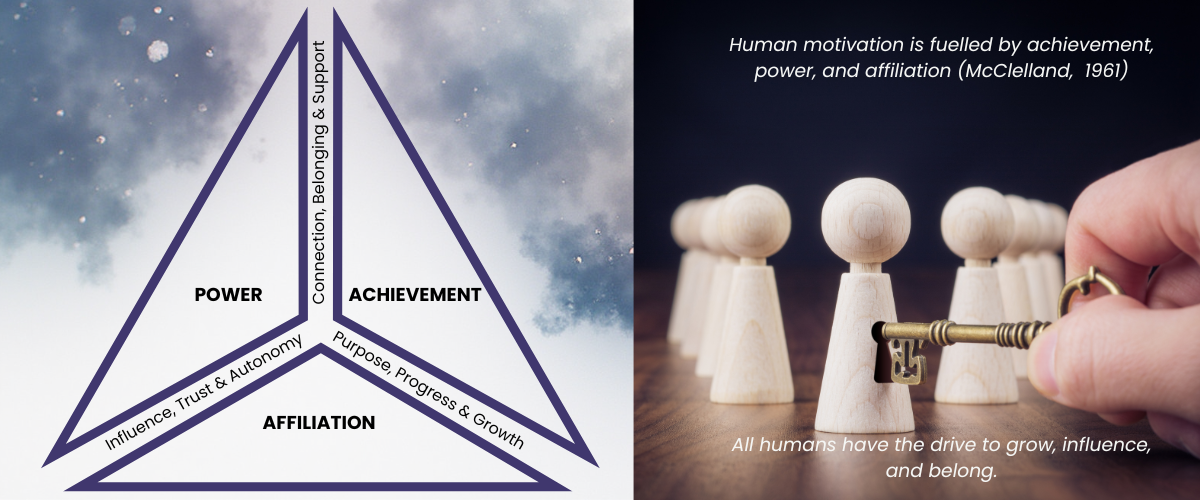
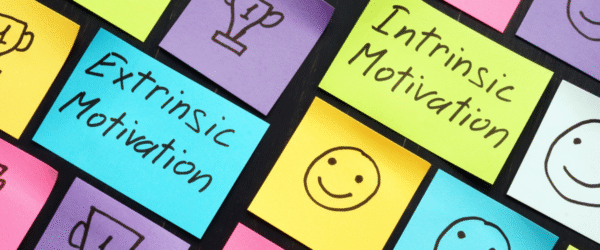
Maslow’s Hierarchy of Needs has gained popularity in recent years, and  Psychologist David McClelland’s model proposed that three core drivers shape human motivation at work, which is much more practical for many leaders to utilise in terms of delivering an impact on performance.


The first need is achievement, the second is power and the third is affiliation which are outlined below.


1️⃣ Achievement – the desire to excel, improve, and see results.


2️⃣ Power – the drive to influence, make an impact, and feel trusted.


3️⃣ Affiliation – the need for connection, belonging, and positive relationships.


Leaders can draw on these three drivers to energise their teams in meaningful ways, tapping into intrinsic human needs.


Remember some people are driven equally by all three, whereas others may have higher preferences for one or two of the different needs. Leaders can help utilise these three drivers, or needs by taking the following steps.


1️⃣ Reconnect People to Purpose (Achievement)

When people feel disconnected, money rarely fixes it. Meaning does. A small bonus may improve performance momentarily, if at all, but creating connection is what taps in to our innate needs for achievement. This is that warm feeling you get when you deliver something exceptional, or complete something which matters for someone.


Leaders need to remind teams why their work matters. Not just to the organisation, and the individuals, but to customers and communities.


Allowing these stakeholders to show how much they value what the employee is delivering for them is even more powerful. Allow employees to listen to, and hear, real stories of impact, not just performance metrics.


People with high achievement motivation as a driver thrive when they see tangible progress and purpose in their work.


2️⃣ Create Psychological Safety (Affiliation)

All humans need to feel like they belong. Employees with strong affiliation needs will be driven by being connected, being part of a group and having strong relationships with other employees.


Those with lower affiliation preferences, which never means no affiliation preferences, may be less focused on connections.


However, as we have seen with DEI initiatives – everyone needs to feel included and that they belong.


A team where people don’t feel they belong often masks fear or frustration. Employees are disengaged. And to overcome this leaders need to create safe spaces for honest conversations.


Asking supportive questions such as “What is currently hindering you, or getting in the way of you, doing your best work?”, or “What would make the biggest positive difference to how you feel at work today?” can both help identify what is needed.


And then leaders must act. When people feel listened to and included, their need for affiliation is met, but they also need help resolving challenges and to see improvements which restores trust and belonging.


3️⃣ Give Autonomy and Responsibility (Power)

Leaders who can’t let go will undermine their teams and take away any power. This can be difficult as some individuals have a higher need, or driver, for power. If these people become the leaders it is vital to manage this driving need, especially when others in the team may also have this as a preferred need.


Micromanagement kills motivation faster than any pay freeze or lack of bonus.


People need to feel trusted and know what they can control. Giving people more control over how they deliver outcomes is the first step.


Empower people to make decisions and lead projects. This satisfies the need for power. The ability to see how they have the power to decide their own destiny.


Leaders need to set employees up for success. Power is a need, but it is not about dominance or control. This needs is a positive kind that comes from influence and ownership as if this turns negative then the other needs, achievement and affiliation quickly suffer and everyone needs all three to some degree to feel motivated.


4️⃣ Recognise, Often and Authentically (Affiliation + Achievement)

People like to feel noticed. Many leaders we have worked with fail to recognise the hard work of their teams.


Changing goal posts, or moving what is required when someone has already invested time. effort and resources quickly creates frustration and often leads to people stepping back and becoming disengaged.


It is important to remember that recognition doesn’t have to be financial. But it does need to mean something.


Say “thank you” publicly can be extremely motivativational for some, and cringeworthy for others. Celebrating milestones not completions (as progress is vital) and little and often has a much bigger impact on performance.


Acknowledge both outcomes and effort. When recognition connects to team values and shared purpose, it fuels both achievement and affiliation needs.


Individuals have other drivers, e.g. to be affiliated with their family so recognition which supports the whole of their life can be a double driver so think creatively.


5️⃣ Develop Without a Budget (Achievement)

Growth opportunities don’t always mean expensive courses. Especially in todays world where growth, development and learning from others is about time more than financial investments.


Leaders can offer the following:


  • Offer stretch assignments or cross-team projects aligned to what the individuals are interested in
  • Promote peer mentoring or job shadowing, bringing people in on opportunities
  • “Lunch and Learn” sessions led by team members can be invaluable to both the deliverer and the attendees


Those with a higher need for achievement will thrive when challenged and supported to grow, and everyone needs this to some extent.


Monotony or complacency occurs when people are not developed and stretched in their roles.


A Culture of Motivation

People become disengaged when they feel kept in the dark. Whereas camaraderie fuels team dynamics and builds individual and group resilience.


Leaders need to encourage connection beyond the task list. This is how cultures of motivation are truly created. So that when times get tough, people come together, not apart.


Many companies promote volunteering, use this as time to spend together as a team. Shared coffees or “win of the week” check-ins help people feel part of something bigger than themselves.


Importantly, don’t just focus on the positives. Humans like to be part of the solutions. This brings all three needs and drivers together. Share openly current challenges and progress, ask for help and support in ensuring your organisation is a good employer.


Leadership presence, shown by listening, being empathetic and demonstrating fairness, signals integrity and builds the kind of trust-based power that motivates others to follow. Which becomes a self-sustaining culture of motivation.

Motivation is psychological, emotional, and moral. It is not just financial.


When you can’t offer more money, offer more meaning, autonomy, and belonging.


When you can’t expand budgets, expand trust.


And when you can’t promise change overnight, promise fairness and transparency and deliver what you say you will.


Progress is crucial. That’s what fuels motivation.


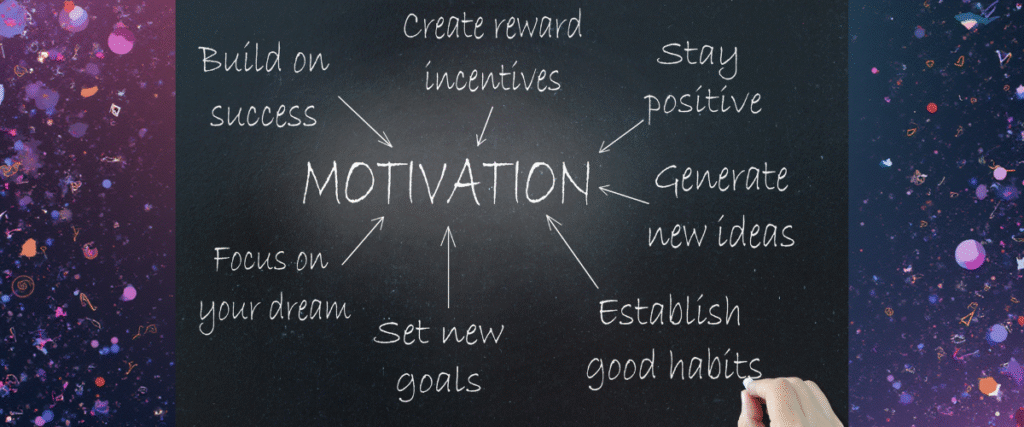
Motivation is about generating new ideas, establishing good habits and understanding the needs of others and ourselves such as affiliation. achievement and power.


More about Motivation

There’s more about Motivation in this Think Organisation Post: Top Trends in Work Motivation

Alternatively, copy and paste this link into your browser: https://cortex.clyq.co.uk/staying-ahead-of-the-game-top-trends-in-work-motivation/

Toxic Culture : Behaviour Is At The Heart of Scandal & Failure

The news is full of stories about toxic culture. Toxic cultures have contributed to financial collapses, personal scandals and reputational downfalls. From politics to business to public institutions, the number of examples seems to be growing exponentially.


Whether it is politicians abusing power, corporate leaders chasing profit at all costs or charities losing the trust of the very communities they serve, culture is the term many would use to describe the cause of the crisis. But does this description add value?


Does Culture Eat Strategy for Breakfast?

It’s often said that “culture eats strategy for breakfast” but is this really true? Despite the endless discussions of whether Peter Drucker actually said this, or if he did has it been interpreted how he intended? It is a prime example of the impact culture can have on how information is interpreted.


A bold plan, a strong financial model, or even the most talented leadership team cannot survive long in the shadow of a toxic workplace culture. If behaviours are unchecked, if voices are silenced, and if the pursuit of short-term gains overrides long-term purpose, failure is only a matter of time. How visible this is internally versus externally is also on the clock in terms of exposure, that and the investment in a good marketing team.


So What Are The Warning Signs of a Toxic Culture?

Toxicity rarely happens overnight. And we have yet to meet a leader who deliberately designed a toxic culture.


It creeps in slowly, often disguised as “high performance” or “efficiency” and is often an indirect result of misaligned goals, metrics or increasing pressure being place on people.


Warning signs can include:


    • Fear & Silence – where employees stop raising concerns or ideas, and conversations become hidden or none existent.

    • A Hero Culture – where success become tied to specific individuals, as opposed to teams

    • Blame Becomes A Game – mistakes become hidden, or deflected, and people are worried about what others think

    • Misaligned Values – values may not exist or be stated, or if they are then which is said publicly doesn’t match daily behaviours

    • Wellbeing Washing – pressure, burnout and high staff churn could be seen as ‘normal’ and wellbeing isn’t a priority


This list is not exhaustive, and often toxic cultures can look positive on the outside, but not truly live and breath these behaviours in reality. When these behaviours become embedded, accountability disappears and poor decisions are rationalised, hidden or just become part of the expectations.


The cost of a toxic culture can be huge, both in terms of negative PR and brand image, and the lost employee productivity. Because a toxic culture doesn’t just damage staff morale, it destroys value.


A toxic culture leads to higher turnover, spiralling sickness costs, disengagement, customer mistrust, regulatory fines, and, ultimately, reputational collapse.


For leaders, ignoring cultural red flags is no longer an option. Regulators, investors, and the public are scrutinising culture like never before and the pressure is mounting.


So How Do We Build Healthy & Resilient Cultures?

The good news is that cultures can always be shifted. Sometimes quickly, other times more slowly. This can be done by leaders who take tangible steps to rebuild trust and create healthy workplaces where people – and businesses – thrive.


Key actions often include:


1. Starting with a purpose – because it is vital to reconnect everyone to the “why” behind the organisation

2. Modelling the behaviour you expect – people follow people, and this is where leadership authenticity sets the tone

3. Create psychological safety – encourage employees to speak up, be open to feedback and understanding reality

4. Listen and act on feedback – show that raising concerns leads to change, don’t penalise people for being honest

5. Measure what matters – track engagement, wellbeing, trust and psychological safety alongside financial metrics

6. Recognise and reward the right behaviours – culture is reinforced by what is celebrated and promoted


Whilst toxic cultures may dominate many headlines currently they don’t have to dominate workplaces.


Organisations that choose to prioritise culture alongside performance will not only avoid the scandals we see in the news, but they will also build stronger, more resilient businesses where people genuinely want to contribute and grow and bottom lines benefit.


If you would like to measure your culture please reach out.

More about Culture

   
There’s more about Culture in this Think Organisation Post: Conscious Competence

Alternatively, copy and paste this link into your browser: https://cortex.clyq.co.uk/how-to-use-the-four-stages-of-conscious-competence-to-improve-your-culture/

Forming, Storming, Norming & Performing

With countless books, articles, podcasts, and videos on “how to be a great leader,” it can be hard to know where to begin. How do leaders create high performing teams? Especially when the first real experience of leadership comes from bringing people together to perform as a team with little support or preparation.


Leadership is often described in terms of vision, strategy, and execution. But beneath these visible levers lies a quieter, equally powerful driver of success: team psychology.


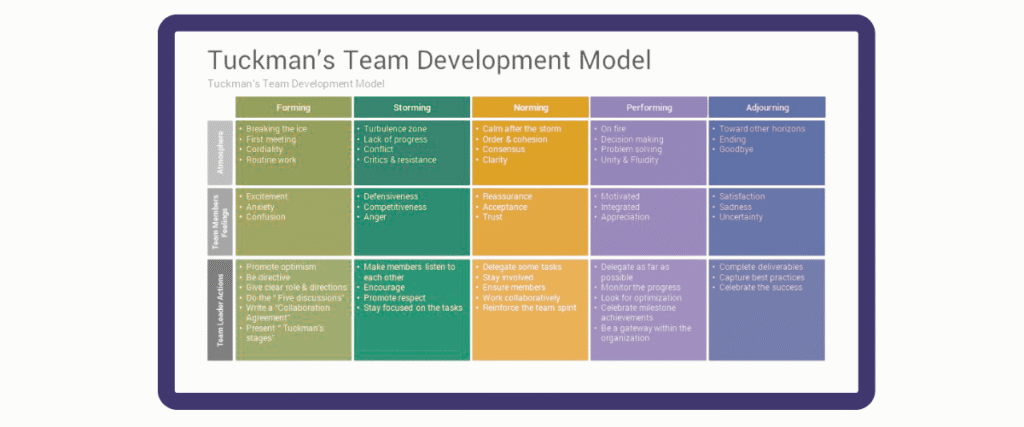
Which reminded us of one timeless framework which continues to resonate for its simplicity and relevance: Bruce Tuckman’s Model of Team Development.


First proposed in 1965, this Stages of Team Development model describes, how teams move through different stages as they evolve: forming, storming, norming, and performing.


Much of this stems from the human behaviours and how we as individuals behave in groups when we know, or don’t know, others.


Think about your own experience. Whether it’s pulling together a team to run a community event or leading a global organisation, the way people feel, think, and behave often follows the same patterns. From our work as culture consultants, we see that while leaders are energised by the forming stage and eager to reach performing, it is usually the middle stage – storming – that decides whether a team stalls or thrives. And yet this is often the stage that leaders try to rush through, or bypass altogether. Both of which can cause more long-term damage to performance and success.


What Are The Stages of Tuckman’s Model?

Forming

This is the starting point for any new team. People are typically polite, cautious, and focused on working out roles, purpose, and boundaries. Teams can slip back into this stage when new members join, or when a new leader takes charge, creating sub-groups of people who know each other better than others.


Just last week, we worked with a team who believed they were already high performing. In reality, they were back in the forming stage: although they all knew one another, they had been assembled as a brand-new project team to deliver a cross-functional strategic initiative. Taking the time to establish the foundations of a forming team was critical to setting them up for future success.


Storming

Teams often revisit this stage multiple times throughout their lifecycle. It’s when tensions rise and differences in styles, opinions, and expectations become more visible.


While it can feel uncomfortable, storming is a vital part of growth. A client we worked with last week was experiencing intense storming, largely because they had skipped over the forming stage.


Ground rules, roles, and ways of working hadn’t been properly established, so conflict was surfacing. Storming often escalates when the first tight deadlines loom or external pressures start to mount.


Norming

At this stage, the team begins to find its rhythm. Roles and responsibilities become clearer, ground rules are in place, and trust starts to grow.


People feel more comfortable sharing ideas and giving feedback, and collaboration improves as conflicts are worked through.


A client we supported recently reached norming after a difficult storming phase; once they agreed on how decisions would be made and clarified ownership of tasks, the atmosphere shifted noticeably. Energy that was previously tied up in tensions which with our support was released into problem-solving and progress.


Performing

This is the stage every team aspires to reach.


Trust is high, roles are clear, and collaboration flows with ease. The team is focused on delivering outcomes rather than managing tensions, and individuals feel confident taking initiative because they know they have each other’s support.


We recently worked with a leadership team who had reached performing: meetings were solution-focused, responsibilities were owned without reminders, and innovation was encouraged. The level of psychological safety was high because with strong foundations in place, everyone’s energy could be channelled into achieving results rather than navigating process or conflict.


At this stage the team operates at a high level of trust and autonomy, delivering results with energy and cohesion and overcoming challenges together.


Adjourning (Or Mourning)

Whilst not technically included in the original model this is a vital stage for many where any high-performing team needs to celebrate success.


This stage, describes when the team comes to the end of its journey and morphs into new teams or ceases to exist all together e.g. during a restructure or when a project has been delivered. With the project complete, objectives met, people begin to move on to new roles or responsibilities.


While there can be a sense of pride in what’s been achieved, there is often a feeling of loss too, especially when strong bonds have formed over the duration of the team.


We recently worked with a project team who, after successfully delivering a major transformation programme, felt a mix of celebration and sadness as they disbanded.


Recognising this emotional aspect is vital and important, yet it’s often overlooked by many leaders who move on to the next task or project. In our experience, leaders who take time to reflect on successes, celebrate contributions, and formally close the team, will create a positive ending that strengthens motivation for future work and success.


Tuckman’s model reminds us that high-performing teams don’t appear overnight – they are built through a process which is often messy and complicated.


Storming isn’t a setback; it is a sign that people care enough to challenge and engage and can be a critical stage of any successful teams development journey. Leaders who lean into this stage with openness, clarity, and empathy give their teams the best chance of reaching true performance.


Below are some insights to help leaders embrace and lead through each of the stages:


Forming: Build the Foundations

At this stage many leaders feel a mixture of excitement, optimism and a sprinkling of worry at the scale of the tasks ahead.


Setting the tone and leaning into these emotions and feeling can help build strong foundations as well as:


  • Setting a clear purpose, vision, and objectives from the start with the teams buy-in
  • Facilitating meaningful introductions that highlight each person’s strengths
  • Establishing mutually agreed ground rules and ways of working together
  • Leading from the front by encouraging questions, clarifying expectations and helping to embrace uncertainty
  • Creating early opportunities for quick wins to build confidence and make an impact


Storming: Support & Navigate Conflicts

At this stage many leaders feel extremely uncomfortable as it is human instinct to try to reduce or avoid conflict. However, knowing as a leader that guiding people through this stage will ensure everyone comes out stronger is crucial.


This can include:


  • Normalising conflict as part of growth and naming it when it appears
  • Stepping in early to mediate tensions, supporting individuals to voice concerns and reducing risks of escalation
  • Reframing disagreements around shared goals instead of personal differences is a crucial skill
  • Role modelling calm and respectful dialogue, and inviting multiple perspectives is invaluable so everyone is heard
  • At times clarifying or revisiting roles, responsibilities, and decision-making processes can help deliver improvements


Norming: Strengthen & Facilitate Collaboration

Many leaders feel relief as this stage is entered, and can at times step away too quickly leading to regression back into storming.


This stage is about encouraging the shoots of trust which may be building, supporting the team members to continue to collaborate whilst remaining true to the purpose of the team.


Actions leaders can take include:

  • Reinforce agreed norms and recognise behaviours that support them day to day
  • Encourage peer-to-peer feedback and shared accountability
  • Facilitate team-building activities to deepen trust and continue progress
  • Involve the team in problem-solving rather than providing all the answers
  • Celebrate progress and highlight examples of effective collaboration


Performing: Enable & Empower Autonomy

At this point it can feel like “my job as leader here is done”, but whilst there is an opportunity to step back this is not the time to step away completely as often curveballs mean the team need to know you are there as a leader.


The leaders role swaps top focus on removing obstacles for their team and steps which can help include:


  • Step back and allow the team to take ownership of delivery whilst being there is needed
  • Empower individuals to make decisions within their remit and support these decisions
  • Focus on removing obstacles and securing resources for the team
  • Encourage innovation and calculated risk-taking ensuring any mistakes are learnt from
  • Continuously link the team’s work to wider organisational goals and impact


Adjourning/Mourning: Lead & Close with Purpose

Often leaders get pulled into a new team and find this stage one of the easiest to overlook or avoid. However, any great leader will be reflective with the team and celebrate successes and review learnings for everyone going forward.


This can include:


  • Take time to reflect on and celebrate the team’s achievements including individuals
  • Publicly acknowledge individual and collective contributions – externally and internally
  • Capture lessons learned to carry forward into future teams
  • Provide space to discuss the emotional side of ending together and alone
  • Ensure members transition smoothly into new roles or projects with the full support of their old team members


Next Steps

As you can see, and will have experienced, every team will pass through these stages in their own way, sometimes moving forward quickly and other times circling back when new challenges or changes arise.


The role of a leader is not to rush the process, but to recognise where the team is and provide the right support at the right time.


By setting strong foundations in forming, leaning into conflict during storming, reinforcing collaboration in norming, empowering in performing, and closing well in adjourning, leaders can guide their teams through the full journey. Thus turning groups of individuals into cohesive, high-performing teams that deliver lasting impact across organisations.


Forming, Storming, Norming Model

More about Leadership

There’s more about Leadership in this Think Organisation Post: Importance of Job Design for Leaders

Alternatively, copy and paste this link into your browser: https://cortex.clyq.co.uk/the-importance-of-job-design-for-leaders-practical-tips-for-success

Can Understanding Social Identity Unlock Productivity In Your Team?

Leaders of teams cannot afford to overlook the science of human behaviour – which can provide evidence-based solutions to common people challenges – including identity.


Organisational success is not only driven by strategy and resources but also by the unseen impact of individual and group behaviour.


Group behaviours are the patterns of interaction, attitudes and actions that emerge when individuals come together as a team or unit within a workplace. They reflect the shared norms, roles, values and dynamics that shape how the group operates and performs.


These behaviours can be formal (aligned with organisational policies, goals, and processes) or informal (driven by unwritten rules, social bonds, or cultural influences).


Culture change is all about changing the ‘way we do things around here‘ is often unsuccessful, because leaders or change makers miss some fundamentals about human behaviour. Which is why we want to share an overview of Social Identity Theory and provide some powerful insights for leaders to harness the power of psychology to make a real difference.


In a theory originally developed by Henri Tajfel and John Turner, this theory, their research highlights some key messages:


Why People Think of ‘Us’ Versus ‘Them’

Because Social Identity Theory explains how people define themselves by the groups they belong to. These groups could be a department, profession or organisation as a whole.


These groups could also be anything from the eight protected characteristics to a football team which people choose to support because:


1. Identity is through Membership

This means you are part of a group, which may be by choice or by circumstance, and employees derive pride, motivation and meaning from their in-groups.


It means that people, either visibly or invisibly, belong to a group which can be identified as different to others e.g. we are in finance, or we work at X company. This leads to different dynamics between people, depending on whether you are in a group or out of a group.


2. In-group & Out-group Dynamics

Loyalty to one group, can intentionally or unintentionally, fuel competition or division. Think of football team supporters.Wearing shirts, waving scarves or flags. This is all intentional behaviour to identify with a certain group. Competition is fuelled through performance, and identity stretches ‘off’ the pitch.


With people in work (e.g. in Manchester where Think HQ is based where a question of are you red or blue is often second only to “how are you?” when people meet) becoming linked through which team they support.


3. Emotional Connections

Being in a group, or out of a group, can provide strong emotional connections and explain people’s identities.


With a recent client there was a clear disconnect between regional offices versus the head office. This led to polarised opinions and divisions when one group (the regions) felt unfairly treated compared to the other (head office).


Despite many people experiencing fair treatment, the perceptions soon grew based on the stories being circulated, which led to a growing “them versus us” group mentality which quickly became divisive when resources became scarce.


How Does Our Board Balance The Power Of Team Identity With The Need For A Cohesive Culture?

Organisational cultures often hinge on in versus out groups. They deliberately promote the group of one organisation over another, enticing employees to join their business over others because ‘their culture is better’.


In fact,  organisational culture and engagement hinge on fostering a strong, inclusive “one company” identity.


But what is the risk to this?


And how do leaders utilise the psychological theories which underpin human behaviour?


Social Identity During Mergers & Acquisitions

Restructures, mergers and acquisitions often fail to realise the predicted benefits due to identity clashes, not just strategy missteps. This is because people don’t just work for organisations, they identify with them.


Employees derive part of their concept of self from their organisations brand, history, values and culture. Then when two companies, or teams, come together they can feel that their identity is being challenged, lost or replaced.


This can lead to disengagement, and negative behaviours, as when people don’t recognise themselves in this new organisation they no longer feel like ‘themselves’.


Resistance and then attrition can follow, which leads to further division, as groups often blame each other for negative events which happen.


This categorisation of ‘us’ versus ‘them’, shows up during M&A through the acquirer versus the acquired, or the new company versus the old.


Behaviours and expectations are often different and without an aligned culture plan to create a new cohesive vision built up from the best elements of both groups, employees begin to vie for their ‘way of working’ to win.


This dynamic fuels siloed behaviours and internal competition then undermines integration efforts.


Culture Clashes Are Identity Clashes

Research, history and the teams experiences of M&As show failures are rarely about the financials or strategy.


They usually stem from cultural misalignment. Symbols, rituals, language and even leadership styles all represent identity markers of different groups. When these conflict, employees resist adopting the new way because it threatens their sense of belonging.


And all humans need to feel like they belong, that is how we have survived.


Leadership behaviours often signal whose identity ‘wins’, which causes greater unrest. Especially if leaders only promote or highlight one ‘sides’ history, practices and talent.


Employees from the other side may feel erased, or under-valued, which causes further ‘in’ group and ‘out’ group conflict.


However, when leaders consciously blend identities, honouring the best of both and co-creating a shared ‘new we’ then integration succeeds, and the two groups become a new improved group with a new identity.


The Cost of Culture

Losing our sense of identity leads to higher employee turnover, especially with top talent, however there are many other costs of culture clashes.


Employees who are disengaged contribute less in terms of discretionary effort, as well as lower productivity and outputs. Customers can also pick up on internal pressures, fractures between teams or organisations creating a weakening of brand trust. Especially when customers may be feeling a similar loss of identity – like when Somerfield and the Co-op merged. Many customers had chosen to shop at Somerfield stores over Co-ops, but then they became one. Taking choice away for many customers.


Steps Leaders Can Take

Whether change is needed, teams are merging or there are large-scale acquisitions, all leaders can take the following steps to harness the psychology behind humans needing to be in groups, and our social identities.


1. Acknowledge Identity & Identities

Culture is not a soft issue, or something which is ‘fluffy’. It is measurable and strategic and belonging is a fundamental need of all humans.


Taking steps to acknowledge identities, support people to be unique, whilst embracing what makes us similar is crucial. Many DEI strategies are all about bringing people together, but some have actually increased divisions and failed to deliver improvements.


Whatever, your thoughts or experiences it is vital to engage with all employees. Ensuring employees are diverse, representative of our global society and ensure that they’re involved in creating shared values and stories.


Learning, listening and being curious is the first step in this journey.


2. Embed & Signal Inclusivity In The EveryDay

Many people acknowledge, or join, groups which speak to their own identity. LGBTQ+ is an example of this.


It is vital that everyone feels included, whether it is a protected characteristic or just for being awesomely unique.


Two organisations joining together need to celebrate the legacies of both organisations, while building a new vision for the new one.


Progress needs to be measured, but this is about day-to-day interactions, not a set of boxes to tick.


In some organisations, even over a decade later, the legacies of individuals being from one or another organisation can often still exist.


The culture gaps need to be measured, social identities measured and then a strategy put in place to deliver the alignment over 12-18 months.


3. Monitor Integration Health

Being internal and part of the transition can be difficult, especially as it’s difficult to see the bigger picture when looking out from the inside.


Financial KPIs are always measured and tracked at a board level, yet often integration indicators are overlooked.


Understanding and having visibility of predictive indicators is critical, after all if you don’t measure it, it can often result in it not mattering.


Tracking employee perceptions, behaviours and expectations are critical alongside other cultural alignment KPIs.


Social Identity

At the heart of whether people belong is social identity. Ignore it, and you risk culture wars, disengagement and talent fights and flight.


Understanding, embracing and harnessing social identity can allow leaders, and employees, to create truly integrated cultures.


If you build a stronger, unified identity then integration can be accelerated and ROI can be delivered.

More about Culture

There’s more about Culture in this Think Organisation Post: Football as a Metaphor for Organisational Culture

Alternatively, copy and paste this link into your browser: https://cortex.clyq.co.uk/why-football-is-a-great-metaphor-of-organisational-culture/

How To Ensure The Right Work Is Done To An Exceptional Standard

How do we ensure the right work is being done? Or are our teams busy without achieving the purpose required?


Teams are regrouping after the summer period, with some colleagues returning from holidays, others yet to escape and those who have worked throughout.


Many boards are now reconvening to review progress, refine strategy and address current challenges facing their organisations.


Data shows productivity dips significantly during summer months, with 45% of employees reporting being distracted (Personnel Today, 2025).


But as a leader asked in a recent board meeting we attended – “how do we ensure the right work is being done?”


This is one of the advantages to the summer slump, if you review what was critical and what could be improved, it is a perfect opportunity to ensure clarity of purpose, alignment and accountability. Think Organisation has already delivered its popular 4-hour strategic review which provides independent insight to help leaders ensure the right work is being done to an exceptional standard.


Below is a summary of some practical steps you can take at your next board or leadership team meeting:


1. Define “The Right Work”

Link to strategy: Make sure every piece of work ties back to the organisation’s purpose, strategy or agreed priorities. The summer is the perfect time to review how this happens, or didn’t happen, and work with team members to ensure alignment. Which also means it is vital that leaders and organisations set outcomes as opposed to outputs.


Set outcomes, not tasks: This is ensuring focus on what success looks like rather than micromanaging how it gets done. There are many ways different tasks can be achieved, and whilst operational elements can be crucial, this is about allowing employees the autonomy to make their own decisions and deliver high quality outcomes.


Prioritise: With over 30 years experience using different frameworks, for example the Eisenhower Matrix or Objectives & Key Results (OKRs), our team understand how it is vital that you use a method which aligns to your business needs. It’s also good practice to empower employees to distinguish between urgent vs. important and strategic vs. operational work.


Asking the following in a leadership meeting can provide exceptional insight ‘Where might we be over-investing in activity that looks important but delivers little impact?‘ or ‘Are we spending too much time and effort on work that feels important but doesn’t actually make a real difference?’.


2. Set Clear Standards of Excellence

Define exceptional: Make “exceptional” tangible to people across teams and levels. What does exceptional look like? What does quality mean in your context (e.g. is it accuracy, or creativity, or speed, or compliance, or innovation, or impact?) Often it is a collection of these elements, but where does this exception standard give your business its unique selling proposition? What if you could rank the elements of exceptional? It is vital everyone understands what exceptional looks like as a whole, as well as by teams of people. To do this, especially for complex products or services setting benchmarks or gates of excellence can be critical.


Create benchmarks: This is about ensuring everyone uses internal best practices, external industry standards or customer expectations as the reference point for what is exceptional. Helping individuals understand the value they add, and how this impacts others, is crucial to ensure that services are delivered to the exceptional standards required but remember you can’t have every benchmark at 100%, that is not possible so work out what truly matters to your business. Reviewing time, cost and quality is always a good starting point for benchmarking.


Agree measures: So often we see leaders spend hours discussing what exceptional or good looks like but then struggle to agree a way forward. It is vital to define KPIs or success metrics that capture both outcomes and behaviours. Everything needs to be sustainable, and behaviours are critical to this. Measures of success need to be clear, plausible and support the delivery of the outcome. This is why OKRs can be helpful for some companies, as they provide more proactive steps or actions and be more leading indicators.


3. Lead by Example

This element is critical. Often leaders focus on elements which they can’t control and the one thing any leader can control and influence from the moment they return to the business is how they behave and lead by example. With timeout to reflect, for those lucky enough to have a summer holiday, now is the time to set your own commitments going forward. Over time these form habits. which are crucial as people will rise, or fall to the level their leaders are willing to tolerate.


Model high standards: People learn from people and role-modelled behaviours from other people. Often saying or telling can be much less effective than ‘going there first‘. If you are open to feedback, reviewing current standards or delivery or learning how to improve, then this will empower others to follow your lead. Which leads onto the next element – ensure visibility.


Be visible in priorities: Your attention signals what truly matters. So often there are mixed messages sent from leaders either not aligned, or with fluctuating priorities. One of the hardest things for a leader can be agreeing what not to do with the team which is where having visible priorities is crucial. Team members then know what needs to be a focus, without always having to ‘check in’ with the leader and decisions can be made fluidly.


Show care and discipline: Ensuring there is a balance between support and direction with clear high expectations is critical. Leaders who care about the whole person, and demonstrate this to employees ensure higher levels of engagement and commitment (Forbes, 2023).


For more help and support, including an independent work review session please reach out to us.


Book time with Sarah Clarke: 30-Minute Free Consultation


Discover the Secrets of Business Psychology Models

A business can tap into a vast array of models depending on whether its focus is strategy, operations, people, innovation, change or culture. Some of these were highlighted in last week’s insights.


Yet, many management and board consultants have limited, or even no, awareness of the hundreds of models grounded in psychological theories, research and most importantly proven scientific methods.


Psychology is vital for businesses because it helps you understand how people think, feel and behave. It is a science which can help you make better decisions, build stronger teams and create workplaces where everyone can do their best work.


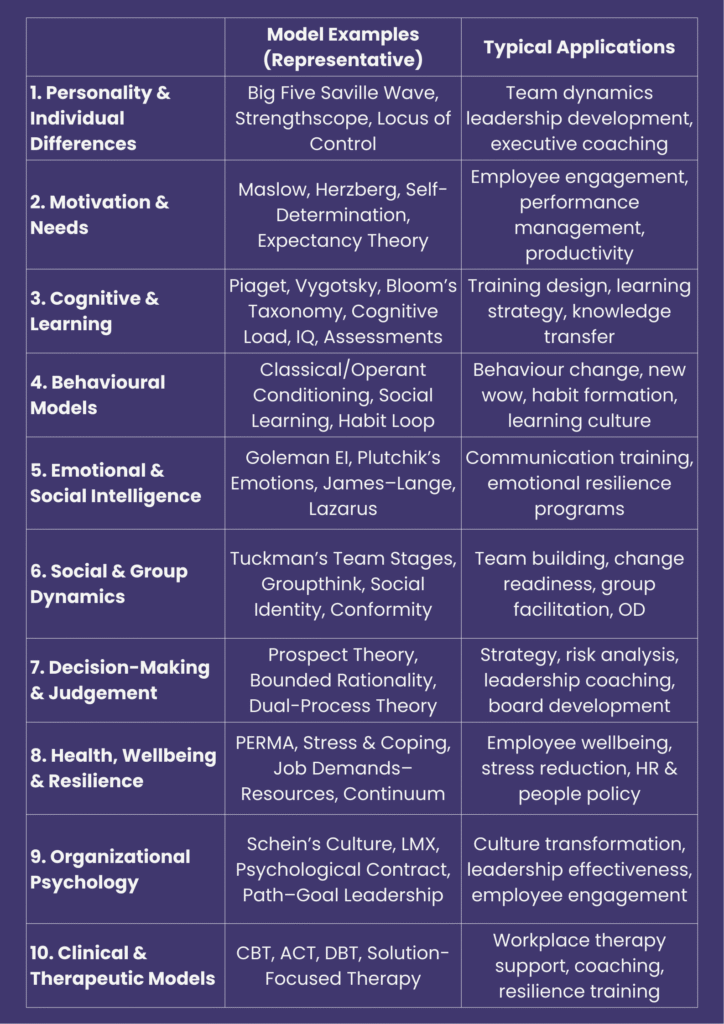
The table below provides a high level overview of some of the models that have been developed:


Psychology in Business


Forward thinking businesses can tap into over a century of psychological research to improve leadership, teamwork and performance.


Personality Models

One of the main areas which businesses focus on, often to the detriment of other areas, is personality & individual differences.


Personality is the unique combination of traits, behaviours and patterns of thinking and feeling that consistently shape how a person interacts with the world.


Various models, like the Big Five (OCEAN), Cattell’s 16 factors, Saville Wave or Strengthscope can help leaders and organisations, understand more about their employees.


Personality is one element of what makes us human, and every individual is unique so understanding traits can help enhance performance. Utilising models such as Locus of Control can help coach people, and teams, in how to respond effectively to challenges.


Models of Motivation & Needs

Motivation is the internal drive or external influence that initiates, guides and sustains goal-directed behaviour, or indeed any behaviour. This can be conscious or unconscious. The basics of Maslow’s Hierarchy or Herzberg’s Two-Factor Theory, to Self-Determination Theory can help leaders understand what drive people to perform at their best.


Other factors may influence this performance, such as culture, situation, time or wellbeing but understanding human needs is key to ensuring effort is spent in areas which deliver results. There is no point in spending money on development, when organisations aren’t meeting basic needs – such as paying a fair wage so people can live.


Cognitive & Learning

Cognitive relates to the mental processes involved in acquiring knowledge and understanding, such as thinking, learning, memory and problem-solving.


Theories, such as Kolb’s Learning Cycle or Bloom’s Taxonomy, reveal how we process and apply knowledge which is crucial when understanding how to train and develop employees, or leaders for today and tomorrow. The effectiveness of training courses, online or face to face, and induction programmes is often overestimated and can cause various challenges in organisations when leaders report ‘no change in behaviour’ as a result of training and development.


Learning is the process of acquiring, modifying or reinforcing knowledge, skills, behaviours or attitudes through experience, study or instruction.


Ironically, instruction is one of the least effective methods for helping change behaviours, despite it being the preferred option for many trainers. In fact, behavioural models can provide much more insight into how to embrace new ways of working (wow).


Behavioural Models

How we think, feel, respond physically and then behave, is all inter-linked and cross-linked. Behavioural models like Operant Conditioning or Social Learning Theory explain how habits and workplace behaviours form.


Using these behaviour models, which can be frameworks or theories to explain, predict and guide how individuals or groups act in specific situations can help leaders by identifying factors that influence those actions.


The social impact of culture on behaviour in business is the way shared values, norms and beliefs shape employees’ actions, decisions and interactions, ultimately influencing organisational performance and reputation as a whole.


Humans learn from watching other humans, not just doing what they say.


Modelling Emotions

Emotional intelligence is the ability to recognise, understand and manage your own emotions and those of others to guide thinking, behaviour and relationships effectively.


Social intelligence is the ability to understand and navigate social situations effectively by perceiving, interpreting and responding appropriately to the behaviours, emotions and dynamics of others.


Frameworks such as Goleman’s EI or Plutchik’s Wheel of Emotions can help explain away some of the complexity which equips leaders to manage emotions and relationships effectively.


Group Dynamics

Group dynamics is the study of how people interact, influence and behave within a group. This includes the patterns, roles, and relationships that shape how groups function. These include things such as Tuckman’s Stages and Social Identity Theory.


These theories explain how individuals form, maintain and function within groups based on shared goals, identities, and social structures that exist. Closely connected are group dynamics which examine the patterns of interaction, influence, and relationships within those groups.


Together, both are vital to organisational success because they affect collaboration, communication, decision-making and overall team effectiveness. This impacts performance, innovation and workplace culture and whilst complex, it measurable, and can help leaders ensure teams form, cooperate and succeed. They can also explain why groups sometime fail.


Decision-Making & Judgement Models

Decision-making models are structured frameworks that guide individuals or organisations through a systematic process to evaluate options and choose the most effective course(s) of action.


Often human thinking can create biases, assumptions and lead to ineffective decision making so models like Prospect Theory or Dual-Process Theory can help explain why people make the choices they do under uncertainty.


Tools such as RACI or RAPID, many of which are trade-marked, can help empower effective decision making by helping take out some of the emotion and provide more objective clarity.


However, effective team performance is often an outcome of using a suite of theories and psychological models, unique to the who, what, when, where, when and how success will look.


Health & Well-being

In many ways, the health continuum is the main model for this category but in reality individuals are predisposed to health, or poor health, based on physical, genetic and psychological factors.


Frameworks such as PERMA, Job demands-resources and burnout models can help provide insights but often it is multifaceted what causes stress and unsustainable performance in organisations.


Organisational leaders who promote health and wellbeing at work, need to strive for a holistic state in which employees are physically, mentally and socially supported to thrive, perform effectively and sustain long-term productivity.


Often surface level efforts can have detrimental effects, or mask deeper challenges which is where organisational psychology becomes paramount.


Organisational & Work Behaviour

An organisation is an entity formed by people working together in a structured way to achieve shared goals or purposes through coordinated activities and resources.


In many ways, organisations are a living breathing entity.


In terms of the thoughts, feelings and emotions, people can connect with organisations or brands. Organisations are more than just a physical object, in that they exist because people agree on the structure, purpose and rules which make that organisation.


There may be tangible elements, like buildings or equipment, products or services, but organisations are all unique and successful organisations harness this for commercial gain.


Schien’s culture model, or leader-member exchange theories, help explain how it feels to be part of an organisational entity. There is no right or wrong as such, but alignment, consistency and direction anchored to a purpose is fundamental.


Unlike therapeutic psychologists, organisational psychologists are not registered medical practitioners with the HCPC. However, it is important that they hold an MSc in Occupational Psychology or a Psychology degree, along with accreditation from the British Psychological Society and ideally the Association of Business Psychology.


Clinical & Therapeutic Interventions

Whilst many workplaces offer counselling via employee assistance programmes (EAPs), therapeutic approaches are generally reserved for outside workplaces.


Yet, increasingly, managers are being called upon to help deal with mental health challenges, or other more serious blockers to performance.


Often therapeutic interventions come when employees are experiencing mental health challenges, such as stress, anxiety, depression, trauma or burnout, which have become serious, and visible, affecting their wellbeing, performance, or workplace relationships.


Often early intervention, confidential support or structured treatment can help them recover and function effectively, and a proactive approach delivers significant benefits and ROI.


Cognitive behavioural therapy (CBT) is a common intervention which if understood and utilised when people are well can be much more beneficial as a preventative tool. CBT coaching can also help individuals overcome blocks and thrive.


Psychology offers businesses a vast, evidence-based toolkit to understand and influence how people think, feel and behave.


By tapping into proven models, from personality and motivation to decision-making, group dynamics and wellbeing, leaders can make better decisions, build stronger teams and create workplaces where employees thrive.


Forward-thinking organisations that integrate these insights don’t just improve performance, they foster a culture where people can do their best work, every day – sustainably.


Contact sam@cortex.clyq.co.uk to get our Top 100 Models or book a free 30-minutes insights session with us.

Is There One SUPER Leadership Model?

Is there a leadership model to help leaders and businesses ensure employees enjoy their jobs? As consultants specialising in culture, change and creating a better world for everyone, we often ask:


“What if we all truly enjoyed our jobs?”


The cost of work-related stress and burnout to the UK economy is staggering – £28 billion every year (Axa, 2023).


Just imagine the positive impact, not only on individual happiness, but also on the NHS and global productivity, if we won the never-ending battle leaders face. The other week someone ask us, as they do frequently:


“Is there one go-to leadership or culture model you’d recommend? Or a single book that holds the answer to how we improve things?”


No. The answer is most definitely no.


No. No. No. No. No.


And yet asking the question in itself gives us huge helpful insight into the mind of the client, or any amazing leader asking such a question.


Because many aspiring leaders have read hundreds of books, watched countless videos and are still looking for the ‘magic pill’ or the ‘needle in the haystack’. But this is where we help, by giving you the expertise you need, at the time you need it most.


Whilst there is no ‘one’ super model the first thing we always start with is:


“What problem are we trying to solve?”


Baked into this question, is also the question of what perspective do I want to look at this from? What will success look like?


Success could look differently from different perspectives. Is it from the employee, the organisation, you the leader, the team or even an outsider investor or competitor perspective?


Different models help you understand different perspectives and every perspective is vital and provides more information. That said, information needs to leads to a decision, confirmation, continuation or a change in strategy to add any real value.


Be wary of information paralysis which impacts many senior leadership teams leading organisations in a quandary about what next.


When we brainstormed, and went through our suite of models we’ve used during 30+ years of experience, we found a huge swathe of both practical and academic theories, research and models we can draw from.


Strategy Models

Strategy models such as SWOT Analysis, PESTLE Analysis, Porter’s Five Forces, the BCG Growth-Share Matrix, Blue Ocean Strategy, the Ansoff Matrix and the Balanced Scorecard. These all help organisations set direction, make competitive choices, and allocate resources effectively.


Leadership and Management Models

Leadership and management models including Transformational Leadership, Servant Leadership, Situational Leadership, Leader-Member Exchange (LMX), Goleman’s Emotional Intelligence Framework and Kotter’s 8-Step Change Model. These all provide frameworks for influencing people and guiding organisational direction.


Change Management Models

The book ‘My Iceberg Is Melting’ is one which really stands out in its ability to explain successful change (Kotter, 2006). But we also like change management models like ADKAR, Lewin’s Change Management Model, the McKinsey 7-S Framework, Bridges’ Transition Model and the Prosci Change Triangle (PCT). All designed to help support smooth transitions during times of change.


The challenge with any model is using it to enhance decision making, diverse thinking and ensure you have considered every aspect.


Organisational Culture Models

Of course, organisational culture models such as Schein’s Three Levels of Culture, Hofstede’s Cultural Dimensions, the Denison Organisational Culture Model, the Competing Values Framework and Trompenaars’ Seven Dimensions of Culture. Whilst these all help to shape values, norms, and behaviours across the workplace, all of these tend to be very basic so we have designed our own multi-faceted model for culture as it depends on the maturity of the organisation as well.


Employee Engagement and Motivation Models

Employee engagement and motivation models including the Gallup Q12 Engagement Model, the Job Characteristics Model, Maslow’s Hierarchy of Needs, Herzberg’s Two-Factor Theory and Self-Determination Theory. These all help leaders focus on boosting satisfaction, productivity and employee retention. But for all of them you need the basics right and there is no point rushing in with a job characteristics model when you haven’t met the basis levels of human needs.


Innovation & Growth Models

Another suite of models which have grown in popularity, initially in the tech sector, are innovation and growth models such as Design Thinking, Lean Startup, the Stage-Gate Innovation Model and Rogers’ Diffusion of Innovations. These all can be used to encourage adaptability, creativity and scalable success. However, many of these models have been used detrimentally in some industries so there are always risks associated with using models and these should be understood.


5 Why’s Model

Interestingly, one model which we didn’t even used to know was a model, but something we use frequently with our clients is the Five Whys.


One example of this was when leaders were frustrated with a company consistently missing deadlines to launch new product campaigns. A summary is below of how the root cause was identified, which is another name for this model.


  1. Why are product deadlines being missed?
    → Because product assets are not ready on time.
  2. Why are product assets not ready on time?
    → Because the design team receives briefs later than planned.
  3. Why does the design team receive briefs late?
    → Because the campaign plans are often finalised at the last minute.
  4. Why are campaign plans finalised at the last minute?
    → Because the approval process from senior management takes too long.
  5. Why does the approval process take too long?
    → Because there is no clear deadline for management feedback, and approvals often get delayed when executives are travelling or busy with other priorities.


This one is a brilliant example, as it was the leaders themselves causing the delays but this was resolved everyone spend much less time chasing and had more time to deliver.


This is a great tool to help diagnose what is the actual problem which needs to be solved? Are we looking at the symptoms? Or are we looking at the cause? Who has the power or control to provide the solution, or influence the solutions? It certainly wasn’t down to the Product Assistant who spent the majority of their job chasing managers for approval to be able to establish firm deadlines but once the issue was uncovered it was quickly resolved – improving work for everyone.


Next Steps

Join us for our next insight, where we explore a suite of 100 powerful models—many of which management or leadership consultants have never encountered, and that few (unless they’re psychologists or trained executive coaches) know how to apply effectively.


Post it notes lined up saying what is your why on a black and purple background.


Evaluating Emotional Intelligence In Your Boardroom

Does your board practice emotional intelligence in meetings?


Boardroom evaluations are a vital part of good governance and are a legal requirement for many organisations (e.g. UK listed businesses). Yet how many evaluations measure emotional intelligence around the boardtable?


A boardroom evaluation helps identify whether a board is performing effectively, making sound decisions and fulfilling the boards strategic, financial and legal responsibilities. But the effectiveness of board evaluations has often been questioned, particularly in recent years following a number of high profile scandals (e.g. Carillion, Post Office) where one of the ‘big 4’ had given both these organisations a clean bill of health following their board evaluations (IOD, 2024).


In our opinion, and based on our team’s extensive exposure to a diverse range of boards across 30+ industries there is one crucial factor that many board evaluations overlook: emotional intelligence, measured by their emotional quotient (EQ).


You can have a boardroom full of brilliant minds, but if emotional intelligence is lacking, performance, relationships, and ultimately, organisational outcomes can suffer. One of the most critical elements of emotional intelligence is self-awareness and its absence often shows up in subtle but extremely dangerous and powerful ways in the boardroom. How self-aware are your board?


Our latest insights explore the role of emotional intelligence in board effectiveness, with a particular focus on self-awareness and why it should be a central item in your next boardroom evaluation. No matter what size your business, having a boardroom evaluation can be critical in protecting your organisation and your board.


Why Boardroom Evaluations Are Imperative

Boardroom (or board effectiveness) evaluations are structured reviews of how well a board functions. Whilst some organisations (e.g. listed PLCs) are legally required to conduct independent evaluations we recommend every board has an independent review to help protect organisations and society as a whole.


How else do you know how your directors are performing?


Evaluations assess governance, decision-making, skills, relationships, all critical elements linked to the board’s effectiveness and impact on organisational culture.


Evaluations can be conducted internally (by the Chair or Company Secretary), or externally (by an independent governance expert), or by an independent third party such as a non-executive director.


The challenge with the Chair, or even Company Secretary conducting the reviews it is is a bit like marking your own homework – it is difficult to see things when you are part of them. Because perceptions, power dynamics and expertise are critical when deciding on how, who, when, why, where and what feeds into a board evaluation. Typically evaluations explore:

    • Board composition, diversity, and skills

    • Clarity of roles and responsibilities

    • Meeting dynamics and decision-making processes

    • Oversight of risk, compliance, and strategy

    • Relationships between board members and executives

    • The culture and tone set by the board, and chair


Which, in reality, many boards would struggle to do without external expertise and an independent eye.


One of the most critical elements of any evaluation is often missing. Because Psychologists are often not part of the assessment. Psychologists are experts in human emotions, motivations and behaviours, so the value they can add is phenomenal. As experts in behavioural insight (the human dynamics that truly shape how a board really operates) their input can, and has, significantly impacted board performance across a wide range of our clients because of their impact on decision making, focus and the ability to work collectively.


Emotional Intelligence – Is This The Hidden Driver of Board Success?

All humans are influenced by their emotions. An emotion is a strong feeling, often instinctive or intuitive, derived from a person’s circumstances. 


Emotional intelligence refers to a person’s ability to recognise, understand and manage their own emotions, and is linked to their ability to empathise with and influence others. It is not about shutting down or closing emotions, but recognising they exist. 


In the boardroom, emotional intelligence (which is measured by the emotional quotient) enables:


    • Directors to remain calm under pressure

    • Professional constructive challenge

    • Stronger relationships across the board and the executive team

    • Improved decision-making as individuals and a collective

    • Better conflict resolution

    • Inclusive, psychologically safe dynamics


Boardrooms are not just places of strategy, where leadership theory prevails. They are spaces where high-stakes conversations, conflicting priorities and large personalities often converge. Which is why technical skill alone isn’t enough. This is only one half of the coin. 


When our consultants are working with emotionally intelligence boards, the Directors tend to:


    • Ask better questions

    • Listen more deeply

    • Challenge without creating defensiveness

    • Adapt their approach to meet the needs of different stakeholders

    • Prioritise legal and governance requirements protecting self, employees and organisation


In a boardroom where there is a lack of emotional intelligence, even the best-intentioned boards can become risk-averse, disengaged or divided. 


So how can this be avoided?


Self-Awareness: Is The Cornerstone of Boardroom Effectiveness

In our opinion, based on over 30 years of experience across numerous industries, the most important (and often most overlooked and underestimated) component of boardroom effectiveness is self-awareness. 


Think about the Post Office scandal. There were over 900 sub-post masters wrongfully convicted of theft under the stewardship of over 50 directors. The one thing that was missing was self-awareness. If the directors had been self-aware, or even open to listening the scandal could have been avoided. The investigation and enquiry is uncovering how Directors refused to publish information they didn’t like, or agree with – the very opposite of being self-aware.


Self-awareness is the ability to:


    • Understand your own thoughts, emotions and behaviours

    • Recognise how your actions affect others

    • Acknowledge blind spots, biases and limitations

    • Accept feedback and adapt constructively


Directors who are not prepared to feel uncomfortable, or listen and seek to understand, with a curious mindset, help create and fuel scandals such as the Post Office or Carillion. 


In the boardroom, self-awareness supports:


✅ Better Relationships

Because self-aware directors are more likely to recognise when they’re dominating, interrupting or shutting down conversation and they are able to course-correct in the moment.


✅ Constructive Challenge

Directors need to challenge, but self-awareness helps them do so thoughtfully, ensuring professional approach without ego, reactivity or point-scoring. Helping promote psychological safety.


✅ Better Decisions Under Pressure

When emotions run high, self-aware leaders can pause, reflect and most importantly choose a response suited to the situation, rather than reacting on impulse or defaulting to groupthink.


✅ Growth and Improvement

A board is only as strong as its willingness to learn. Self-aware directors invite feedback, acknowledge when they’re wrong, and model the continuous improvement they expect from others creating and leading a culture of growth across their organisation.


Self-awareness missing?

In reality, there are two types of people those who think they are self-aware (95%) and those that really are self-aware (10-15%). Tasha Eurich explains more, because for many of us we don’t do introspection well, especially when we ask “why we do things“.


When self-awareness is missing, then the loudest voices dominate while the others stay silent, creating a culture which doesn’t foster growth. 


Egos get in the way of objectivity, with individuals needing to be heard for their own reasons, as opposed for that of the organisation or business.


Over time, if not checked, then meetings become performative, not productive, and there is an increasing risk of the board potentially missing its role in understanding organisational issues.


On the surface a board may look (much like the Post Office board) as if they are high performing and meeting their requirements. Because many of these issues often sit below the surface, they can be difficult to spot in tradition evaluations.


Because unless psychological safety, emotional intelligence and the quality and productivity of relationships is evaluated then board evaluations fall short. Much like the board evaluations produced by one of the big 4 for Carillion and the Post Office, giving them a clean bill of health shortly before the scandals broke.


How Do We Embed Emotional Intelligence into Board Evaluations?

Any Director can assess their own emotional intelligence (EI), but real transformation happens when EI is assessed and developed collectively across the board.


In a rapidly changing world, boards that embed emotional intelligence into their evaluation processes are better equipped to lead with empathy, adaptability, and strategic clarity.


If you’re ready to future-proof your board, it’s time to put emotional intelligence in the spotlight.


If you’d like support, reach out to Sarah Clarke for a free 30-minute Emotional Intelligence consultation. In the meantime, here are four practical ways to bring EQ into your board evaluations:


1) Undertake Behavioural Feedback

Traditional board evaluations often focus on technical competencies or industry-specific insights. But to truly understand a board’s effectiveness, you need behavioural feedback on how directors interact, communicate and challenge one another.


To do this gather insights from across the organisation to capture how board members are perceived, especially in relation to trust, collaboration, empathy and self-regulation.


Employees at various levels often see what goes unseen in formal evaluations such as relationship tensions, unspoken power dynamics, or emotionally unintelligent behaviours.


Prioritise behavioural data to get a true picture.


2) Facilitate Board Reflection

One of the most effective ways to build emotional intelligence is through guided reflection. Creating space for directors to explore how they behaved in key moments, what they said, how they said it, and why they said it, can unlock deeper self-awareness and team growth.


Psychologically safe, professionally facilitated workshops enable directors to reflect without judgement.


This encourages openness, surfaces hidden motivations, and builds stronger alignment. Reflection transforms individual insight into collective improvement.


3) Observe Board Dynamics

Boards are more than the sum of their members. Because boards are shaped by unspoken norms, power plays, and interpersonal dynamics.


Inviting an independent observer, such as a Business Psychologist, to study how your board operates in real time can be hugely revealing.


Because it is not always about what is said, but how it’s said and who is (or isn’t) heard.


Observing tone, body language, timing, and patterns of contribution provides invaluable data which can help improve boardroom dynamics.


The goal isn’t to judge, but to understand and enhance the relational health and effectiveness of the boardroom. This is what a Business Psychologist is an expert in.


4) Assess Culture Fit & Influence

Boardroom culture is more than policy, because it is the lived experience of “how we do things around here”. Each director contributes to, and is shaped by, and also helps shape their organisational culture.


Understanding how individual behaviours align with or influence the board’s shared norms is essential.

By assessing both fit (how well a director embodies the board’s desired values and behaviours) and influence (how their presence shapes the wider organisational culture), boards can ensure alignment, inclusivity, and long-term effectiveness. Afterall, a successful organisation is sustainable.


Emotional intelligence isn’t a “soft” skill but, when understood and embraced, it is a strategic asset.


By embedding EQ into your board evaluations, you will unlock stronger collaboration, better decision-making and a healthier sustainable organisational culture.


Book your free 30-minute consultation with Sarah Clarke to explore what this could look like for your board.


It’s time to treat emotional intelligence as a core boardroom competency, not a soft skill. The future of governance demands it.

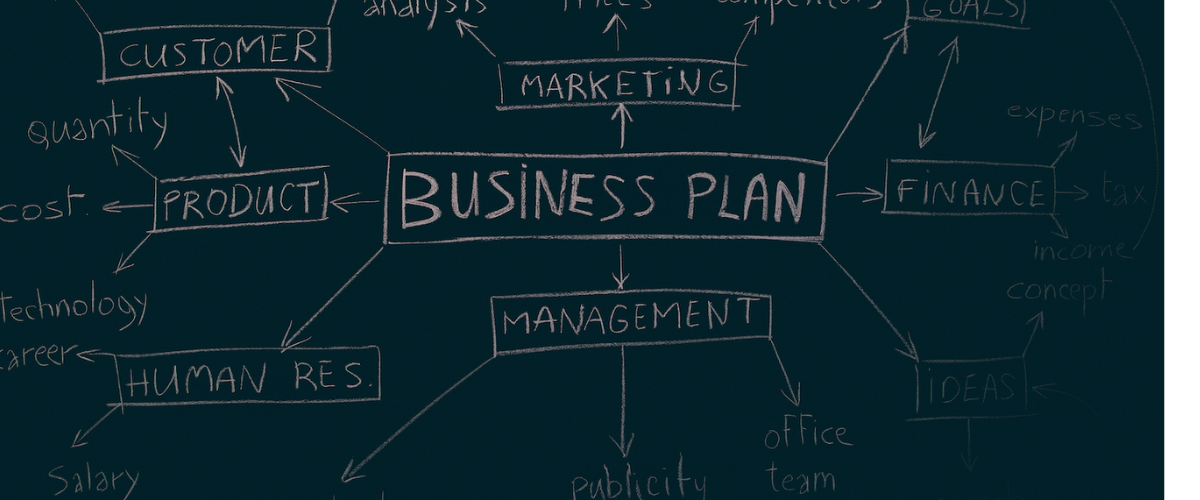
How To Make Your Work Culture Fair

Life is unfair. Life is fair. What do you think? And more importantly, since we spend all our time at work do you think your organisation treats you fairly.


Fairness is more than a buzzword, it is the bedrock of trust in any organisation.


People need trust in order to work effectively together and yet, trust is often eroded when employees don’t feel listened to or are treated (in their perception) unfairly.


Many employees end their week feeling disheartened, telling friends and family, “It’s just not fair because X at work got to do Y”. So whether the example if about recognition, workload or event future opportunities, fairness or the lack of it shapes how people feel about their work.


What Does Being Fair Really Mean?

In an organisation there are numerous policies, processes and procedures put in place, to ensure people are treated fairly.


Fairness is about impartial and just treatment. Being fair is often not about treating everyone the same. Being fair is about treating everyone with the same level of respect, dignity and opportunity as their colleagues.


Fairness is also about a perception, which means whether people percieve something as fair might not be as simple as leaders would like.


The Reality Of Being Fair

Laura, a call manager at a local call centre, had been in an organisation for five years. She consistently exceeded her targets and mentored new staff when they started due to her expert knowledge and quality of service.


When a team leader role opened up, she applied, excited about the opportunity. However, the role went to someone newer, with much less experience. Jade wasn’t upset about not getting the job, but she felt is was unfair because she couldn’t understand why.


On paper she had all the requirements and wanted to ensure she would be successful next time, by working on whatever had let her down this time.


Over time, this perceived unfairness and lack of conversation led her to leave the organisation for new role. It was the lack of transparency that made her feel invisible, unvalued, and that there was an unfairness about the decision.


This story isn’t unique. It’s a reminder that fairness isn’t just about outcomes, it is about process.


It is also about the parameters, brief and expectations which are set ahead of work being completed.


Nicola was asked to present in a competition where she had the chance to win a £1000. As part of the brief she has been asked to present for 10 minutes, on the subject of leadership and to ensure people took something away at the end. By the end of the competition Nicola thought she had done well, but wasn’t sure she had won.


However, when the winner was announced – someone who went well over the allocated 10 minutes she felt the whole thing was very unfair. Especially as, if she was honest, another entrant, who in her mind should have won, stuck to the time limit and didn’t win either.


Nicola told her friends about this and within a couple of years the competition folded as people got to know it as being ‘unfair’.


Why Does Fairness Matter To People?

People who work in an organisation, which is perceived to treat people fairly have:


🧠 Higher morale, because being treated fairly makes people feel valued

🧠 Less inclination to leave, because they are happier

🧠 Higher levels of performance, because fair environments foster collaboration and innovation


What Can Leaders Do To Promote Fairness?

Ultimately is an organisations systems and processes are unfair it is the leaders role to change these to create a fair, inclusive and diverse workplace. All leaders, no matter what level need to promote fairness through:


🧠 Be transparent, share how decisions are made and the rationale behind decisions


🧠 Ensure rules and policies makes sense, and are applied consistently across team and departments, whilst ensuring flexibility to adapt to suit the values driving the culture


🧠 Be empathetic and compassionate to people, understanding individual needs and circumstances to ensure adaptations are made (in a consistent manner which supports everyone)


Fairness is about how things are done in your workplace culture. It is about treating people fairly, especially when no one is watching.


It is about everyday actions, not just policies and rules which in themselve can become unfair depending on the circumstance.


So what?

Fairness is about perception, experience and understanding the rational for decisions which are made. Especially when resources are scarce.

More about Culture

There’s more about Culture in this Think Organisation Post: How to Create and Embed a Culture of Fairness

Alternatively, copy and paste this link into your browser: https://cortex.clyq.co.uk/how-to-create-embed-a-culture-of-fairness/

How To Improve Employee Engagement on a Limited Budget

Employee engagement has fallen into and out of favour over the years. At times it is seen as an illusive concept which is difficult to quantify, measure or obtain. And at others, it is quoted around the board table alongside the figures from the P&L as a sign of how successful an organisation may, or maynot, be. But does it really matter? And if it does matter then how can we improve employee engagement without spending a fortune?

Employee Engagement describes the level of enthusiasm and dedication an employee feels toward their job and organisation.

In reality, employee engagement is not about huge budgets and flashy perks, it is about connection, recognition, purpose and trust. So how can you improve employee engagement without blowing the budget?

1. Get Engagement Basics Right First

Many organisations overlook the fundamentals which include how people are treated on a daily basis. At a recent event, our Founder, Sarah Clarke presented with Ian MacArthur on the importance of the having the fundamentals in place. The Greater Manchester Charter is a vital tool to which helps businesses understand what they need to do to get the basics right, and whilst some do cost money (e.g. paying living wage), this is proven to deliver ROI for businesses in the long-run (GEC Evaluation, 2022). In the meantime, for businesses who want to get the basics right focus on reducing confusion or frustration by creating clarity and care across teams. This includes reviewing and clarifying all roles, responsibilities and handovers and setting clear service expectations between teams and individuals. Help coach people to focus on how their work contributes to the team and business goals as by empowering people to work together this creates engagement.

Actions could include: open roles & responsibilities, team huddles, shared ‘ways of working’, visual collective goal and progress boards, innovation huddles, etc.

2. Listen (& Mean It!)

Leaders who do not listen to their teams, peers or even own leaders create frustration and disenchantment. Employees who are asked for feedback, but nothing changes as a result can in reality become more disillusioned so it is vital to listen – and we mean really listen, and then act on the feedback. A client recently had undertaken an employee engagement survey for the fourth year and the results has fallen off a cliff, because of the perceived lack of improvements. Whilst the leaders could list all the changes they had made some fundamental suggestions had been overlooked, and whilst they were not possible, no leader had explained why this wouldn’t happen to the employees. Once this conversation was had, and the employees understood why their suggestion was not possible (and in reality it was for legal and discrimination reasons) they were more than happy with other improvements which had been proposed. The following year engagement soared – because people has been listened to, and the feedback loop has happened.

Actions could include: free online surveys to gain feedback, hosted ‘ask me anything’ sessions or feedback circles, holding stay interviews with people who have been in the business for different tenures, practical improvement workshops, etc.

3. Recognise & Appreciate Others More

All people need to feel valued, and whilst some might dread (understandably) being asked to stand up in front of a crowd for applause and awards that does not mean they should not be recognised for their effort, dedication and commitment. Recognition does not need to be public, although it can be for some, and it needs to suit the individual being recognised. Small gestures of thank you from senior leaders, even if off the cuff, can be hugely rewarding for individuals. Peers who recognised and appreciate each other forge closer bonds and deliver higher quality work so design a framework which is not onorous to recognise and appreciate each other, both individually and collectively.

Actions could include: introducing peer-to-peer shout outs, encouraging managers to give timely thank you specific to the task or action, personal thank you cards written with meaning, etc.

4. Promote Belonging & Relationships

People stay for people. In many situations it is the people, not the job, which forces people to leave – or ideally, stay. Ensuring people have productive relationships across teams, with their peers and with their teams is vital to promote employee engagement. Ensuring that people understand each other, and really feel like they belong is a huge driver of engagement. Encouraging people to talk to each other, have lunches together and chat either face to face or remotely is crucial to help promote positive relationships and foster a sense of belonging.

Actions could include: Buddy systems for new starters or across teams, set lunch times promoting people eating together, inclusive spaces for people to have time out together, guided team walks outside the office or sharing of recreational ideas or external volunteering events as a team.

5. Empower People To Develop & Learn

Many organisations cut their training budgets in times of crisis, which despite being proven to be detrimental, is often something non-negotiable around the leadership table. Learning and progression does not need to cost as creating peer-to-peer learning networks, ensuring people work across teams or regions and role modelling a sharing of knowledge can really help empower people to learn – without the large price tag. Many younger workers, and older workers, like learning new things so cross-mentoring can be really helpful. Employees who feel like they are progressing, improving and learning new skills are more engagement because of this.

Actions could include: set-up a training and development sharepoint site to share knowledge, create a library of business books in the canteen, create skill swaps where people teach each other, give time for self-directed learning online and ask people to share what they have learnt with each other.

What next?

If you think employee engagement may be low in your team or organisation, especially in time so financial strain then listen to what people are saying. Often people have their own solutions which when implemented will improve engagement. Flexible working is often seen as a huge perk, much more than a salary increase which impacts tax and other benefits so it is not all about money when it comes to engagement. Have a read of our engagement checklist below to gain some more ideas.


Powered By EmbedPress


Reach out for a free 30-minute consultation with one of our team to find out more.


More about Motivation

There’s more about motivation in this Think Organisation Post: Motivation: Understanding What Drives People at Work


How Can Leaders Improve Motivation In Their Workplace Culture?

The carrot versus the stick is a powerful analogy of the type of tools which many leaders still use when attempting to improve motivation.


What is the best way to motivate employees to behave, or deliver, certain aspects of their jobs. But does this really work and which is better – the carrot? the stick? or neither because there is a better way of motivating people . . . ?


The Psychology of Motivation

The carrot-and-stick approach is based on behavioural psychology developed by B.F. Skinner (Skinner, 1953) and I. Pavlov (Pavlov, 1903) which focused on conditioning, rewards and punishments, which many of us will remember from school – think the of the Pavlov dogs working to gain treat or avoid punishment, or the rats in the maze gaining food when successful.


However, in recent years the complexity of motivation, humans and the environments people work in has led to these theories being seen as outdated, limited and even-counterproductive – especially in the work environment.


Think about it – how many times has someone been disciplined at work, or faced a disciplinary process, and come out the other side positively behaving in the way which was desired? In our experience, less than 0.01%. Research says the same (Rollinson et al., 1997).


How Punishment or Avoidance Motivation Can Be Detrimental

The threat of the ‘stick’ can lead to employees undertaking behaviours which may have unintended consequences.


For example, people who are avoiding something bad (e.g. a reprimand, job loss or failure) can often go to extremes to avoid this. Many sickness absences, which also costs businesses resources, time and productivity can be linked to avoidance. In fact, the threat of a stick at work can create fear, stress and at times the desired compliance.


However, the costs of the compliance needs to be understood. For example, in workplaces the threat of the stick may lead to box-ticking, withholding information, burnout and pushing any resistance underground. Over time it can also reduce psychological safety and intrinsic motivation.


In short, whilst using a stick can deliver short-term compliance it may, in turn, reduce commitment. So it needs to be used consistently, fairly, transparently and sparingly.


How Positive Reward Motivation Can Actually Reduce Motivation

On the flipside, the promise of something positive, a reward or a bonus can extrinsically motivate employees to behave in the desired way, or deliver the desired task.


However, whether it is praise, recognition or other rewards this only works for simple, clear tasks and has a finite shelf life.


The type of positive reward, or carrot offered, also needs to suit the individual.


However, for some tasks (such as creativity, innovation or leadership) positive rewards and reinforcement can actually reduce motivation as people become more focused on justifying their actions, focusing on the reward, they stop valuing the skill, behaviour or task itself.


Again this can lead to box-ticking, burnout and over focus with other positive behaviours going underground.


Why Leaders Need Psychology To Utilise The Right Tool

The reason these basic theories and tools don’t work is because:


  • They assume that people are passive, that they need controlling, but this is most not the case
  • They create short-term, surface compliance but not long-term change as the behaviour disappears once pressure is removed
  • Creativity, collaboration and risk-taking can be stifled due to the pressure to “play it safe” to gain rewards or avoid punishments.
  • They make learning from mistakes more unlikely, as this is something which needs to be promoted, championed and role modelled, which is difficult in a reward vs punishment culture


So What Can Psychology Teach Us About Motivation?

The first is that there is no one-size fits all. And that every tool, technique or option selected will have short-term, long-term, intended versus unintended consequences.


What actually motivates people at work is extremely complicated.


Sometimes having a good night’s sleep can increase motivation, whereas for others it could be working with people or having space to work alone. But to provide an alternative to the carrot and stick it is vital leaders focus on the intrinsic drivers people have. Reward versus punishment is extrinsic. In contrast, intrinsic motivations are driven from within us.


These include, but are not limited too:


1. Purpose

People are driven by what really matters to them, and/or others. Think of children. When they have a purpose and know what they are doing matters then they are motivated to keep doing what they are doing. The same is true in the workplace.


Simon Sinek famously outlined the importance of purpose, and finding your why, at an organisation level (Sinek, 2009). More recently, his book ‘Finding Your Why’ focuses on individual purpose which can be helpful for some individuals. Yet be warned, handing out this book to your team is NOT the answer. For many, this can be too much too soon. Instead, focus on the individuals, use coaching and active listening to really understand them.


Purpose should not be forced or coerced, it is about self-reflection and self-awareness but as a skilled leader your job is to uncover this for your people – reaching them on their level (not yours).


2. Autonomy

There is a myth going around that people hate change.


This is not true. In reality, people love change e.g. new hairstyles, new houses, different place for holidays, new clothes but they like change when they choose it.


When change is forced on someone they tend to resist. This is why autonomy is so crucial in motivating people at work.


Allowing people to have a say in what they are doing, how they are doing it and allowing them to use their own mind and thoughts to solve problems, is critical to ensure buy-in, commitment and motivation at an intrinsic level.


Leaders have a role in providing guardrails to ensure employees have a plan (direction & purpose), and that they are in control of their own destiny, with the tools and resources to be successful.


3. Mastery

People always like to improve.


Think about how competitive people are, especially children. Many of us, to differing degrees, have a competitive streak. It is that sense of improvement, getting better, developing, learning more or growing which helps ensure we keep doing what we are doing, and improving.


Individuals who get stuck in jobs where there is no room to improve, where suggestions no matter how good they are, are rejected and where status-quo is everything, can be extremely detrimental to our health and well-being.


People are motivated by seeing, feeling, hearing and getting external feedback on how they are improving and growing. This keeps us motivated. How often have you moved jobs or companies because you felt you were stuck? Or going nowhere?


4. Belonging

People need to belong.


It is an innate need for all humans built from our primal survival instincts. Because humans who didn’t work with others, or belong to a group, did not survive.


This need to belong may vary, and can be met through friendships, work or other activities but feeling like you don’t belong, can quickly demotivate people in the workplace. Every leader has a responsibility to ensure that all employees see, think and feel that they are part of something.


It is fundamental to ensuring people are deeply motivated at work. Motivation also fosters collaboration, innovation and improves people’s health and wellbeing. Diversity has been shown to add value to organisations, but only when people feel included and that they really belong.


5. Trust

Trust is a fundamental element which all leaders need to cultivate with their employees, teams, peers and organisations.


Delivering 1-4 helps with this but ultimately if leaders can’t be trusted then motivation will dissipate.


Trust is discussed in another article we recently published, however, motivation is all about connection, purpose and trust.


How often have you been let down at work? Or someone has promised they will deliver and this hasn’t happened?


Creating trust is multifaceted as people need to be capable, willing, able, consistent as well as really care about each other to build and maintain trust.


What Next?

Forget the carrots. Ditch the stick. At Think Organisation we help leaders create cultures people want to be part of – not ones they fear or tolerate because they have no choice.


We help everyone in your organisation think differently, so contact us today to know more. If you are ready to move beyond compliance and gain real commitment from your employees then reach out to us today.

Motivation post it notes. Intrinsic or extrinsic.

More about Motivation

There’s more about Motivation in this Think Organisation Post: Leadership Fundamentals : Psychology, People, Purpose, Plans

Alternatively, copy and paste this link into your browser: https://cortex.clyq.co.uk/leadership-fundamentals-psychology-people-purpose-plans/

How To Ensure You Have a Credible Coach

In an era where leadership is defined by agility, resilience, and strategic foresight, executive coaching has become an essential lever for transformation. Not just at a personal level, but at an organisational level. Investing in a coach is an important investment, however, how do you know you have picked the right coach for you and your organisation?


Yet not all coaches are created equal.

While anyone can call themselves a “coach,” the difference between an impactful executive partnership and a costly misstep, often comes down to one crucial factor: credibility.


So, how do you know if a coach is credible?

Many successful business leaders, who may have sold their businesses, are claiming to be expert executive coaches, with no training whatsoever. Lived experience is really important if you are a mentor, but not necessarily as a coach.

Mentoring is the act or process of helping and giving advice to a less experienced person, especially in a job or at school.

Today’s leaders can’t afford to gamble on advice disguised as coaching or well-meaning conversations. Especially not when they are paying for the privilege.


Coaches can often reinforce dependency when they are untrained. Instead, it is vital that anyone investing in coaching, for themselves or their business, must seek out qualified, experienced, and accredited coaches (particularly those certified by the International Coaching Federation (ICF) who, in our opinion and based on extensive research, bring not only gravitas but rigorous ethical standards, a scientific psychological foundation, and a commitment to ongoing personal development.


Mentoring is not coaching.

The ICF defines coaching as “partnering with clients in a thought-provoking and creative process that inspires them to maximise their personal and professional potential” and sets the global benchmark for coaching professionalism.


Coaches who are accredited by the ICF, such as at ACC, PCC, or MCC levels, have undergone a comprehensive training program, demonstrated real-world coaching hours, and passed stringent assessments and examination. As a result, and most importantly, they commit to a code of ethics and core competencies that ensure coaching is safe, structured, and results-oriented.


This matters because the stakes at the executive level are high. When a CEO or C-suite leader receives poor coaching, often based on anecdotal experience rather than proven methodology, it doesn’t just affect them. It ripples through the business: decision-making slows, confidence erodes and leadership capacity diminishes.


“Telling reinforces dependency; coaching develops capability.”
Paul Walker, CEO


More Than Experience: The Discipline Of An Executive Coach

It is important to understand that there is a growing trend of individuals calling themselves “coaches”, often based on business or role success alone. But the ability to grow a business, or be successful in a board role, doesn’t automatically translate to the ability to coach others to do the same. In fact, the most effective coaches know how to withhold advice, ask powerful questions, and challenge constructively, techniques learned through formal training, supervision, and deep personal reflection.


Often executive coaches coach you through things you don’t want to hear, help you see what you struggle to see and empower you to unlock your potential and maximise growth.


True executive coaching is a disciplined, high-impact process. It blends behavioral science, adult learning theory, and organisational psychology – to support leaders in driving change. Qualified coaches bring these tools to bear with intention and expertise – enabling transformation that sticks.


Reflective Practice and Supervision Are Non-Negotiable

Experienced executive coaches invest in supervision, which is the structured reflective practice with another qualified professional. Supervision sessions examine their work, manage bias and continuously sharpen a coach’s effectiveness. Supervision isn’t optional. It is a sign of a coach’s commitment to their clients’ success and their own development.


Without reflective practice, coaches risk projecting their own beliefs, missing critical dynamics or creating dependency rather than empowerment. With supervision, they model the kind of self-awareness and accountability they expect from their clients. It ensures client are getting the best coaching in return for their investment.


For leaders, working with a coach who is committed to supervision and CPD (continuing professional development) means entering into a partnership rooted in rigor, ethics, and excellence – not ego or improvisation.


A Coach Builds Capability, Not Dependence

One of the hallmarks of skilled executive coaching is that it develops leadership capability, not reliance. The goal isn’t for a coach to stay with a leader indefinitely, nor to become an advisor. It’s to build the executive’s ability to think more strategically, act more decisively, and lead more authentically – long after the engagement ends.


Accredited coaches are trained to contract clearly, define measurable outcomes, and structure engagements to ensure sustainability. They uphold the belief that real coaching success is when the client no longer needs them.


If you are worried you are not getting value from your coach, or that a coach may not have the credentials they claim, then reach out to us and have a free 30-minute consultation. Afterall, when organisations select ICF-accredited coaches, such as our Co-Founder Steph, who are actively learning and being supervised, they’re not just investing in a leader, they’re investing in the future health and success of their organisation.


More about Coaching

There’s more about Coaching in this Think Organisation Post: Comfort Zone – How Leaders can Foster Growth

Alternatively, copy and paste this link into your browser: https://cortex.clyq.co.uk/comfort-zone-how-organisations-can-foster-growth/

How To Create Trust: The Invisible Thread of Successful Cultures

There is one thing that has remained constant over the 25+ years Sarah Clarke and Steph Durbin, our Co-Founders, having worked across 35+ industries: culture is the bedrock of success. Culture is built on trust.

While strategy, plans and performance targets are all vital, organisations ultimately succeed or fail based on how things are done around here. The unwritten norms, the everyday behaviours and the energy of the workplace, ultimately at the very core of all of that lies something less tangible but far more powerful: trust.

What Do We Mean by ‘Organisational Culture’?

Organisational culture is more than a mission statement or company sayings. It is the shared values, beliefs and behaviours that shape how work gets done.

Culture is felt in:

  • How decisions are made
  • How people communicate
  • How leaders lead
  • How employees interact with one another

And beneath all of this? Trust. At the heart of a healthy culture and a thriving organisation lies trust – without it, no matter how good they are, even the best strategies crumble.

What Is Trust & Why Does It Matter?

Trust is the firm belief in the reliability, truth, ability or integrity of someone or something.

Trust is context-dependent and built over time. Trust is influenced by our thoughts, feelings, experiences and relationships. In the workplace, trust can take many forms:

  • Interpersonal Trust: Confidence that others will act fairly, honestly and with goodwill.
  • Organisational Trust: Belief in the intentions and ethics of leadership and the wider business.
  • Technological Trust: Confidence in the accuracy and reliability of systems and data.

In a recent client meeting, most of the discussion focused on whether the data was accurate (and not on what the data was telling them). This is a clear sign of eroded trust. When trust in information or technology breaks down, it stalls progress and clouds decision-making.

So, how can we build and maintain trust across organisations?

Ken Blanchard’s ABCD of Trust

In his book Trust Works! (2013), Ken Blanchard outlines four key elements of trust, using a simple but powerful framework: ABCD. While it simplifies a complex concept, it provides a helpful lens for reflection and action:

  1. Able – Do you have the competence and skills to deliver?
  2. Believable – Are you honest, with a strong sense of ethics and integrity?
  3. Connected (Caring) – Do you show concern for others? Do people feel you have their interests at heart?
  4. Dependable – Do you follow through on promises and stay consistent?

Let’s break this down a bit further, and if you need more information we recommend purchasing this book.

Are You Able to Be Trusted?

Trust starts with ability. You need to demonstrate the competence to deliver on your promises. Whether you’re a senior leader setting strategic direction or a team member committing to a deadline, credibility comes from capability.

When people fail to deliver, especially repeatedly, trust is reduced. But mistakes happen. The key is how we respond: are we accountable, transparent, and proactive in recovery? Do we keep people up to date and communicate what is happening, which leads to the next element.

Are You Honest and Open?

Integrity is non-negotiable. When people act dishonestly or prioritise personal gain over the team or organisation, trust erodes rapidly. Openness, transparency and moral consistency create safe and high-functioning environments.

There are elements to consider. For example, are your teams confident that others have their backs? Or are they second-guessing motives and questioning transparency? Regularly measuring perceived integrity across teams can shine a light on hidden issues that undermine trust. Understanding levels of psychological safety can also help.

Do People Know You Care?

Trust grows when people feel seen, heard and valued. Leaders who genuinely care about their teams (and show it through actions, not just words) will create psychological safety.

That sense of connection builds the kind of loyalty and mutual respect that fuels high-performing teams.

Are You Dependable?

Consistency is often underrated. In reality, the simple act of doing what you say you’ll do, time and again, builds a strong foundation for trust.

Being dependable shows people they can rely on you, especially when things get tough. Again communication can be key, being dependable is about keeping people up to date and in the loop.

Culture Doesn’t Exist Without Trust

In every organisation we’ve worked with, trust has been the critical, non-negotiable ingredient for cultural health. The moment trust doesn’t exist, or dwindles, or is questioned there are different directions which cultures can go.

Because trust influences how people behave, what they believe is possible, and influences whether they bring their best selves to work. Many clients have invested heavily in employee engagement surveys and measures, however when they fail to deliver improvements this can erode trust. Because the organisation is seen as not dependable.

As leaders and teams, if we want to build resilient, adaptive and high-performing cultures, we must ask ourselves regularly:

  1. Are we truly able to be trusted?
  2. Are we acting with integrity?
  3. Are we showing we care?
  4. Are we consistent and dependable?

These questions can be asked at an individual, team or organisational level. For example, if a board isn’t able to be trusted, or doesn’t act with integrity this quickly undermines trust in the board and organisation as a whole.

The answers to these questions will tell you everything you need to know about the strength of trust, and culture, in your team or organisation. Especially, when the answers are gleaned from multiple sources by experienced, competent, open and honest experts who consistently deliver improved cultures and do what they do because they care about creating workplaces where everyone can thrive.

Trust

More about Culture

There’s more about Culture in this Think Organisation Post: How To Make Your Work Culture Fair

The Hidden Cost of Silence: Leading Through Conversations

Leadership isn’t always about vision boards, strategy decks, and celebrating success. It is about conversations.


Day-to-day, leadership is often about uncomfortable truths, direct feedback, and navigating tough conversations. Yet, how often do leaders or managers get trained in these skills?


For years, and often across organisations, big and small, far too many leaders are side-stepping the conversations that would help their teams thrive. With the increased challenges facing businesses today, suddenly the pressure is mounting, often resulting in a more pressing need to have difficult conversations – but where do you start?


Difficult Conversations: The Cost of Not Being Direct

A senior manager in a financial services firm repeatedly avoided addressing a team leader’s passive-aggressive behaviour in meetings. Instead, she reassured herself that “it’ll settle down.” Over time, others in the team stopped contributing. The team’s engagement scores plummeted, and two high performers left within six months. At the point the client contacted us, they were at risk of losing a third high-performer and sales were at an all-time low.


This is surprisingly frequent. When leaders shy away from honest conversations, avoiding giving direct and clear feedback, poor behaviours go continually unchallenged. This sends a loud, unspoken message to all employees.


That this is acceptable here.


Then, over time, this behaviour can spread. Because, once unchecked, others will copy it and also ‘get away’ with it. After all, if poor behaviour is tolerated, what incentive is there for others to maintain high standards?


Vague Expectations: Mixed Results & Team Frustrations

A tech scale-up promoted a brilliant developer to team lead but didn’t define what leadership looked like in practice. They were asked to ‘just keep doing what you’re doing, but keep an eye on the others. Months later, performance across the team had slipped, and the new team lead was overwhelmed and demoralised. The newly promoted team leader felt like a failure, and both their and others’ work standards had slipped.


Many leaders assume their team members “just get it” when it comes to what’s expected. This can be related to tasks, projects or leading others. However, unless expectations are clear, aligned and discussed regularly, they can quickly become a source of confusion, tension, and inconsistency.


One side gets frustrated, leading to the other side getting frustrated. Which then circles around as expectations are missed. Increasing frustration, reducing well-being.


Unchecked Under-Performance Quietly Drains Team Energy

In an NHS Trust, one team had a consistently underperforming project officer. The team leader, reluctant to “rock the boat,” picked up the slack themselves. They also spread it over others.


But over time, resentment grew, from both the team leader and the rest of the project team. Others began reducing their effort, feeling the imbalance, and voicing their frustrations to each other. But although the leader was aware, they didn’t voice it openly. Eventually, the team’s delivery suffered and patient feedback dipped noticeably. Which led to us being called in to help the trust.


When underperformance goes unaddressed, it sends the message that effort doesn’t matter.


This demoralises high performers and breeds disengagement.


The impact is rarely confined to the individual. It spreads. It grows. It manifests in other areas, with other teams. And when there are times of high pressure or challenge, it can erupt and become even more serious.


So what can you do to help resolve these challenges?

1. Reset. Restart. Review.

Depending on how far frustrations have gone, it is important to have a reset of expectations. Explaining the challenges and the vision for what is needed, whilst asking for input from others.


This is best done in collaboration and in a planned and restructured way. It is important to review progress. Suddenly changing expectations overnight can cause confusion, so this is an important step in starting to role model being direct, clear and consistent.


2. Select Structured Frameworks To Suit

Using frameworks can add value and help consistency across your organisation or team. It is important to pick frameworks which suit your needs, such as the SBI (Situation-Behaviour-Impact) model. This helps conversations stay focused and objective.


It can help people practice short, direct and kind conversations that invite reflection and improvement, not shame.


3. Make Expectations Visible

Ensuring expectations are visible to all is critical. Role profiles can help provide this as an overview. But ensuring role profiles include behaviour expectations, not just task outputs, is critical.


There also needs to be regular reviews, with role profiles written and aligned across organisations and teams to ensure aligned efforts. Expectations need to be visible to all, not just in terms of what needs to be done but also in terms of how things need to be done.


4. Have Conversations Early

Don’t wait for issues to grow and get worse. Speak early and take action early. Managing performance does not need to be a formal process if it is tackled early.


Using a coaching style, supporting and directing, helps ensure people feel safe. Ensuring time is given for improvements, with clear expectations and people are set up for success, is key. However, timelines need to be followed through. Acting early is critical, but goals for improvement need to be achievable too, along with expectations for delivering them, monitoring and next steps if goals aren’t being met.


5. Share Ownership

It shouldn’t just be down to leaders to communicate and set expectations. The best cultures become self-regulating cultures where team members hold each other to account, supporting each other to improve.


Leaders who role model fairness, consistency and honesty help empower others to do the same. With written expectations then people know what to expect, and can help support others to meet expectations in terms of how and what they deliver.


Conclusion – one brave conversation at a time

The best leaders are not the ones who avoid conflict, or highly liked by everyone. They are the leaders who build the confidence and capability to face conflict, to work through it and use it to improve and deliver success. All in the service of something better.


If you’re leading a team, remember: avoiding the awkward conversation today creates a bigger, messier problem tomorrow.


High-performing cultures don’t happen by chance. They’re built one brave conversation at a time.

To learn more, please reach out – sam@cortex.clyq.co.uk.


More about Leadership

There’s more about Leadership in this Think Organisation Post: Teaching Leaders How to Think

Alternatively, copy and paste this link into your browser: https://cortex.clyq.co.uk/teaching-leaders-how-to-think-ten-tips/

How a Professional Facilitator Can Save your Business Money

Board meetings are pivotal moments for strategic decision-making, governance, and organisational oversight. Yet how many businesses invest in a professional facilitator to ensure ROI is delivered?


Inefficient meetings, misaligned strategies, and unresolved conflicts can be costly to any business, especially when they occur in the boardroom.


A professional facilitator brings structure, focus, and efficiency to meetings, workshops, and decision-making processes. This has been proven (repeatedly!) to save time and money.


When that facilitator also has expertise in workplace psychology, they add even greater value by enhancing team dynamics. They enable people to be themselves and empower everyone to work together to foster a productive working environment.


A facilitator, who is independent of the organisation, can add value and save your business money through the following steps:


1. More Productive Meetings

Currently, the average employee spends 31 hours per month in unproductive meetings (Forbes, 2023), which is a huge cost to businesses. In the UK, SMEs waste an average of £5,796 per employee per annum on unproductive meetings. This is a significant cost and is getting worse with hybrid working.


A facilitator can ensure meetings stay on track.


With a recent client a full review of meetings delivered a saving of 27 hours per month for each employee, removing duplication and reducing confusion. Profit increased significantly as a result, as did employee engagement and staff retention levels.


2. Maintain Strategic Focus

Board meetings can often descend into operational discussions, losing their focus on values, purpose and strategy.


Having a facilitator can ensure this doesn’t happen, especially as sometimes the Chairperson can get embroiled in these discussions. Training your Chairperson to be a great facilitator can add a huge advantage here too.


Previous relationships, experience and preferences can shape discussions which may be based on cognitive bias. Having a facilitator who is a Workplace Psychologist helps prevent this from happening.


Recent new articles, such as the Post Office scandal, could have benefited from an independent facilitator.


3. Create Inclusive Cultures

Many people avoid speaking in some meetings, or when they do, they avoid speaking their absolute truth including ideas, suggestions and criticisms. This can lead to groupthink, hindering innovation.


Being able to balance contributions from individuals, ensuring dominant personalities don’t dominate discussions to the detriment of more reflective personalities.


Understanding team dynamics, and being an independent facilitator allows the rest of the people in the room (with the skills and expertise) to fully participate in their meeting. This reduces the distraction of being sidetracked by agendas and potential personal conflicts which arise.


4. Improves Employee Engagement

The cost of replacing an employee is expensive.


Not only do businesses lose knowledge, expertise and skills but it also has a damaging impact on other employees, and at times just one employee leaving can cause an ‘exodus’.


The cost of replacing a lost employee is 6-9 months of their salary in absolute terms but much higher when lost efficiencies and the reality of training people comes into play.


Having experienced and skilled facilitators ensures that everyone is heard, meetings become more productive and employee engagement increases.


Difficult discussions (e.g. about pay or renumeration) for some leaders can be helped through facilitations to ensure everyone benefits from the working relationship and exchange of services.


5. Ensure Governance & Risk Management

Balancing doing the right thing, and complying with legal regulations and complicated frameworks can be difficult.


Discussions can often be swayed around the choices organisations may or may not have in terms of the level of risk they want to accept. Often this gets lost in meetings when people push their own agendas, which can lead to decisions not being made effectively.


Reputational risk and huge fines are commonplace when boards or senior leaders fail to have the appropriate levels of governance in meetings.


A skilled facilitator ensures that governance requirements are met and there is the appropriate level of effective scrutiny applied to risk-based decisions.


Having a facilitator is not just a ‘nice to have’. It is fundamental to ensuring your business meetings are more effective. Even twice a year facilitated strategy meetings have been proven to add value to organisations ensuring good habits are established and maintained.


Investing in the expertise of a facilitator strengthens governance, improves board dynamics, and ultimately contributes to a healthier, more successful organisation.


Reach out if you would like to know more.


More about Leadership

There’s more about Leadership in this Think Organisation Post: Reduce Organisation Hazards to Reduce Work-Related Stress

Alternatively, copy and paste this link into your browser: https://cortex.clyq.co.uk/how-to-reduce-organisational-hazards-to-reduce-work-related-stress/

Power Psychology: How To Unlock The Secret of Boardroom Dynamics

Boardroom and power dynamics are complex and crucial for the success of any organisation.


Yet many people struggle to understand the realities of boardroom dynamics.


Boardroom dynamics refer to how people on the board interact with each other. They are about how individuals perceive each other. Effective boardroom dynamics are key to ensuring diversity of thought, challenge, and the appropriate level of governance.


Psychology in the Boardroom

Understanding the psychology, which is the science of human behaviour, of how individuals, groups and leaders around a board interact is key. Often people say one thing, but in reality they think another.


All of these, and more, influence and impact the power dynamics in a boardroom: power dynamics; personality; social groups; personal relationships; expertise and experience.


Understanding of boardroom dynamics is built on understanding the psychology of power. How individuals navigate influence, control, and utilise authority within their environment hugely impacts the effectiveness of the dynamics in the boardroom.


In reality, there are different types of power. Many people are unaware of this but it is important for people, especially leaders, to understand these different types. In the boardroom you can often see different types of power interacting, some are positive, others are negative and some have both attributes.


Power Dynamics

Coercive Power

Coercive power is the ability to force someone to comply through fear of punishment or negative consequences. This can sometimes be linked to informational power, which is the ability to control access to important information. This is especially common in the boardroom where information, fear and pressure are strong. There may be individuals who are not included in conversations, or don’t ‘hear’ bits of information which means they can lose power in their ability to make suggestions, or decisions.


Legitimate Power

One power everyone will have on the board is legitimate power over the rest of the organisation. This is power derived from a formal position of authority.


As named Directors, and the fact they are in the boardroom, means people have legitimate power. Hierarchies in organisations outline who has legitimate power over who, however that doesn’t always translate into actual power. Power is the ability to directly, or indirectly, influence something or someone. This could be the behaviour of others, or the strategy of the organisation. Just because people are on the board does not mean, necessarily, that they can influence strategy – although they should be able to!


Expert Power

Power can often be based on perception of knowledge, skills, or expertise in a particular area – expert power. Often this is assumed when leaders are higher up in the organisation, but we frequently find that the people nearer the tasks are the true experts in what they are doing as they know the detail. The expert power of board members is more leadership, horizon planning and bringing the whole organisation together.


Referent Power

The one power which many people tend to aspire to, but often struggle to achieve, is referent power. This is power bestowed by others and arises from admiration or respect for someone. A person gains this by others wanting to follow or be associated with the individual. It is not something which can be bought, or coerced. Think about your organisation – does anyone have referent power in it?


Reward Power

Many people have reward power in organisations – which is highly extrinsic. This is the ability of people, usually higher up in the organisation, to offer rewards, or exchange compliance for positive outcomes. This is a very transactional power. The renumeration package organisations offer is reward power. Which is why performance-related pay is so often rolled out in the hope of improving motivation levels, productivity or quality.


Unlike referent power, which is much more intrinsic, reward power can lose its potency. It can also be moved from people as someone else gains the ability to offer rewards. Many leaders in history show how they used reward power, but when it came to it, another leader could entice their followers away. Whereas, some of the inspirational leaders of our past have achieved referent power.


Gandhi, Mother Theresa, Martin Luther King – each of these individuals inspired referent power as people chose to follow them. In some cases, to the detriment of themselves.


Here are some questions to help you understand which power leaders exert in your organisation or community.


  • What motivates people to follow this leader?
    • If it’s because they admire and respect them, the leader likely has referent power.
    • If it’s due to fear of consequences, they probably have coercive power.
  • How does this leader influence decisions?
    • If they provide rewards like promotions or bonuses, they have reward power.
    • If they rely on their position or formal authority, they have legitimate power.
  • How often do they rely on their expertise or knowledge to gain influence?
    • If their credibility comes from their skills or experience, they likely have expert power.
  • Do they control access to key information or resources?
    • If people depend on them for critical knowledge, they hold informational power.
  • Would this leader still have influence without their job title?
    • If yes, their power comes from personal qualities (referent or expert power).
    • If no, their power is more likely legitimate, coercive, or reward-based.


Whilst it is often difficult to understand where power comes from, and varies based on individual perceptions, the reason these questions are important is because of the link between behaviour and power.


Behaviour & Power

When people gain power, through whatever means research and history show they become less empathetic, more risk-taking and the majority become more self-serving which can alienate others.


Having power allows people to perceive themselves differently from those without it, which inevitably leads to changes in their behaviour.


The ‘true’ information people in power hear is often more diluted as individuals adapt what they say, and how they behave in the wake of the power differential. Have you ever felt uncomfortable when a police car drives past? Even when you know you have done nothing wrong.


Powerful individuals take more control in conversations, with people looking to them to lead the conversations and decisions. This is more common with coercive, reward, legitimate or expert power. Depending on the individual with the power, referent power can inspire others to follow, when in reality they have the same power. It is only by the masses’ decision to follow someone that they gain power.


This video is an amazing example of leadership and the power of followers to choose to follow someone – Dancing Man Leading.


More about Workplace Psychology

There’s more about Workplace Psychology in this Think Organisation Post: How to Drive Business Success by Understanding Others

Alternatively, copy and paste this link into your browser: https://cortex.clyq.co.uk/understanding-others-how-to-drive-business-success/

How To Protect Culture during Cost Reduction

Cost reduction is an inevitable reality for many businesses, yet the statistics are sobering.


Less than half (43%) of organisations achieve their intended savings in the first year (HBR, 2022), and only 11% sustain these reductions over a three-year period (FT, 2021). While cutting costs may be a necessary strategy for financial stability, how a company navigates this process speaks volumes about its organisational culture.


Reducing expenditure often involves restructuring, streamlining operations, and, in many cases, reducing headcount. These actions (especially when not managed effectively) can erode trust, diminish engagement, and create an atmosphere of uncertainty that ultimately weakens the business.


A strong organisational culture needs to be built on transparency, fairness, consistency and engagement so managing culture through times of reduction ensures an organisation’s culture does not become collateral damage in the pursuit of financial targets.


Strategies to Safeguard Culture During Cost Reduction


Lead with Transparency

Employees appreciate honesty. Clearly communicate the reasons behind cost-cutting measures, the decision-making process, and how these changes align with the organisation’s long-term vision. Keeping people informed reduces speculation and fear, fostering a sense of control amid uncertainty.


Prioritise People-Centred Leadership

Leaders need to show empathy, actively listen, and provide support focused on varying individual needs. Even when difficult decisions must be made, ensuring employees feel valued and respected makes all the difference. Compassionate leadership maintains morale and protects the integrity of workplace relationships.


Preserve Core Values

Culture is more than words on a corporate website – it is reflected in daily behaviours and decisions. Any cost-cutting initiative should align with the organisation’s core values. If collaboration, respect, or innovation are central to company identity, these principles must remain at the forefront of any changes.


Invest in Remaining Employees

Downsizing often results in increased workloads for those who stay. Providing development opportunities, new ways of working, health support, and clear career pathways ensures remaining employees feel engaged rather than burdened. A resilient culture relies on people who feel motivated, not overwhelmed.


Ensure Fair and Inclusive Decision-Making

Cost-cutting measures can disproportionately impact certain groups if not handled equitably. Inclusive decision-making means considering diverse perspectives and mitigating biases which helps maintain fairness and prevents potential long-term cultural damage.


Monitor and Adapt

Culture is dynamic. It is built over time however following significant change, businesses need to understand and assess employee sentiment following times of change. This can be done through surveys, feedback sessions, and engagement metrics (e.g. Employee Net Promoter Score). Regular check-ins allow organisations to address concerns and recalibrate strategies to maintain a healthy workplace culture.


To Summarise

Cost reduction is not just a financial exercise. It is a leadership challenge that tests the strength of an organisation’s culture as how the process is handled feeds into the culture of tomorrow.


Businesses that successfully navigate these periods do so by balancing financial pragmatism with a deep commitment to their people.


Those that prioritise transparency, fairness, consistency and communication will not only survive cost reductions but emerge stronger, with a workforce that remains committed and motivated for the future.


More about Culture

There’s more about Culture in this Think Organisation Post: A Slice of Culture – Why Cake is So Important

Alternatively, copy and paste this link into your browser: https://cortex.clyq.co.uk/a-slice-of-culture-why-cake-is-so-important/
Are you ready to

start your joruney?

Take the first step to transform your workplace.

Call us on 07123 456 789
Email us at sarah@cortexworx.com

© Copyright Cortex Worx LTD. All rights reserved. | Website by Clyq