Why is innovation stagnant or unsuccessful in your organisation or team?

Our insights look at fear of failure, lack of direction and other fundamentals to help you understand how to build a psychologically safe culture that sparks creative thinking, bold ideas and action.

Think Better, Not Faster: The Science of Pausing for Innovation and Growth

In a world that celebrates productivity, it’s easy to mistake motion for progress. How often do you take a breath or pause at work? Innovation happens when we deliver something new and useful to our customers, organisation or even society as a whole. But with innovation constantly declining, how can pausing help us innovate faster?


Think about your average week at work. . . .meetings roll into more meetings, inboxes refill faster than they empty, and reflection feels like a rare luxury.


For psychologists, leaders, and anyone guiding people through change, there is a growing scientific evidence that pause, which is a deliberate, reflective space, is not wasted time. In fact, it is this time to think which is the birthplace of creativity, clarity, and sustainable innovation (Kline, 1999).


When Doing Less Creates More

The paradox of creativity is that our best ideas often emerge when we stop trying to have them. Stepping away from active problem-solving allows the mind to reorganise information, draw unexpected connections, and reveal insights that relentless focus can obscure.


Pause Button


Scientists refer to this as incubation. It is a recognised stage in the creative process first described by Graham Wallas in 1926 and now well supported by neuroscience research.


During incubation, the brain quietly continues to process information beneath our awareness, in our subconscious. It explains why solutions appear in the shower, or clarity strikes whilst we are on a quiet walk. We may not look like we are doing anything. However, this does not mean we have stopped thinking. In fact, it is because we’ve stopped forcing ourselves to think, that we allow our brains to really think.


Ask yourself, where am I when I have my best ideas? For some it may be on walks, for others in the bath, the shower or even in the gym. Giving our brains time to pause and think, deeply and subconsciously, is crucial. Yet why do organisations seem to promote motion for progress?


Tomorrow, many HR leaders, people experts and inspiring leaders and experts will be descending on the CIPD Conference 2025, aptly focusing on championing people to transform work. Our Co-Founder, Sarah Clarke, is supporting the Semper Hopkins team to deliver 6 interactive sessions we call the Creative Pause in the Relax & Rewind area of the conference but this is about anything but relaxing and rewinding. This is about helping people use the power of their brain to become more innovative, more productive and improve their own, and others, well-being through creativity and allowing time to think.


The Neuroscience Behind the Creative Pause

Our Co-Founder undertook extensive research which transformed her misconceptions and understanding of creativity whilst completing her MSc dissertation. One element is that creativity is not down to a single area of the brain. Current research shows there is not a single “creative region” of the brain that sparks ideas, but it is the interaction between three key networks which drives creative thoughts in our brains. These are referred to as:


  • The Default Mode Network (DMN), which is active when we daydream or reflect inwardly, responsible for imagination and association thoughts.
  • The Executive Control Network (ECN) which is active during focused problem-solving, analysis, and decision-making.
  • The Salience Network (SN) which acts as a switch, guiding attention between inner reflection and external focus.


Based on studies by Beaty and colleagues (2015 & 2019) research shows that creativity depends on how fluidly we move between these networks. It was based on this research that the creative pause sessions were first designed. Because, focusing on something else, allowing our brain to be creative helps allow this shift.


Fuelling and releasing the brain from the narrow beam of focused attention and enabling it to diffuse and move to more associative thinking that can, and often, fuels originality of thought.


In other words, pausing isn’t doing nothing. It is allowing your brain to do what it does best: integrate, imagine, and make connections. Many of which you will be unaware of, that is until the idea or solution pops into your conscious thought.


During her research, our Co-Founder’s supervisor was Dr Mark Batey, an innovation and creativity guru who worked at the University of Manchester. His seminal research highlighted that creativity doesn’t exist in isolation. In fact, it can operate across four levels. The person, the process, the environment (refereed to as the press) and the product. These levels interact, which makes measuring creativity so difficult as it is vital to decide which lens is being used (Batey, 2012).


This heuristic model focused on the following elements:


  • The person brings motivation, mindset, and self-belief.
  • The process involves divergent (idea-generating) and convergent (idea-selecting) thinking.
  • The press, or environment, either nurtures or constrains creative behaviour and innovation.
  • The product is what emerges, this can be tangible innovation or a new understanding.


Based on this, the suite of Creative Performance workshops were designed. In addition, our creative pause sessions touch on all four levels within an hour.


Join us to allow yourself time to reconnect with the person, understanding your intrinsic motivations, where we will support you in the process of reflection, and help you understand the elements of the pressures which impeded or fuel creativity and innovation.


As Batey notes, creativity thrives when people feel psychologically safe, valued, and given permission to think differently. The pause, therefore, is as cultural as it is cognitive. How often do you pause to think in your work?


Why Psychologists and Leaders Should Model the Pause

Psychologists and leaders are often at the centre of complexity. That is certainly how the Think Organisation team operate. Every week we are helping teams adapt, shifting cultures, and navigating uncertainties with the businesses we support. Yet constant responsiveness can come at a cost.


Pause


When we don’t pause, we lose access to deeper intuition, empathy, and perspective. These are the very capacities that make us effective in human systems. That’s why some of our great thoughts come whilst we are on holiday, well away from the office and constant motion of being at work.


So how can leaders embed creative pauses into their organisational and team cultures?


Embedding pauses into professional and organisational practice isn’t indulgent; it is strategic.


Research shows that reflective time improves problem-solving, boosts wellbeing, and enhances collective learning.


In cultures that reward speed, modelling stillness is an act of ultimate leadership.


Designing the Pause Into Organisational Life

To make the creative pause part of daily practice, Think Organisation recommends small, intentional shifts:


  • Micro-pauses: Take 5–10 minutes before key decisions or during meetings to ask, What assumptions are we holding? What might we be missing? A quick walk to gain some fresh air is often all the time that is needed.
  • Reflection rounds: Begin or end meetings with space for sense-making rather than updates.
  • Thinking time: Schedule undisturbed blocks in calendars and protect them as fiercely as client time. If these are the first elements of time to be sacrificed what does this say about your commitment to innovation?
  • Creative spaces: Build environments that signal reflection is valued in your organisations. Areas such as quiet zones, promoting walking meetings, off-site thinking days or booking creative performance workshops all empower employees to be more creative.
  • Model curiosity: Leaders who share their reflective practices give permission for others to pause too.


We know it is difficult, which is why at Think Organisation, we work with leaders who understand that the future of performance is not about doing more, but about thinking better.


Whether you need an ICF accredited executive coach, leadership development or an organisational culture review. The science is clear: creativity, innovation, and resilience all depend on our ability to pause, to step back, connect ideas, and reimagine what’s possible.


So, next time you feel the urge to rush from one task to another, take a breath.


The most important thing you could do might not be the next thing, it might be the pause before it.


Reach out to the Think Organisation for more support. More information about our Creative Performance Workshops can be found here or for your own bespoke onsite solution, reach out.


References

More about Innovation

There’s more about Innovation in this Think Organisation Post: How to Create a Culture of Innovation

Alternatively, copy and paste this link into your browser: https://cortex.clyq.co.uk/how-to-create-a-culture-of-innovation/

Put Your Thinking Hats On: Use De Bono’s Model To Unlock Better Ideas & Results

How we make decisions, come up with ideas, solve problems or approach challenges is all down to how we think. Imagine if you could change how you think based on the thinking hats you decide to put on your head.


Thinking defines the mental processes of generating, organising or evaluating ideas, information and experiences to understand, reason, make decisions and solve problems.


As Psychologists, we often call it cognitive processing because thinking involves functions such as perception, memory, imagination, reasoning and judgement.


Everyone’s mind manipulates information differently, whether it is words, images or abstract symbols, our minds use this information to make sense of the world and guide our behaviour. Because of this we often get asked, is there a tool or model which can help us think better, deeper or differently?

The answer is yes, because one model, in our opinion, which can help reduce the bias, emotions or rigid thinking patterns is Edward de Bono’s Six Thinking Hats. This tool is a simple framework, which when used correctly, can help transform decision making, by helping teams think more clearly and make better decisions.


What Are the Six Thinking Hats?

Developed by Dr. Edward de Bono, a pioneer in creative and lateral thinking, the Six Thinking Hats model is designed to help individuals and groups look at problems from multiple perspectives, by deliberately and systematically using each “hat” to represent a distinct mode of thinking:


    • White Hat: is all about facts & information, this hat focuses on data, evidence and objective information. Questions such as what do we know? Or what do we need to find out? What does the data show us?

    • Red Hat: is about feelings and intuition, bringing emotions and gut instincts into discussions. Questions such as how do we feel about this idea? What is our immediate reaction? Is this emotional?

    • Black Hat: is more about critical judgement, and to some extent caution. This hat identifies risks, weaknesses and potential problems it is about asking what could do wrong?

    • Yellow Hat: is about the benefits, and optimism. It is about looking at the positives, the opportunities and the positive values which could be added. Why might this work well?

    • Green Hat: is about creativity and possibilities, in terms of encouraging new ideas, alternatives and fresh perspectives. This is about seeing if there is another way of looking at this?

    • Blue Hat: focuses on process and control, in terms of the step by step process itself. This hat manages the process itself in terms of how should we organise the discussion? What is the next step?


Is There Psychology Behind The Thinking Hats?

At its core, the Six Thinking Hats approach is rooted in psychology, because it acknowledges that humans often think reactively, or emotionally, or logically.


It appreciates that people may have different preferences in terms of how they think, and that cognitive biases can distort decision-making.


Using De Bono’s model can help us separate thinking into clear, structured modes, helping people become aware of how they think, not just what they think.

Thinking about thinking, is called metacognition. This psychological shift, thinking about one’s thinking, consciously adopting different hats helps people step outside of habitual thought patterns and consider viewpoints they might otherwise dismiss.


Supporting others to utilise the hats, either as a collective, or as individuals can help foster empathy, reduce conflict, and builds psychological safety. This model is about giving permission for all perspectives, from cautious to creative, to give equal weight to different ways of thinking.


How De Bono’s Thinking Hats Can Add Value to How People Work

The Six Thinking Hats create a shared language for thinking, which can be used across teams and organisations. Instead of clashing opinions, teams explore ideas sequentially.


With a recent client, everyone wore the Yellow Hat to discuss positives, then the Black Hat to assess risks, each hat being used in turn. This structured approach help resolve personal conflicts and improves clarity. Instead of one person always being seen as critical, and another as overly positive.


This in turn helps improve decision-making quality, by removing some of the potential emotions and ensuring all perspectives are covered. It ensures no one perspective it overly focused on. and helps create more informed and balance decisions.


In boardrooms, this can he used to remove the risks of group think, which can happen when risks and opportunities are not equally considered.


A productive meeting may start and end with a blue hat, to frame and close the discussion. Using the white hat early on can help gather facts, and alternating between yellow, black, green and red hat can help balance optimism, caution, creativity and emotion.


Being able to balance free thinking, and experimentation, without immediate judgement is crucial in organisations which need increased innovation. Using the green hat to overcome a fear of failure in organisations can be extremely helpful.

Just as leaders who use the red hat intentionally, to help teams to acknowledge emotions in decision-making, can strengthen empathy, motivation and trust. It is important that when everyone knows there are different modes of thinking, they are valued, and utilised. Individuals who may have different preferences can feel safer, knowing about the different styles of thinking. And businesses can use this model to help in multiple situations such as: strategic planning, innovation workshops, conflict resolution and performance coaching.

In an era where adaptability, empathy, and critical thinking define organisational success, De Bono’s Six Thinking Hats offer more than just a brainstorming tool, they provide a psychological framework for better collaboration and smarter decisions.


By learning to wear each hat with intention, teams move beyond bias and ego, unlocking a culture of curiosity, balance, and shared purpose. Because ultimately, when people learn to think together, not just talk together, the quality of both their work and their workplace transforms.

Below are some questions which may help you utilise the thinking styles of the hats:


🎩 White Hat – Facts & Information

Focus: Data, evidence, and what is known or unknown.


Use these questions to establish the factual foundation:


    • What do we know for certain about this situation?

    • What data or evidence do we have?

    • What information is missing, and how can we get it?

    • What trends or patterns can we identify?

    • Are there any assumptions being made that need to be checked?

    • What do the numbers, reports, or research say?


❤️ Red Hat – Feelings & Intuition

Focus: Emotions, gut reactions, and instinctive responses.


Encourages people to share what they feel, not just what they think.


    • How do you feel about this idea or situation right now?

    • What’s your gut instinct telling you?

    • Does anything about this make you uncomfortable or uneasy?

    • What excites you about this possibility?

    • Are there any emotional reactions from others we should consider (e.g. staff, customers)?


Black Hat – Caution & Critical Judgment

Focus: Risks, weaknesses, and potential problems.

Helps identify pitfalls and prevent poor decisions.


    • What are the potential risks or downsides?

    • What could go wrong if we proceed this way?

    • What obstacles might we face?

    • Are there any compliance, ethical, or reputational concerns?

    • Is this idea practical and sustainable long term?

    • What evidence do we have that this might not work?


💛 Yellow Hat – Optimism & Benefits

Focus: Positives, value, and potential gains.

Balances caution by highlighting why an idea could succeed.


    • What are the benefits of this idea or decision?

    • How could this create value for the business or team?

    • Why might this approach work well?

    • What opportunities could come from this?

    • Who would benefit the most?

    • How could we make this idea even more effective?


💚 Green Hat – Creativity & Alternatives

Focus: Innovation, new ideas, and alternative approaches.

Encourages divergent thinking and brainstorming.


    • What are some new ways we could approach this issue?

    • How else could we achieve the same goal?

    • What if we had no limitations — what would we try?

    • Could we combine ideas to create something better?

    • What unconventional options haven’t we explored yet?

    • How could technology or partnerships help us innovate here?


🔵 Blue Hat – Process & Control

Focus: Managing the thinking process itself.

Used to guide the meeting, maintain structure, and summarise outcomes.


    • What is the main goal or question we’re addressing today?

    • Which hat should we be using right now?

    • Are we spending too much time on one perspective?

    • What have we learned so far?

    • What’s our decision or next step?

    • How will we track progress or follow up on this discussion?

More about Coaching

 
There’s more about Coaching in this Think Organisation Post: Coaching in Adversity

Alternatively, copy and paste this link into your browser: https://cortex.clyq.co.uk/individuals-teams-and-organisations-need-coaching-in-adversity/

Why Workplace Culture Is More Important Than AI

Culture is defined as they ‘way we do things around here’ and is unique to any organisation. Culture can either help or hinder workplace success, and it is crucial that there is alignment from leaders regarding an organisation’s culture – otherwise it just happens, which is a missed strategic opportunity.

In a conversation at the ABP Workplace Experience Conference 2025 our Co-Founder, Sarah Clarke, who has spend over 20 years specialising in culture, found many organisations are so focused on Artificial Intelligence, and the opportunities it may bring, that they are forgetting about the fundamentals.

Whilst AI offers plenty of time-saving opportunities, including new ways of working and hopefully an increase in productivity when harnessed effectively. Many leaders are drawn to the shiny new thing and need to recalibrate and focus on what is important – how people work in their organisation, aka culture.

Workplace culture is more important than AI…

…because it determines how effectively any technology (including AI) is adopted, used, and governed.

In your organisation it’s the processes, procedures, ways of working, leadership behaviours and many other elements which create the unique culture. And it is this culture which drives human behaviour in the workplace.

1. Culture Drives Human Behaviour

The culture in an organisation promotes collaboration, trust, accountability, and innovation.

It helps promote certain behaviours, or reduces the likelihood of other behaviours depending on the responses to different behaviours. It is these human factors that are essential to making any technology, including AI, work effectively.

AI is driven by employees and even the most advanced AI won’t deliver any value if employees don’t understand how to use it, or how its power can be used to add benefits.

Many people struggle to trust AI due to the complexity of the algorithms which drive it, and if there is a lack of trust then many people question its output. Plus understanding how to prompt AI is crucial – just like years ago when people learnt how to utilise computers. Over time we became better at it, because culture influences human behaviour.

2. Culture Drives Ethical and Responsible AI Use

People will make decisions based on a a number of factors, including their emotions at the time.

How we work, how we do things and societal expectations all influence how ethical decisions are made. AI is trained, deployed and monitored by people, so it is paramount that this is based on ethical and responsible decisions.

Just because we can, doesn’t mean we should. Without ethical standards, motivations or an approach for doing things, AI can cause more harm than good.

AI can reinforce biases, make dangerous decisions or magnify already irresponsible or harmful ways of working.

Hence, the way we do things needs to be ethical and responsible to benefit all.

3. Culture Influences Change and Adaptation

The way a group collectively approaches situations can either support or hinder change, adaptation, and improvement.

Numerous social psychological theories explain how group dynamics influence these outcomes.

The adoption of AI is linked to change, and people can often resist change that they are not in control of.

A culture that supports learning, curiosity, and psychological safety can help people adapt and evolve their roles, ways of working – and ensure AI adds value to organisations.

4. AI is Built By People

AI is created, trained, implemented and maintained by people, which means it brings everything people have to offer together and extrapolates it.

AI doesn’t operate in a vacuum, it builds on what already exists and learns from others.

The values, motivations and dynamics of people, and their culture, shape the outcomes AI produces – especially in closed loop AI products which organisations may use for security.

After all, what you put into AI influences what you get out because it is in many ways automated intelligence, as opposed to artificial – or is it?

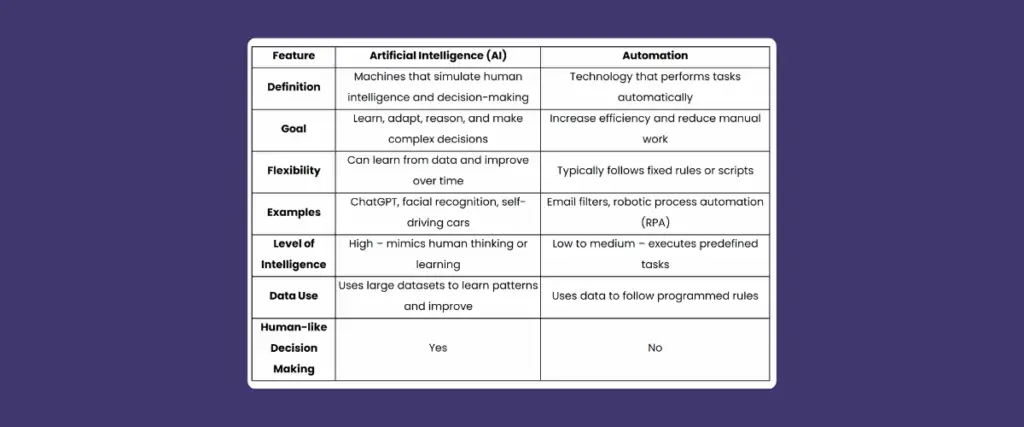
The table below shows the difference between AI and automation, which is vital when working out the best way for organisations to work more effectively with the latest tech available.

Culture and AI
Culture and AI

5. Culture Is a Strategic Asset

There is a brilliant book we recommend called Measure What Matters, by John Doerr which highlights the need for effective measurement.

Being able to understand, measure and infer what current culture is, has been shown to be vital to our clients, because then culture can be harnessed as a strategic asset.

But the key to this is defining what is meant by culture.

Researchers generally agree a strong culture drives retention, engagement and performance which creates a more sustainable competitive advantage, something that AI alone cannot provide.

Companies with a toxic culture can invest heavily in AI and still fail because of the intricacies of implementation and the way that people interact with the AI.

Therefore understanding your current culture is critical to the success of AI utilisation, because whilst AI is a powerful tool it is the workplace culture which decides how wisely and effectively it is used.

To know more about how to increase productivity in your organisation please reach out to us – sam@cortex.clyq.co.uk.

More about Artifical Intelligence

There’s more about Artifical Intelligence in this Think Organisation Post: The Importance of Human Behaviour and Artificial Intelligence.

LINK: https://cortex.clyq.co.uk/the-importance-of-human-behaviour-and-artificial-intelligence/

How To Maximise Your HR Budget & Deliver Goals

Every organisational budget will be feeling the challenge of having to make less into more as taxes and tariffs change. So what should leaders be doing? HR is fundamental to business success but so often is the fire-fighting team who deal with people issues when things go wrong. Instead, HR needs to be involved with the business strategy and feel empowered to be proactive. Ensuring issues are dealt with proactively not reactively.


It is a bit like focusing on the negative when you will make significantly more progress focusing on the positive, and on the strengths which people, teams and organisations already have. By leveraging existing strengths in times of challenge, organisations can become even more successful.


At this time of high pressure on businesses, where HR costs are increasing, now is the time to conduct an HR audit of your business and see where you can reinvest money on the things that matter. Make savings in areas which don’t drive the same value to your employees.


Here are five steps businesses can take to help strengthen their current HR budget:


1. Align HR Goals (and Budget) with Business Strategy

So often HR is missed out when it comes to business strategy and this is a fundamental mistake which never happens in successful sustainable organisations. After all, it is the people which deliver the business strategy and ensure it is a success. So having the right people, in the right place, at the right time with the right resources is crucial. Hence all HR goals need to be aligned with business strategy.


2. Design for Productivity

How an organisation is designed in terms of structures is crucial for productivity. So often businesses morph over time and never take stock of the actual design of the organisation. This means workforce planning is often not optimised and there is wasted people effort, which then leads to confusion and frustration. Have an organisation design review, to ensure all the productivity-enhancing skills and expertise in your organisation are maximised. Helping businesses get more out of existing costs. Ensuring hiring processes are cost effective, and deliver what the business needs ensures productivity can be maintained.


3. Maximise Employee Development

In times of cost cutting business so often cut development and training budgets which harms their productivity and leads to lost talent over time. Investing in high-impact development courses, or executive coaching, is crucial for employees to develop and improve which in turn helps stretch already tight budgets. Linked to HR goals and business strategy it is vital that all development and training delivers ROI. This can include details measures of learning outcomes back in the business to ensure organisations are seeing the change required for the training they invest in.


4. Support Effective Decision-Making

Often in times of turmoil, or cost cutting, organisations can make short term decisions which harm the future growth of organisations. This can lead to longer-term repercussions which then spiral out of control. Making decisions using data and practical insights from the experts, is fundamental to preventing this. A full review of HR metrics such as retention, engagement, absenteeism, promotion ratios, productivity, etc can help provide important insights into how the HR plan can align to the business strategy. HR predictive analytics can help model what could potentially happen which allows evidence based decisions to be made ensuring risk can be managed.


5. Measure what Matters

So often big ticket offers which look good for recruitment don’t always deliver ROI. It is vital to measure what matters when it comes to HR metrics. This ensures business goals are being achieved.

For example, asking how many employees used your EAP per month is really insightful when compared over time, and compared to the cost would single counselling add more benefit depending on the numbers?

It is vital that organisations review everything as a whole, not just in isolation. This is why measuring what matters, and not just what the others measure is crucial for long-term sustainable success.


If you would like a free consultation on how aligned your HR goals are to your business strategy then please reach out – sam@cortex.clyq.co.uk.


More about Change & Transformation

There’s more about Change & Transformation in this Think Organisation Post: Why The Most Successful CEOs Focus on Culture 

Why We Need to Celebrate Cyber Secure Culture

At Think Organisation, we understand that businesses need policies, procedures, processes, and rules to ensure work is delivered consistently and to a high standard. Being cyber secure is vital.


However, we also know that what a business says it does doesn’t always align with what it actually does. Many organisations proudly display awards for culture while struggling with high staff turnover and disengagement. That’s why aligning actions with values is critical, especially when it comes to cyber security.


In our opinion, and despite it being out of our comfort zone for businesses dedicated to building a strong organisational culture, safeguarding operations and data should be as much of a priority as nurturing people. With ever-rising cyber threats, achieving Cyber Essentials accreditation isn’t just a technical necessity—it’s a powerful demonstration of integrity, care, and responsibility.


Aligning Security with Integrity


As Culture Scientists, addressing difficult topics such as feedback or conflict comes naturally to us. Cyber security, on the other hand, is outside our natural expertise. Yet, we recognised that protecting our customers, employees, and community was essential. Currently, 80% of cyber attacks stem from basic, common methods. Ignoring this reality would undermine the trust our clients and partners place in us.


Achieving Cyber Essentials accreditation required stepping out of our comfort zone. We had to invest time and money, learn about areas we weren’t familiar with, and commit to change – all while managing hundreds of clients and growing our business. However, delaying action would have gone against our core values of integrity and excellence. Luckily we had the experts at Linten Technologies to help us make the process easier.


The Business Case for Being Cyber Secure


For organisations like ours, Cyber Essentials isn’t just about preventing attacks; it’s about reinforcing trust. By becoming certified, we:


  • Protect sensitive data and reduce vulnerabilities to common cyber threats.
  • Demonstrate our commitment to safeguarding our employees, clients, and community.
  • Enhance our reputation as a responsible and forward-thinking organisation.
  • Align our actions with our values, ensuring consistency between what we say and what we do.


Cyber Essentials is also a strategic business enabler. Certification is often a requirement for government contracts and partnership opportunities, opening doors that might otherwise remain closed.


A Testament to Commitment


The result? You can search for us and see our Cyber Essentials certificate, knowing that we are doing our utmost to provide a secure environment for everyone we work with. Achieving certification wasn’t easy, but it was necessary. By stepping outside our comfort zone and tackling something new, we’ve strengthened both our business and our commitment to our clients and employees.


For leaders, this is a reminder that protecting your organisation goes beyond traditional priorities. Cyber Essentials isn’t just about IT – it’s about values, trust, and long-term success.


If you need culture experts please reach out, if you need help with your cyber security we recommend Linten.


More about Innovation

There’s more about Innovation in this Think Organisation Post: Why Workplace Culture is More Important than AI


Alternatively, copy and paste this link into your browser: https://cortex.clyq.co.uk/why-workplace-culture-is-more-important-than-ai/

How To Create Sustainable Success: Project Managing Culture

Culture plays a pivotal role in project management, influencing how teams collaborate, communicate, and deliver on objectives. It shapes the working environment and has a direct impact on decision-making processes, team morale, and the overall success of a project. In order to effectively manage projects, it is essential to consider the cultural context within which a team operates.


A few weeks ago, our Co-Founder was invited to host a panel at the UK Construction Week conference in Birmingham. Observing the culture of the businesses exhibiting, it was fascinating to see how behaviours shifted depending on whether leaders were present at their stands.


One stand, in particular, caught our attention. When the leader of the team was present, the stand was immaculate, quiet, and exuded a sense of formality. However, as soon as the leader stepped away, the atmosphere transformed. The staff began laughing, joking, and engaging with visitors in a more relaxed, yet still professional, manner. Like moths to a flame, this more lively energy attracted more foot traffic, and the stand became significantly busier than its competitors. However, when the leader returned, the atmosphere reverted to its original, more sombre and formal tone.


We see this so often with our clients, because it is our job to help clients see the reality of the situation they find themselves in. Think about this example: how does this dynamic manifest back in the organisation? Is there a similar shift in behaviour when leadership is around versus when they aren’t whilst problems are being solved? What does this say about the underlying culture of the business?


Waterfall or Agile Culture

At the same exhibition, during a discussion, the conversation shifted from waterfall project management to agile, exploring whether either, or both approaches were beneficial to organisations. It was an interesting debate, but it quickly became clear that the large construction company in question hadn’t fully considered why they were selecting a particular methodology. They had simply decided they needed to modernise their, in their view, outdated project management techniques – despite these methods having been incredibly successful in the past.


One critical factor they hadn’t considered was the culture of their organisation or of the project team. They had never considered this to be a factor, or as it transpired, the root cause of why their project delivery was starting to falter. So, what happened, and what can we learn from this?


Project Management Culture

There are numerous tools and techniques to deliver projects. Forbes (2024) provides a great high-level overview here but even the most experienced project leads so often forget the most important element of project delivery – the culture of an organisation or the project team.


The culture of an organisation provides the foundation for how projects are managed. Core values, beliefs, and priorities within the organisation influence everything from project objectives to communication styles and risk tolerance. Think Organisation have worked with hierarchical cultures, where decision-making tends to be top-down, with leaders holding most of the authority.


Often decision-making rests in a couple of lead roles, while flatter organisational structures encourage a more participative approach. At times these organisations are smaller, or newer, where team members are empowered to contribute to decisions. Other times they are more matrix-like, however understanding this dynamic is crucial to navigating project leadership successfully.


Cultural norms also play a significant role in shaping team dynamics.


People Dynamics in Projects

Some organisations prioritise collaboration, which results in a greater emphasis on teamwork and open communication. This can be at a deep level, where difficult issues are raised and addressed safely, openly and collectively. Or a more surface level, where people collaborate on the easy stuff, overlooking the more challenging conversations and discussions.


The opposite to this, are more individualistic cultures where there is a higher value placed on personal accountability and independent problem-solving. Additionally, different cultures approach conflict resolution in various ways. New starters can often find joining a new culture difficult if it differs from what they have previously experienced.


Project leaders often focus on encouraging open discussions to resolve disputes, while others may prefer indirect methods to avoid confrontation. The alignment can often underpin the project success.


In addition, leadership styles must also adapt to the cultural context of the team. A directive management approach might be effective in cultures where authority is respected and structure is preferred. Yet, a more inclusive and participative style may work better in cultures that value collective input and shared responsibility.


For project managers working with global or diverse teams, cultural sensitivity is critical to maintaining team cohesion and avoiding potential misunderstandings.


Leadership styles must also adapt to the cultural context of the team. A directive management approach might be effective in cultures where authority is respected and structure is preferred, whilst a more inclusive, participative style may work better in cultures that value collective input and shared responsibility.


Risk & Change Culture

Culture also affects how organisations perceive and manage risks. In some environments, innovation and bold decision-making are encouraged, allowing teams to embrace risk and drive forward with new ideas. In contrast, more risk-averse cultures may require extensive analysis and cautious planning before taking action.


The project manager’s ability to recognise these cultural tendencies will influence their approach to risk management and problem-solving, ensuring that strategies are aligned with the team’s preferences.


Change management is another area where cultural considerations are key. Organisational culture greatly influences how teams respond to change.


In flexible, innovation-driven cultures, change initiatives may be embraced more readily, while more traditional or rigid environments can be resistant to new ways of working. Aligning change programmes with the organisation’s core values can help smooth the process, particularly if those values place importance on employee well-being and/or inclusivity.


Ultimately, cultural alignment has a profound effect on project outcomes. Ignoring cultural factors can lead to misunderstandings, miscommunications, and delays, all of which can jeopardise the success of a project. Conversely, when cultural elements are integrated into the management process, teams are more likely to work harmoniously and deliver high-quality results within set timeframes.


Incorporating culture into project management is not only about recognising and accommodating differences, but also about leveraging the strengths that diversity brings.


By fostering an environment where cultural considerations are at the forefront, project managers can create more cohesive, productive, and engaged teams, ultimately driving project success which creates business success.


More about Innovation

There’s more about Innovation in this Think Organisation Post: Why We Need to Celebrate Cyber Secure Cultures

Alternatively, copy and paste this link into your browser: https://cortex.clyq.co.uk/why-we-need-to-celebrate-cyber-secure-culture/

Staying Ahead of the Game: Top Trends in Work Motivation

How has motivation changed in UK workplaces from 2010s to the 2020s?

In June 2024, two colleagues from the Think Organisation were invited to attend the BPS Occupational Psychology Annual Conference to present their research output from a Decade of Data. As part of this, they shared insights into how motivation has changed across over hundred UK SMEs during the last decade.


With data taken from 2010 to today, spanning eight key topics, the Think Organisation shared the insights gathered from this data to a packed room.


The mission is to understand more about how business leaders can use data to prioritise their leadership focus. So we can have a world where everyone is empower to have better workplaces.


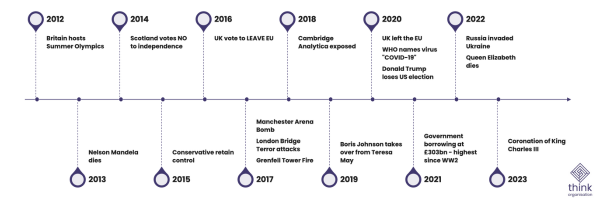
In 2010, when the first data was being gathered, Apple had launched this new technology called the Ipad. This transformed (and founded) the tablet market. Horrific events, such as Deepwater Horizon occurred in the spring of 2010, impacting health and safety at work in far reaching ways. The after effects of the 2008 financial crisis were still impacting the world – especially in Europe.


The trend of well-known household brands disappearing from UK high streets has started, with Woolworths shutting their doors as many more followed throughout the 2010s.


The instability was mirrored in the the political landscape. Gordon Brown was replaced by David Cameron and Nick Clegg in a hung parliament which made way for years of rapid, and frequent political change (Sky News, 2020).


On this backdrop, a Professor from a prestigious University started gathering data from UK SME firms to understand how they were performing against eight fundamental topics, motivation being one of them.


This rich data has provided invaluable insight into how organisational cultures have developed alongside the external changes we have seen over the last decade. Many are summarised below.


What correlations (if any) can be drawn between external changes and internal organisational performance and motivation?

The events highlighted above are a selection of newsworthy items, which may or may not, have influenced the changing course of motivation in the workplace. As discussed in our recent article, motivation is a complex phenomenon which Psychologists have spent years trying to decipher.


General consensus concludes that motivation is a psychological force, defined as ‘the reason, or reasons, why people act or behave in certain ways’. Being able to see how motivation has changed across over a hundred UK companies provides significant insight into changing organisational cultures over the last decade.


So what have we learnt?


Why has motivation hit an all-time low despite basic needs being more met today than in 2010?

Whilst everyone has basic needs, which appear to be being met more today than in 2010 according to some research (BMJ, 2022). Motivation has plummeted to an all time low in hundreds of workplaces across the UK.


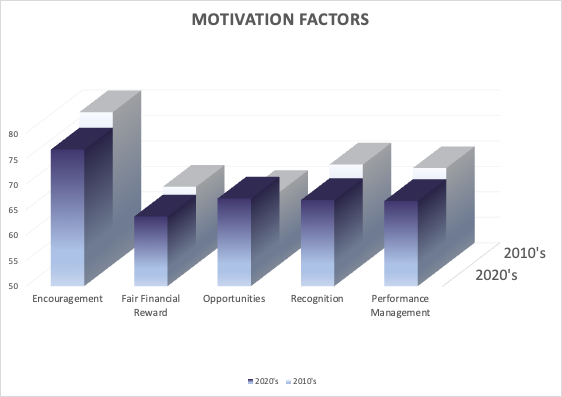
The Think Culture Measure (TCM) uses five factors as a measure of motivation in the workplace. Each of these factors are measured at a strategic, team, individual and actionable level to ensure the results can be triangulated across organisations and factors.


As shown in the graph below, motivation levels have declined significantly from 2010 to the 2020s across all factors, except for opportunities which have fluctuated and now remain slightly higher than in 2010s. Whilst a number of questions make up each of these factors, the data makes for interesting reading. Especially when combined with the external environment that UK SMEs are operating in.


Encouragement drives Motivation – FACT!

Encouragement, done well and at the right time, can provide motivation to anyone. Humans need humans, and when things are difficult the action of giving someone support, confidence or hope, can fuel someone’s effort and bolster their resilience.


In our research, the levels of encouragement in SMEs surveyed was at its highest in 2015 and then hit an all time low by 2021. This contributed to the overall decline in current levels of motivation and was mirrored closely by fluctuations in recognition that employees were receiving.


Fair Financial Reward is VITAL.

In contrast, employee’s perceptions of receiving fair financial rewards has fluctuated significantly throughout the decade. Whilst this metric peaked in 2014, it was at its lowest in 2013 and then rose slowly until reaching its current all time low in the 2020s.


There are many elements which contribute to an employees perception of receiving a fair financial reward so these changes can be anticipated in many organisations.


Performance Management Impacts Motivation.

Performance management, including ensuring employees meet required standards of delivery and behaviour, was at its highest in 2014 across the SMEs surveyed.


By 2022 it was an an all time low, which is no surprise when you consider the landscape and changes in organisations over the last decade. Whilst our research paper (in review) and white paper (in production) do more to outline any potential correlations, it is difficult due to the nature of the data to suggest causation.


How can business leaders use this data to improve motivation in their workplace?

Whilst this research poses more questions it is vital that all leaders are aware of the trends to ensure they are benchmarking current employee engagement and motivation levels.


If levels in your organisation have remain constant then this is cause for celebration, or if the decline has been less severe, as this indicates businesses are improving compared to the overall trends which have been happening over the last decade.


There is a paradox in that current motivation levels are at an all time low, despite research showing basic needs are being met at higher levels, across wider populations than ever before.


Data shows that over the past decade, motivation in UK workplaces has significantly declined, with the Think Organisation’s data showing a downward trend in motivation levels from 2010 to the 2020s. This raises concerns about how low motivation levels impact organisational culture and performance. The UK has been suffering low productivity for years – could this help provide an explanation?


Whilst, encouragement has been identified as a crucial factor in driving motivation, we can see fluctuations in encouragement levels, peaking in 2015 and hitting a low by 2021, have contributed to the overall decline in employee motivation.


To address these challenges, business leaders need to prioritise using data to inform their leadership strategies, ensuring they focus on key areas such as encouragement and fair financial rewards to enhance motivation and employee engagement within their organisations.


Think Performance. Think Excellence. Think Impact.

Check our Insights page for more valuable information.

More about Motivation

There’s more about Motivation in this Think Organisation Post: How Can Leaders Improve Motivation in their Workplace Culture

Alternatively, copy and paste this link into your browser: https://cortex.clyq.co.uk/how-can-leaders-improve-motivation-in-their-workplace-culture/

Adversity – Why Individuals, Teams and Organisations Need Coaching

Overcoming adversity and being resilient are all words which are frequently used in our workplaces today. Many leaders contact Think Organisation asking for training or coaching to help themselves, or their teams, learn how to be more resilient. So, it got us thinking….


What do organisations really need to know about adversity and resilience to help them be more successful?

Adversity is a state or instance of serious or continued difficulty or misfortune. It is something which is based on perception. Perception is the way in which an individual will see, hear or become aware of something through their own senses.


Perception is how an individual understands, regards or interprets a situation, behaviour, object or anything they may meet in this world.


Everyone has different perceptions so what is adversity for one person, may be mundane for another. Time, experience and life impacts our perception.


For one person, overcoming adversity maybe something like being able to get up from the sofa and walk to the shop. For someone else, overcoming adversity may be being able to jump out of a moving plane at 30,000 feet. Another person may find walking into a room of people they don’t know overcoming adversity.


A different person may find having a shower for the first time in four years the most extreme form of adversity they have ever overcome. Whereas, another person may overcome adversity by being brave enough to continue posting on social media, despite negative backlash. It may be that another person finds picking themselves up after they have lost someone they love overcoming adversity.


All of these statements are examples of extreme adversity which someone has shared about how they have overcome adversity.


How do we overcome adversity?

Being able to bounce back, and overcome adversity is called resilience. Resilience is multi-faceted and is never constant.


Googling ‘resilience‘ leads to swathes of training courses claiming to ‘teach you how to focus on the better parts of your life to adapt to tough events‘.


The challenge is that this theoretical training can often intensify issues, especially if not done by a professional (e.g. Psychologist, Counsellor).


Imagine reading a book on how to ride a bike, then being expected to ride a bike straight away. This is part of the challenge. Resilience is not just something you can read about to increase it. In fact, often we see people taking a dip in resilience levels once support is introduced.


Resilience needs to be cultivated, managed and grown because it is a multi-faceted complex concept reliant on many internal and external factors.


It is generally agreed that everyone has a finite capacity for resilience.


A person’s competence, confidence, connections, character, contributions, coping strategies and locus of control can all influence their ability to overcome adversity.


Numerous research studies have shown the ability to overcome adversity leads to better health, mental wellbeing and life satisfaction (Psychology Today, 2020). It is important to note we are talking about adversity, not extreme events which can result in trauma.


Overcoming adversity has the following benefits


  • Problem-Solving Skills are developed as adversity presents an opportunity to think creatively and overcome challenges which wouldn’t normally be presented.
  • Confidence is increased when adversity is conquered, as people gain a sense of accomplishment and belief in their abilities to overcome future obstacles.
  • Emotional intelligence is developed, especially in children, as they learn to recognise their own emotions and empathise with others.
  • Personal Growth arises as individuals step out of their comfort zones, allowing them to learn valuable life lessons and foster a greater sense of self-awareness.
  • Builds stronger relationships as people seek support from friends, family and colleagues, often collaborating to overcome problems and sharing struggles which creates a supportive network.
  • Inspiration grows when adversity is successfully overcome as knowing something had been overcome fuels determination to pursue future endeavours
  • Compassion increases as people who have experienced adversity firsthand can cultivate compassion and empathy toward others facing similar challenges, many people from diverse perspective are united through adversity.


Individuals and Adversity

During a time of adversity it is important to be in the moment, being kind to yourself and trusting your instincts to tell you what you need.


Often people go through stages of shock, emotion, rationalisation, and struggle to gain their thoughts. However, as the adversity subsides, or when you are ready start to think about:


  • What does adversity look like for you?
  • What adversity have you overcome?
  • What did you learn as a result of this?
  • How can you ensure you put these learnings into practice?


Adversity in Teams

At a team level it is important to talk to others, especially as businesses can go through adversity and everyone will have a different perspective.


What one team member may find exciting, another may find worrying or someone else might find terrifying.


Understanding your team members through psychometrics can help speed up this process, and develop deeper understanding between members enhancing the team’s ability to deal with adversity.


Questions to discuss as a team:


  • What does adversity look like for your team?
  • How does your organisation respond to adversity?
  • Is there anything your team can learn from past challenges?
  • How can learnings be shared across teams?


Organisational Adversity

How does our organisation define and perceive adversity, and how does this perception influence our approach to overcoming challenges?


What specific strategies or resources has our organisation utilised in the past to navigate through adversity, and how effective were they?


In what ways can our organisation foster resilience across teams, empowering employees to leverage our collective strengths to better prepare for and respond to future adversities?


Leaders Need to be able to Coach

In today’s dynamic business landscape, the ability to navigate adversity is essential for organisational success.


Understanding and effectively addressing challenges can mean the difference between thriving and merely surviving. Here’s some valuable advice for organisations seeking to enhance their resilience and overcome adversity:


1. Perception Matters: Recognise that adversity is subjective and can vary greatly among individuals. What one person perceives as a significant challenge may not hold the same weight for another. Embrace diverse perspectives within your organisation and consider how different perceptions of adversity may influence your approach to problem-solving and resilience-building.

2. Proactive Planning: Prepare for adversity before it strikes. Develop robust crisis management protocols, establish clear communication channels, and identify key stakeholders who can provide support during challenging times. Proactive planning allows organisations to anticipate potential challenges and respond effectively when adversity arises.

3. Learn from Experience: Reflect on past experiences with adversity and leverage them as learning opportunities. Evaluate the effectiveness of strategies and resources employed in previous challenges, and identify areas for improvement. By learning from experience, organisations can refine their approach to resilience-building and enhance their ability to overcome future obstacles.

4. Foster a Resilient Culture: Cultivate a culture of resilience within your organisation. Encourage open communication, trust, and collaboration among team members. Invest in training and development initiatives that equip employees with the skills and resources needed to cope with adversity. By fostering a resilient culture, organisations can empower their teams to navigate challenges with confidence and adaptability.

5. Leverage Collective Strengths: Recognise that resilience is not just an individual attribute but also a collective strength. Leverage the diverse talents and perspectives within your organisation to develop innovative solutions to complex challenges. Encourage cross-functional collaboration and knowledge-sharing to harness the collective strengths of your team.


Summary

Navigating adversity is a fundamental aspect of organisational success. By embracing diverse perspectives, proactively planning for challenges, learning from experience, fostering a resilient culture, and leveraging collective strengths, organisations can enhance their resilience and overcome adversity with confidence.


If you would like support coaching your team through adversity please reach out and book a free 30-minute consultation with Think Organisation.


Think Performance. Think Excellence. Think Impact.


*All statements about overcoming adversity are based on personal experiences or experience shared by others e.g Jack Nolan.

Check our Insights page for more valuable information.

More about Coaching

There’s more about Coaching in this Think Organisation Post: How to Ensure You Have a Credible Coach


Alternatively, copy and paste this link into your browser: https://cortex.clyq.co.uk/how-to-ensure-you-have-a-credible-coach/


How to create a culture of innovation? 

Last week Steph Durbin – ICF PCC and Sarah Clarke CDir Fellow ABP had the pleasure of attending the Salford Business School Centre for Sustainable Innovation (CSI) launch event and it got us thinking – how do you create a culture of innovation?  

Innovation in business: the ability to conceive, develop, deliver, and scale new products, services, processes and business models for customers 


Some important questions to consider:


1. Can you create a culture of innovation? 

YES. YES. YES  


Many people believe that you cannot create organisational cultures because they evolve over time. Organisational culture is based on the social connections of the people in an organisation, it is a result of the norms, behaviours and ways of working unique to that business, so individuals are always influencing culture.


Using the science of human behaviour you can create a culture which delivers innovation. Just as many leaders unintentionally create cultures which hinder, limit or reduce innovation – often in complete contrast to what they want to enhance.  


2. How do I create a culture that delivers innovation? 

There is no ‘one size fits all’ answer to this question, although there are several principles which can be applied to help create a culture that delivers innovation.


At the event we were privileged to listen to numerous success stories including Arjen Cooper-Rolfe who was an unintentional CEO but led a family business to huge success through purpose-led innovation. So often businesses think they need more people to be more successful. However, this is not the case when you have a skilled leader creating a culture aligned to purpose where idea generation is brought into the everyday life of a business.  


3. Why do I need a Culture of Innovation? 

Because without it you won’t exist. The business resources will get depleted and the business will fail.


Research suggests 65% of children at school now will be applying for jobs which don’t exist yet (British Council, 2018) and in our opinion this is conservative in its estimates. It took the telephone 76 years to reach 100 million users, ChatGPT took 2 months. Speed of innovation is fundamental to the success of businesses.  

Speed: the rate at which something or someone moves or operates at 

Organisations who embrace innovation have at least a 59% higher rate of revenue growth than those that don’t (BCG, 2017), however the rise of unicorn businesses (over USD 1 billion) has increased dramatically in recent years showing the ROI for innovation is limitless. CBInsights, 2022


Innovation: a new or changed entity, realising or redistributing value 


4. So what now?  

The purpose of The Centre for Sustainable Innovation is to provide critical services to the business eco-system.


Bringing academia and businesses together, by providing a platform for industry partners to access cutting-edge knowledge, research, skills and capacity-building workshops to empower businesses to stay ahead of the competition. Much more information can be found here – CSI Website.  


5. What if I don’t have time?  

Often, business leaders are highly time-poor, with multiple pressures coming from all angles, and the day job taking up the majority of time.


Reacting to customers, solving problems, and responding to queries all mount up and it is often difficult ‘to see the wood for the trees’. If you feel like you don’t have time, or don’t even know where to start, we recommend a diagnostic – to give you the data you need to know where to start.


If this could help you, reach out to Think Organisation and we will help you create the time you need to think about innovation.


Think Performance

Think Excellence

Think Impact


Adapted from an article originally published on LinkedIn, January 30th, 2024.

Check our Insights page for more valuable thought leadership.

More about Innovation

There’s more about Innovation in this Think Organisation Post: How to Create Sustainable Success in a Project Managing Culture

Alternatively, copy and paste this link into your browser: https://cortex.clyq.co.uk/how-to-create-sustainable-success-project-managing-culture/
Are you ready to

start your joruney?

Take the first step to transform your workplace.

Call us on 07123 456 789
Email us at sarah@cortexworx.com

© Copyright Cortex Worx LTD. All rights reserved. | Website by Clyq