

How A Growth Mindset Fosters Employee Achievement
Employee engagement and motivation are declining in many organisations, leading to lower achievement, productivity, higher staff turnover, and diminished morale across businesses and the UK. Whilst there are multiple reasons for this, individual mindset is often key. Mindset is a set of attitudes held by someone and is influenced by the environment they find themselves in.
Employee Motivation
The Think Organisation has conducted extensive analysis on employee motivation levels over the last decade across hundreds of SMEs. Motivation, defined as energising behaviour in the pursuit of a goal, is a fundamental interaction of all humans. Yet it is often overlooked, with leaders unsure how they can create an environment to improve motivation.
Extensive research reveals that a lack of achievement and recognition is a major contributing factor to low motivation. Imagine, working hard but not seeing any results from your efforts. When individuals feel that their contributions are meaningful and recognised, they are more engaged, motivated, and committed to their work.
By understanding the psychology behind achievement and success, businesses can create environments where employees thrive and businesses succeed.
A clear sense of purpose is crucial to workplace engagement. Employees who understand how their roles contribute to the wider mission of the organisation will feel a great sense of belonging and significance.
This results in more proactive behaviour, resilience and higher levels of performance. In fact, people who find meaning in their work experience greater job satisfaction and significantly lower negative stress levels.
Intrinsic Motivation
Ensuring intrinsic motivation (driven from within), instead of extrinsic motivation (driven from external rewards) benefits both employees, teams and organisations as well as society as a whole. So how can psychology help with this?
Psychology is the science of human behaviour, based on years of extensive research, it seeks to explain how and why humans behave as they do.
The feeling of success is deeply embedded in human psychology. Achievement activates the brain’s reward system, releasing dopamine (a neurotransmitter associated with pleasure, motivation, and reinforcement). This neurological response encourages individuals to set and pursue further goals, creating a continuous cycle of engagement and accomplishment. Equally, when people are not feeling a sense of achievement, this can cause a negative spiral as less dopamine is released.
Maslow
Psychological theories also highlight the importance of achievement in maintaining motivation.
Maslow’s Hierarchy of Needs identifies self-actualisation (which is the realisation of personal potential) as a key driver of fulfilment.
Humans have basic needs first, food, shelter and survival and won’t focus on much else until this has been achieved. Then, humans move to focusing on relationships and more ‘nice to haves’ which build on meeting the survival needs as they develop to focus on their own personal development and achieving their potential.
In reality, these stages merge across time and situations, however it is a great model for leaders to understand where their employees may be. Employees struggling to make enough money to pay their rent are unlikely to want to focus on development and going the extra mile due to their economic concerns.
Deci and Ryan
Another theory, Deci and Ryan’s Self-Determination Theory emphasises autonomy, competence, and relatedness as critical components of motivation.
Employees who feel in control of their work, believe in their capabilities, and experience meaningful workplace relationships are much more likely to be engaged and committed to both their role and their organisation.
Humans need each component to varying levels but all humans need an element of each of the components.
Reward & Recognition
In reality, achievement in the workplace should not be defined solely by promotions or financial incentives. While these are important, true engagement comes from recognising progress, celebrating small wins, and valuing contributions that align with personal and organisational goals.
One client found that the performance of their highest achiever had started to decline over many months, and the reasons were linked to how the organisation publicly celebrated success in front of everyone. On so many levels the employee, and the organisation, behaved in intrinsic ways which once understood by a psychologist meant this person soon became the highest performer again, beating records monthly and inspiring others to do the same.
Employees thrive when they see tangible results from their efforts. Regular feedback, goal-setting, and recognition help reinforce a culture of achievement. When employees feel that their work makes a difference, they are more likely to be motivated, productive, and committed to long-term success.
Cultivating a culture where achievement is acknowledged and valued, organisations can help employees overcome barriers to engagement. Life often throws challenges at people, which will affect motivation, however, a supportive, dynamic and successful organisation will help support individuals and teams, which ensures high performance is non-negotiable for all. Transparency, consistency and fairness are key.
Growth or Fixed Mindset
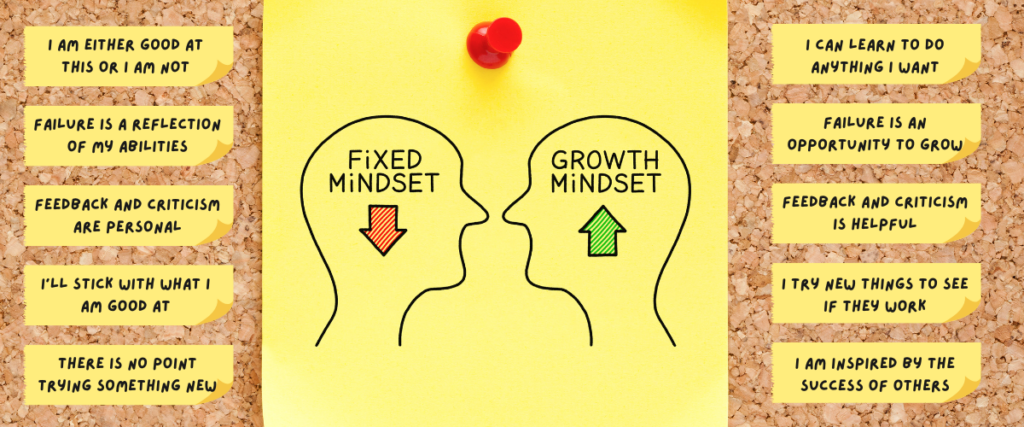
Humans tend to have preferences of either a growth or fixed mindset.
Various factors can impact whether people are facing a problem or situation with a growth or fixed mindset, and leaders who can coach people to a growth mindset have much higher performing teams.
A growth mindset is the belief that abilities and intelligence can be developed through effort. Employees with a growth mindset embrace challenges, seek feedback and remain open to learning opportunities, compared with employees who have a fixed mindset.
A fixed mindset tends to think abilities are unchangeable and innate, and that success can be attributed to individual effort and control. This approach tends to limit personal growth, and organisational performance.
So how can leaders help coach and shift employee mindsets towards a more growth-focused mindset and encourage employees to have a sense of achievement?
1. Understand the Difference Between Fixed & Growth Mindset
Often understanding how these mindsets differ, and that they do exist, can be enough to help people challenge their own assumptions and beliefs.
Using real-world examples to illustrate the impact of each mindset can be invaluable in helping individuals understand their preferences and predispositions.
To do this, at times, the professionals may be needed for stage 2.
2. Reframe Challenges as Opportunities
Encouraging self-reflection can often be easier said than done, and many employees have negative thought patterns contributing to their mindsets.
Leaders, whilst responsible for performance, are often not equipped with the tools needed to help challenge limiting beliefs, and nor would it be ethical for them to try, however, highlighting how their own experience has shifted in light of changing their beliefs can provide insight and encouragement for others to self-reflect.
Coaching questions such as ‘What evidence do you have that this is true?’ or discussions about changes to beliefs and opinions can be invaluable.
Being able to face challenges as positive opportunities can help shift existing belief patterns, however, to address more ingrained beliefs, we’d recommend getting in a professional coach.
3. Encourage an Effort Mindset
Create an environment where people reinforce the fact success comes from persistence, learning and hard work.
Celebrate efforts, rather than just achievement, and support people to make progress and develop – rather than just deliver results.
Don’t have a culture that just focuses on people who ‘can‘ do things and people who ‘can’t’ as many clients pigeonhole employees without having any real evidence or performance measures based on their own perceptions.
Sharing stories of success, and modelling behaviour of how to learn from challenges and develop is key to helping encourage an effort-focused environment and mindset.
4. Cultivate Self-Compassion & Resilience
Many people struggle to practice self-compassion as they have an inner critic of a voice which can often spiral into negative self-talk.
Being compassionate, both to ourselves and others is key, as often we don’t give ourselves the same compassion we would a friend who is struggling or feeling badly about themselves.
Being able to relate to ourselves, and aware of how our own hurtful thoughts and emotions may hinder our performance or impact the reality of situations is crucial.
Kirsten Neff (2003) has loads of helpful resources to support this journey at an individual level and you can measure self-compassion here.
5. Set SMART/OKR Goals & Objectives
Often we have large goals which are difficult to manage or complete, and often cause overwhelm.
One client had the goal of ‘impact 1 million people‘ when their reach was limited to a few thousand.
No one really knew how to achieve this, so it became an underground joke every year they missed their target.
Breaking goals or objectives into measurable steps is key.
These can be SMART or OKRs, or something else that suits your organisation.
SMART goals are: Specific, Measurable, Achievable, Relevant, and Time-bound, which helps maintain motivation and provides a sense of achievement as progress is made towards the larger goals.
OKRs, are Objectives and Key Results. This is where there is alignment between goals and ‘what you want to achieve’ and key results, which are outcomes which indicate progress towards achieving the objective.
More support can be found here on OKRs.
Summary
These steps are not exhaustive but have been proven to help improve a sense of achievement, using the growth mindset approach.
Understanding the psychological aspects of success enables leaders to create a work environment that nurtures motivation. Recognising employees’ efforts, providing growth opportunities, and fostering a culture of continuous learning all contribute to sustained engagement and well-being.
To discuss in more detail, please reach out to us.
More about Motivation
| There’s more about Workplace Psychology in this Think Organisation Post: How to Understand Frustration at Work Alternatively, copy and paste this link into your browser: https://cortex.clyq.co.uk/struggling-at-work-heres-how-to-understand-your-frustration/ |