

Tag Archive for: performance

Transform Culture To Unleash Peak Performance

In the fast-paced world of business, where every decision impacts the bottom line, organisational culture emerges as a pivotal force, it can either propel a company to new heights or impede its progress.


How do leaders ensure an organisational culture drives peak performance?


At Think Organisation, we don’t just recognise the importance of organisational culture; we specialise in transforming it to unlock peak performance.


Our approach is not just intuitive; it’s backed by science and evidence-based interventions that deliver measurable impacts on business, productivity, and profit. 


The Power of Organisational Culture

Organisational culture isn’t just a buzzword; it’s a game-changer.


Over recent years the number of business leaders referring to culture has increased exponentially, with publications increasing in leading business publications.
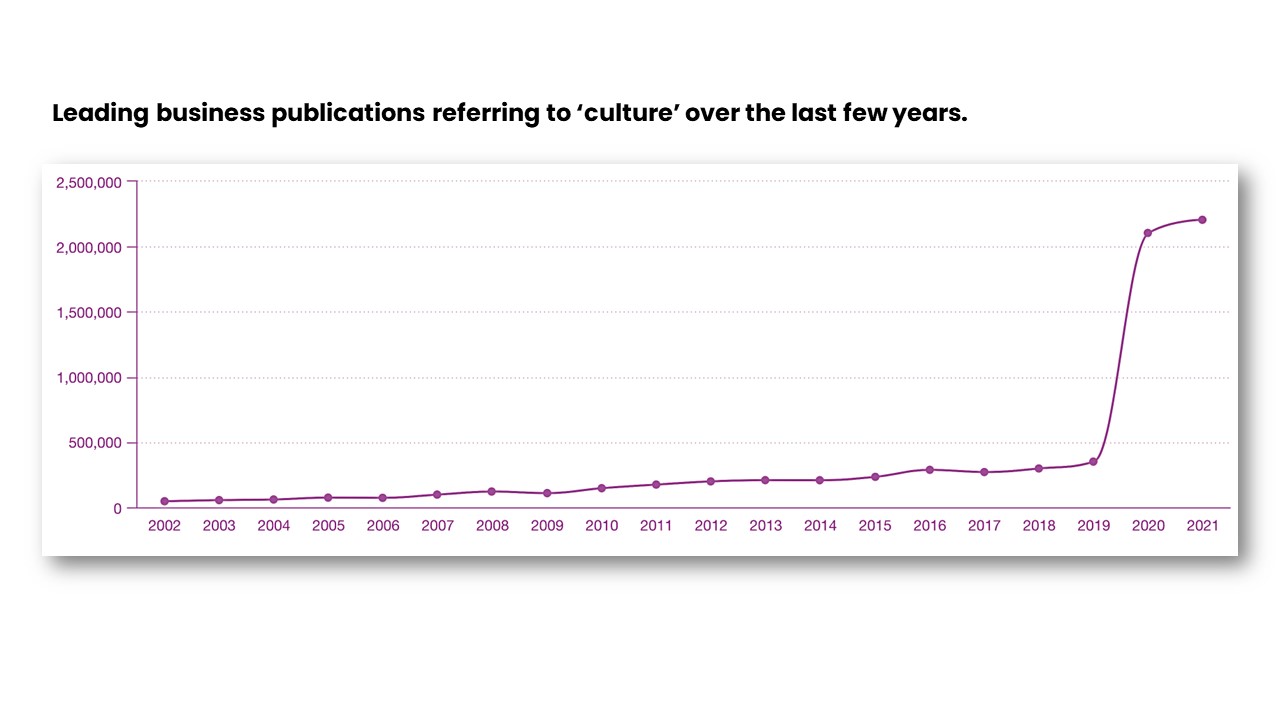
Leading business publications referring to 'culture' over the last few years. According to a study by Deloitte (2019), 94% of executives and 88% of employees believe a distinct workplace culture is crucial for business success. This increased significantly during the pandemic, where a sense of belonging became more important during remote working.

Belonging in the workplace is where an individual feels accepted, or even treasured, for their uniqueness.


A sense of belonging is one of the top three reasons employees give for leaving an employer, despite employers not quoting this in their top ten reasons why people leave (BPW, 2020). This research is supported further by BreathHR (2021), whose data showed almost a third of people are quitting their jobs due to poor workplace culture. The cost of this is currently estimated at £23.6bn every year.  


How can Think Organisation help transform your culture?

Our team at Think Organisation boasts a rare blend of skills, combining advanced knowledge in business psychology with a profound understanding of Organisational Culture.


According to a report by Harvard Business School, companies with a strong and adaptive culture show a 4x increase in revenue growth. Our unique expertise positions us as architects of culture, dedicated to reshaping and revitalising your organisation for sustained success. We use a wide selection of interventions including workshops, executive and CBT coaching, psychometric measures, surveys and behavioural observations.


The Science Behind Our Culture Interventions

What sets Think Organisation apart is our commitment to evidence-based interventions. According to a survey by the Great Place to Work Institute, companies with a strong workplace culture see a 65% decrease in employee turnover. Our strategies are not just theories; they are rooted in the latest advancements in Business Psychology and Organisational Science, ensuring we partner with you to create a workplace that attracts and retains top talent. 


Proven Results

Our interventions are not mere conjectures; they yield tangible, measurable results. A study by Gallup found that companies with engaged employees outperform their counterparts by 202% in terms of profitability. Our clients witness a more engaged, innovative, and resilient leadership team, leading to a positive impact on the bottom line.  


Building a Culture of Excellence

At Think Organisation, we partner with your leadership team, to build a culture of excellence within your company. Research shows that companies with a strong culture see at least a 20% increase in productivity.


Our interventions are designed to align seamlessly with your organisation’s goals and existing culture, ensuring a harmonious transformation that positively impacts productivity and efficiency.


Recent clients have enjoyed in excess of 400% ROI, due to significant productivity gains, and sustainable improvements including higher employee engagement (e.g. NPS) and lower costs (e.g. sickness).  


Develop Continuous Learning for Sustainable Growth

Organisational dynamics evolve, and so should strategies for success. A study by the Boston Consulting Group found that organisations with a continuous learning culture have a 37% higher employee productivity rate.


Our commitment to continuous learning ensures that our interventions are adaptive and future-proof, setting the stage for sustained growth and resilience in the face of change. 


Why choose the Think Organisation? 

  • Specialised Expertise:
    • Our team brings a depth of knowledge in Business Psychology and Organisational Culture, offering a perspective that goes deeper than the surface. 
  • Proven Methods:
    • Our interventions are grounded in evidence-based practices, ensuring that every step we take is backed by science. 
  • Transformational Approach
    • We don’t settle for incremental change; we drive transformation that reshapes Organisational Culture from its core. 
  • Measurable Impact:
    • Our results speak for themselves, with improvements in performance metrics, profitability, and a more robust, engaged leadership team. 


In conclusion, if you’re looking to elevate your organisation to new heights and witness tangible impacts on productivity and profit, Think Organisation is your partner in transformative success.


At Think Organisation, we architect cultures that embody professionalism, excellence and resilience. Our methodology is bespoke, evidence-driven, and anchored in executive pragmatism, aligning closely with your company’s aspirations.  


In the meantime, here are five top tips that you can focus on in any organisation to improve organisational culture and deliver peak performance.


Top five strategies to improve culture


1. Improve your communication

Foster open and transparent communication channels with others and across the organisation. Start with your own behaviour. Encourage regular dialogue between leadership and employees, promoting a culture of trust and collaboration. Effective communication ensures that everyone is aligned with the company’s goals and values, fostering a sense of belonging and purpose. Ensure employees feel psychologically safe asking questions, making suggestions and sharing ideas through authentic encouragement.


2. Relevant recognition and rewards

This does not have to cost anything, saying thank you is free. Implementing a culture of recognition and appreciation to acknowledge employees’ contributions and achievements is fundamental. Being consistent, fair and transparent is key. Tailoring recognition and rewards to individuals helps drive a high-performance culture. Simple gestures such as expressing gratitude, providing praise in public if suited to the individual, or celebrating milestones can boost morale, motivation, and overall job satisfaction. Employees who feel valued and feel they are a part of their culture are proven to lead to improved performance.


3. Employee Development

Empowering employees to develop increases employee tenure. Invest in employee development and growth opportunities. Provide training, mentorship programs, and skill-building workshops to empower employees to reach their full potential. Supporting professional growth not only enhances individual performance but also strengthens the overall organisational capacity and resilience.


4. Empowerment & Autonomy

Delegate responsibility and empower employees to make decisions autonomously within their roles. Encourage innovation, creativity, and problem-solving by granting individuals the freedom to experiment and take ownership of their work. Empowered employees feel valued and engaged, leading to increased productivity and initiative.


5. Foster a positive work environment

Cultivate a positive and inclusive work environment where employees feel safe, respected, and valued. Support employees to have a positive work-life balance, flexibility, and promote well-being initiatives proven to support employees’ holistic needs. This does not just mean yoga at lunch! A positive workplace culture enhances morale, reduces stress, and fosters stronger interpersonal relationships, ultimately driving peak performance.


By prioritising these strategies, leaders can effectively improve organisational culture and drive peak performance without incurring significant costs. These initiatives not only benefit employees but also contribute to long-term organisational success and sustainability.


Think Performance. Think Excellence. Think Impact. 


Adapted from an article originally published Linked In, December 4th, 2023.

More about Culture

There’s more about Culture in this Think Organisation Post: Toxic Cultures : Behaviour is at the heart of scandal and failure

Alternatively, copy and paste this link into your browser: https://cortex.clyq.co.uk/toxic-culture-behaviour-is-at-the-heart-of-scandal-failure/

Is your toxic culture affecting your well-being?

We have all been there when we start a new job. The organisation described the culture as ‘welcoming, ethical and focused on equality for all’ to recruits. However, the traditions, behaviours and attitudes of the leadership quickly showed this was the ‘wallpaper’ covering an old, unfair and highly sexist business culture.


The data would show new recruits leaving within 6-18 months, as the long-serving employees lived in their echo-chamber which reinforced their view of the world.

In this example, this culture was not 100% toxic. It was unfair, masculine, and sexist. High performance was measured by hours at your desk, your ability to keep your head below the parapet, and where long service was the definition of success. If you were there for over five years you may even get rewarded with a car parking space!  

Toxic: very harmful, poisonous or unpleasant in a pervasive or insidious way.  

The BBC wrote an article recently saying many people used the word toxic to describe cultures which they didn’t like. An example was when employees have high levels of work with tight deadlines (How every workplace is toxic – BBC, 2023).

From our experience whether you have a toxic culture is not a yes or no answer. There are degrees of toxicity, which might alter in different situations, different people and different challenges.

Toxicity: the quality of being very harmful, poisonous or unpleasant in a pervasive or insidious way.  

At Think Organisation our team has worked for more than 25 years with over 150 organisations, across 30 industries. From our research and experience, there is a definite ‘degree of toxicity’ in workplace cultures. This toxicity can vary in strength across teams, levels, or locations.


Does it matter if our culture is highly toxic?

Yes.

Organisations need to be sustainable, which includes protecting people, planet and delivering profit.

Currently, toxic cultures are costing the UK economy over £20.2 billion per year (Workplace Insight, 2022). With the surge in recent mental health concerns expected to cost the UK economy £66bn per year by 2030, it is vital organisations understand and improve their cultures.

Especially in terms of the levels of toxicity which may exist.


How can we afford not to measure culture toxicity?  

As many people will have experienced what you see on the outside of an organisation is not always the same as on the inside.

Often, the visibility into the organisational culture is murky. Leadership teams are unable or unqualified to measure and diagnose the toxicity levels.

Over the years Think Organisation has been working with many organisations to help them measure, understand and improve their cultures, driving peak performance.


How do I measure our culture?

Like a toxic gas, which we can’t see or smell, it is often difficult for someone internal to measure and understand the culture. Due to the complex nature of culture, it is also vital that the culture is measured using a reliable, accurate and valid tool. In recent years, the biggest change is the visibility of organisational cultures. People can share online their thoughts, experiences and opinions about organisations. These reviews are reaching huge audiences on a scale which was not available a few years ago.

The advent of Glassdoor in 2008 provides uncensored insight into companies which is often invaluable for people thinking about joining a new company. But then how do you know the information is accurate? It is true that the motivations of people who write many reviews need to be understood. And when this data is used in conjunction with other metrics (e.g. turnover, sickness, current employee thoughts, feelings & behaviours) it can provide the first opportunity to clear the murky waters of culture and understand what it is truly like to work in that organisation.

The key is the measurement, which currently is still very much in its infancy, so like using a ruler made of elastic the results can vary greatly depending on who measured them, when and why. This is where a professional, independent team can add real value. Measuring the culture is always the first step, but you need experts to help you interpret the result and plan a strategy for improvements.


So how does my organisation start to understand the culture toxicity levels? 


Firstly, it depends on your organisation.

Its age, size, industry and trajectory as to which measure is recommended. Science-backed metrics show that, based on academic research, there are many degrees of toxicity. Think about national scandals (e.g. the UK Government during COVID-19, or the Post Office), they either never measured the culture toxicity or if they did, the measures they used appeared to show there were no issues. This was not the case.   


Secondly, there is a journey to a toxic culture.

Organisations may be in the early stages, or somewhere along the continuum, whereas others we would classify as endemic. Many stories in the media could have been avoided if the organisations in question had measured, and gained insight into their organisational cultures. For example, toxicity can be across all levels of an organisation, impacting a high percentage of the employee population. In other organisations, there could be low levels of toxicity across the organisation, with one or two pockets of high toxicity. Until you undertake diagnosis it is impossible to narrow down the measure required, let alone design an effective and commercially feasible solution.  


Thirdly, some areas of toxicity can be more poisonous than others.

Sexual misconduct or racism are poisonous. Imagine different types of gases have different impacts on you. Helium can create high voices, and be funny, in small amounts. Large amounts can stop your breathing and cause death.

There are highly poisonous cultures that can alienate people, causing physical and mental harm. Other areas may impact everyone e.g. disrespect or gossip, and the poison can build over time. Yet in small doses, they have no immediate or significant impact. Like toxic gas which fills the room, the level could be very low, but time spent in the room could lead to physical and mental impacts over time.  


Fourthly, and somewhat controversially, in our opinion 99.9% of the time it is not the Manager’s fault.

Many organisations turn to management training in the hope of changing cultures, this is like opening a window to let some gas out whilst the gas is still pumping into the room. The intervention may help but it won’t solve the problem.

Take a founder we worked with, in the eyes of their employees, they were a bully. The behaviours they showed ticked every box on the bullying list. However, when we worked with them closely, it quickly became apparent they didn’t ‘intend’ or ‘decide’ to be this way. They just didn’t know another way. Their biggest fear was the company not being successful, which ironically led to such detrimental, divisive, and negative behaviours.  


Finally, there are always small, subtle or invisible signs that suggest an organisation is developing issues.

Having an expert to help you understand these issues, like the gas reader which beeps when gas toxicity is high. It is always easier to deal with cultures with low levels of toxicity, and no culture is perfect. Issues often build, compound and escalate to create high levels of toxicity. Using psychometric measures, employee surveys, observations, focus groups, data analysis and psychological observation helps our experts truly understand an organisation’s current culture. However, there are some indicators that anyone can look out for.   


Key indicators which may be signs there is an issue with your organisational culture  


  1. Does your organisation ‘seem nice’ on the surface, with benefits, but then the undercurrent is somewhat different?  
  2. Do people get treated differently? Is there a crowd of ‘favourites’ who get preferential treatment? Or a crowd who gets detrimental treatment?  
  3. Are there multiple decisions made which seem to benefit individuals and not the business or organisation?  
  4. Do people justify their behaviour? Blame others? Or always have reasons why they haven’t delivered what they said they would? Or do people avoid committing to deliver anything?  
  5. Do you trust what the leaders/managers say to you? Or is the gossip more accurate than the official information communicated?  


We recommend you individually think about these questions first. Then discuss them with your manager, leader or founder.


Remember this is about people’s perceptions so there is no right or wrong answer, the important activity is to start the discussion across your leadership teams. 


Frequently Asked Questions

How can an organisation accurately measure the degree of toxicity in its culture?


To accurately measure the degree of toxicity in its culture, an organisation can utilise science-backed metrics aligned with academic research. These metrics should consider various aspects of the workplace, such as employee turnover, sickness rates, current employee sentiments, behaviours, and feelings. Additionally, tools like employee surveys, observations, focus groups, and psychometric measures can provide valuable insights into the organisation’s culture.


What are the early signs or indicators that an organisational culture may be developing toxicity?


Early signs or indicators that an organisational culture may be developing toxicity include subtle changes in behaviour and communication patterns. For instance, underlying issues can be indicated by discrepancies between the organisation’s stated values and the actual behaviours of its leaders and employees.


Other signs may include favouritism, frequent blaming or justification of behaviours, lack of trust in leadership, and a tendency to prioritise individual interests over organisational goals.


What strategies or interventions can be implemented to address toxic organisational cultures, particularly when it may not solely be attributed to managerial behaviour?


One approach is to promote open communication channels where employees feel safe to voice their concerns and provide feedback. Additionally, fostering a culture of accountability and transparency can help mitigate toxic behaviours. Investing in training programs focused on empathy, conflict resolution, and diversity and inclusion can also contribute to creating a healthier work environment.


Establishing clear policies and procedures for addressing misconduct and providing support for affected employees are essential steps in combating toxicity within the organisation.


Adapted from an article originally published on Linked In, December 3rd 2023.

More about Culture

There’s more about Culture in this Think Organisation Post: 5 Steps to Fix a Toxic Culture


Alternatively, copy and paste this link into your browser: https://cortex.clyq.co.uk/five-steps-to-fix-a-toxic-culture/


How to create a culture of innovation? 

Last week Steph Durbin – ICF PCC and Sarah Clarke CDir Fellow ABP had the pleasure of attending the Salford Business School Centre for Sustainable Innovation (CSI) launch event and it got us thinking – how do you create a culture of innovation?  

Innovation in business: the ability to conceive, develop, deliver, and scale new products, services, processes and business models for customers 


Some important questions to consider:


1. Can you create a culture of innovation? 

YES. YES. YES  


Many people believe that you cannot create organisational cultures because they evolve over time. Organisational culture is based on the social connections of the people in an organisation, it is a result of the norms, behaviours and ways of working unique to that business, so individuals are always influencing culture.


Using the science of human behaviour you can create a culture which delivers innovation. Just as many leaders unintentionally create cultures which hinder, limit or reduce innovation – often in complete contrast to what they want to enhance.  


2. How do I create a culture that delivers innovation? 

There is no ‘one size fits all’ answer to this question, although there are several principles which can be applied to help create a culture that delivers innovation.


At the event we were privileged to listen to numerous success stories including Arjen Cooper-Rolfe who was an unintentional CEO but led a family business to huge success through purpose-led innovation. So often businesses think they need more people to be more successful. However, this is not the case when you have a skilled leader creating a culture aligned to purpose where idea generation is brought into the everyday life of a business.  


3. Why do I need a Culture of Innovation? 

Because without it you won’t exist. The business resources will get depleted and the business will fail.


Research suggests 65% of children at school now will be applying for jobs which don’t exist yet (British Council, 2018) and in our opinion this is conservative in its estimates. It took the telephone 76 years to reach 100 million users, ChatGPT took 2 months. Speed of innovation is fundamental to the success of businesses.  

Speed: the rate at which something or someone moves or operates at 

Organisations who embrace innovation have at least a 59% higher rate of revenue growth than those that don’t (BCG, 2017), however the rise of unicorn businesses (over USD 1 billion) has increased dramatically in recent years showing the ROI for innovation is limitless. CBInsights, 2022


Innovation: a new or changed entity, realising or redistributing value 


4. So what now?  

The purpose of The Centre for Sustainable Innovation is to provide critical services to the business eco-system.


Bringing academia and businesses together, by providing a platform for industry partners to access cutting-edge knowledge, research, skills and capacity-building workshops to empower businesses to stay ahead of the competition. Much more information can be found here – CSI Website.  


5. What if I don’t have time?  

Often, business leaders are highly time-poor, with multiple pressures coming from all angles, and the day job taking up the majority of time.


Reacting to customers, solving problems, and responding to queries all mount up and it is often difficult ‘to see the wood for the trees’. If you feel like you don’t have time, or don’t even know where to start, we recommend a diagnostic – to give you the data you need to know where to start.


If this could help you, reach out to Think Organisation and we will help you create the time you need to think about innovation.


Think Performance

Think Excellence

Think Impact


Adapted from an article originally published on LinkedIn, January 30th, 2024.

Check our Insights page for more valuable thought leadership.

More about Innovation

There’s more about Innovation in this Think Organisation Post: How to Create Sustainable Success in a Project Managing Culture

Alternatively, copy and paste this link into your browser: https://cortex.clyq.co.uk/how-to-create-sustainable-success-project-managing-culture/
Are you ready to

start your joruney?

Take the first step to transform your workplace.

Call us on 07123 456 789
Email us at sarah@cortexworx.com

© Copyright Cortex Worx LTD. All rights reserved. | Website by Clyq