The news is full of stories about toxic culture. Toxic cultures have contributed to financial collapses, personal scandals and reputational downfalls. From politics to business to public institutions, the number of examples seems to be growing exponentially.
Whether it is politicians abusing power, corporate leaders chasing profit at all costs or charities losing the trust of the very communities they serve, culture is the term many would use to describe the cause of the crisis. But does this description add value?
Does Culture Eat Strategy for Breakfast?
It’s often said that “culture eats strategy for breakfast” but is this really true? Despite the endless discussions of whether Peter Drucker actually said this, or if he did has it been interpreted how he intended? It is a prime example of the impact culture can have on how information is interpreted.
A bold plan, a strong financial model, or even the most talented leadership team cannot survive long in the shadow of a toxic workplace culture. If behaviours are unchecked, if voices are silenced, and if the pursuit of short-term gains overrides long-term purpose, failure is only a matter of time. How visible this is internally versus externally is also on the clock in terms of exposure, that and the investment in a good marketing team.
So What Are The Warning Signs of a Toxic Culture?
Toxicity rarely happens overnight. And we have yet to meet a leader who deliberately designed a toxic culture.
It creeps in slowly, often disguised as “high performance” or “efficiency” and is often an indirect result of misaligned goals, metrics or increasing pressure being place on people.
Warning signs can include:
Fear & Silence – where employees stop raising concerns or ideas, and conversations become hidden or none existent.
A Hero Culture – where success become tied to specific individuals, as opposed to teams
Blame Becomes A Game – mistakes become hidden, or deflected, and people are worried about what others think
Misaligned Values – values may not exist or be stated, or if they are then which is said publicly doesn’t match daily behaviours
Wellbeing Washing – pressure, burnout and high staff churn could be seen as ‘normal’ and wellbeing isn’t a priority
This list is not exhaustive, and often toxic cultures can look positive on the outside, but not truly live and breath these behaviours in reality. When these behaviours become embedded, accountability disappears and poor decisions are rationalised, hidden or just become part of the expectations.
The cost of a toxic culture can be huge, both in terms of negative PR and brand image, and the lost employee productivity. Because a toxic culture doesn’t just damage staff morale, it destroys value.
A toxic culture leads to higher turnover, spiralling sickness costs, disengagement, customer mistrust, regulatory fines, and, ultimately, reputational collapse.
For leaders, ignoring cultural red flags is no longer an option. Regulators, investors, and the public are scrutinising culture like never before and the pressure is mounting.
So How Do We Build Healthy & Resilient Cultures?
The good news is that cultures can always be shifted. Sometimes quickly, other times more slowly. This can be done by leaders who take tangible steps to rebuild trust and create healthy workplaces where people – and businesses – thrive.
Key actions often include:
1. Starting with a purpose – because it is vital to reconnect everyone to the “why” behind the organisation
2. Modelling the behaviour you expect – people follow people, and this is where leadership authenticity sets the tone
3. Create psychological safety – encourage employees to speak up, be open to feedback and understanding reality
4. Listen and act on feedback – show that raising concerns leads to change, don’t penalise people for being honest
5. Measure what matters – track engagement, wellbeing, trust and psychological safety alongside financial metrics
6. Recognise and reward the right behaviours – culture is reinforced by what is celebrated and promoted
Whilst toxic cultures may dominate many headlines currently they don’t have to dominate workplaces.
Organisations that choose to prioritise culture alongside performance will not only avoid the scandals we see in the news, but they will also build stronger, more resilient businesses where people genuinely want to contribute and grow and bottom lines benefit.
If you would like to measure your culture please reach out.
More about Culture
There’s more about Culture in this Think Organisation Post: Conscious Competence
https://cortex.clyq.co.uk/wp-content/uploads/Think-Blog-Images-3.png5001200Sarah Clarkehttps://cortex.clyq.co.uk/wp-content/uploads/Miscellaneous-Logo.pngSarah Clarke2025-10-20 11:55:522025-10-21 13:13:06Toxic Culture : Behaviour Is At The Heart of Scandal & Failure
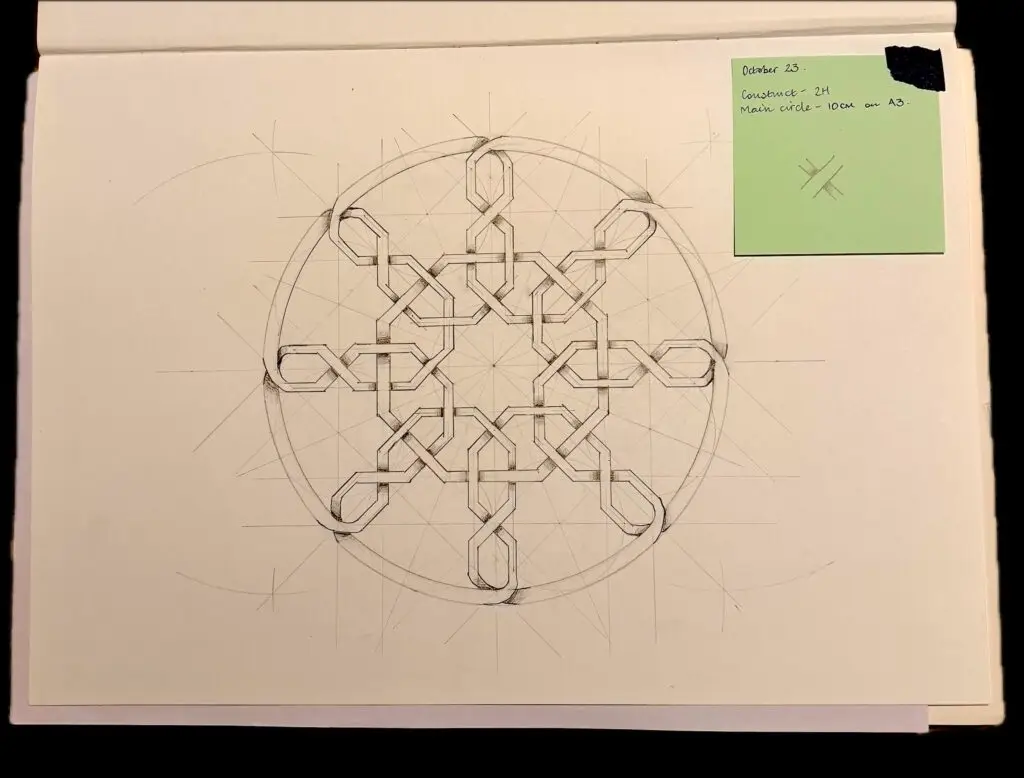
The other week, our Co-Founder Sarah joined the amazing Emma Semper on one of her upholstery crafting workshops, where she learnt how to upholster her very own noticeboard. For those of you who haven’t met Sarah, she is not someone who would naturally call herself creative, especially compared to Steph’s awesome upholstery and craft talents – as shown below, her newest hobby of geometric art using only a compass, a ruler, and a pencil – something she created and built one afternoon.
Crafting Geometric Art
Anyway, back to the point. Here at Think we are often extremely busy, and this can make it difficult to find time to slow down, especially when you throw in all the outside work commitments as well.
In fact, many of us are seeking ways to slow down, reconnect with ourselves, and protect our mental health. Whilst many of us turn to doom scrolling our phone, reading or watching short videos to turn off our mind, in reality, these could be having negative impacts.
Which is why one surprisingly powerful yet often overlooked tool is crafting.
Whether that is knitting, painting, woodworking, sewing, pottery, upholstery, leatherwork or any creative activity done with your hands.
Crafting isn’t just a hobby; it’s a form of therapy.
Research has consistently shown that engaging in creative activities can lead to reduced stress, improved mood, increased cognitive function, and even physical health benefits. Over ten years ago, a study by the American Journal of Public Health concluded that arts engagement is linked to better emotional resilience, reduced anxiety, and an enhanced sense of purpose.
During lockdown, Sarah organised an online event for over 100 employees to undertake some painting led by an artist. The feedback was amazing, and due to the success of the painting experience, a couple of people continue this craft to this day.
So here is some insight into why crafting can be so powerful for your health and wellbeing:
1. Crafting is Mindfulness in Action
Crafting draws you into the present moment.
Whether you’re looking for a number on paint by numbers, choosing a colour, threading a needle or shaping clay, you naturally focus on the task at hand. This gives your mind a break from the constant buzz of worries and future plans.
As Psychologists, we can call this a “flow” state. You will have heard people say, ‘I don’t know where the time went’, or ‘I just got into the flow and then suddenly it was done’. Csikszentmihalyi (1990) explains this in more detail in his book, as when you are fully immersed in an activity, or a state of flow, it is linked to greater happiness and lower rates of depression.
The key with crafting is to find a craft which gets you into that state of flow, not one that completely frustrates you. Enjoyment is vital.
2. Building Confidence and Achievement
Completing a project, no matter how small, gives a tangible sense of achievement. These little wins accumulate, boosting self-esteem and reminding us that we are capable of creating something meaningful. This can be especially powerful for individuals managing long-term stress, anxiety, or burnout.
Crafting provides this achievement, and the majority of crafts are in your control. Sarah tried painting following the event she organised, but it became frustrating, especially when the painting looked worse than what a child could do. However, the actual painting was great fun.
Enter into Sarah’s life, painting by numbers. It provides the right amount of guidance, and a sense of achievement as there is a framework to follow for success. This is key to building confidence and ensuring there’s a sense of achievement.
3. Crafting, Connection and Community
Many crafting activities, from knitting groups to art classes, create opportunities for social connection.
Having a shared purpose can reduce feelings of isolation, a key factor in maintaining good mental health. For some people, crafting is a solitary pursuit, however, for others, being part of a community is key – whether online or face-to-face.
Getting advice, watching tips on You-tube or attending events, all of these can help build a sense of connection.
4. Stress Reduction and Physical Health
There have been years of studies measuring the impact of crafting on health. Crafting has been found to lower blood pressure, improve immune response and even ease symptoms of chronic illnesses.
When you’re being creative, your body moves into a calmer para-sympathetic state, counteracting the harmful effects of prolonged stress. At the start, crafting can often push us out of our comfort zone, but with support and practice, we soon enter a state of flow.
Growing, stretching ourselves and doing crafts we enjoy is crucial. If you feel incompetent, bad or don’t enjoy a craft then try a different one.
5. A Healthy Escape
In moderation, crafting provides a healthy form of escapism. The reason we say “in moderation” is because we don’t want it to become a chore. Recent requests for paint-by-numbers by friends and family was something which soon became a chore for Sarah. Especially when there were three needed to be completed before Christmas!
After a break, and with no intention of ever agreeing to requests again, paint-by-numbers had become a healthy escape again. It is a chance to reset and recharge.
It is not about avoiding life’s challenges, but about giving your mind the rest it needs to tackle them with renewed energy.
In a world that often prizes productivity over presence, crafting reminds us of the simple joy of making something with our own hands.
You don’t need to be “good” at it. You just need to start.
So this week, whether it is 15 minutes of doodling at your desk, joining a painting class or learning a new craft from YouTube, try incorporating creativity into your life.
Think about what you enjoyed as a child, as this will help you narrow down some crafts you might enjoy. Because one small, enjoyable change today will lead to a positive impact on your health tomorrow.
Your mental wellbeing is worth the time.
If you would like to know more about crafting at work and how crafting can be built into your organisational culture or development programmes, please reach out – sam@cortex.clyq.co.uk.
Alternatively, copy and paste this link into your browser: https://cortex.clyq.co.uk/how-to-manage-a-healthy-brain-at-work/
https://cortex.clyq.co.uk/wp-content/uploads/Crafting-MH.webp5001200Sarah Clarkehttps://cortex.clyq.co.uk/wp-content/uploads/Miscellaneous-Logo.pngSarah Clarke2025-04-29 12:10:562025-07-28 11:05:07Crafting: A Powerful Tool for Mental Wellbeing and Better Health
Have you ever been forced to attend a training course you felt was a complete waste of time? Or worked with someone who simply wouldn’t listen? Have you ever reflected on something? Deliberately? So that in hindsight, if you’d been the one who could have listened more, the situation may have become crystal clear sooner? Learning the power of reflection can help with all these challenges.
As we face a new year, budgets are being slashed, recruitment strategies are in turmoil, and business leaders are grappling with mounting pressures.
With all these demands, it’s no surprise that workplace behaviour standards can start to decline. So, what can leaders do to make a difference? How often have you invested in training only to see no change in behaviours in the workplace?
Workplace training and development is at an all-time low. Last autumn, the Government announced plans to prioritise improving skills across the UK workforce. But how much training or development have you completed in the past month? More importantly, has it led to a change in your behaviour?
On average, only 28% of employees have participated in any training or development within the last three months. For those who are self-employed or work solo, this figure drops to just 13%1. In this challenging landscape, the power of reflection and fostering a culture of self-directed learning becomes even more vital. Here’s how understanding the psychology of learning can benefit you, your team, and your organisation.
Reflection involves absorbing information, asking deep and probing questions, and challenging your understanding of situations or events.
Cultivating a reflective mindset opens the door to learning, greater understanding, and seeing things from new perspectives. While reflection can feel uncomfortable at times, like any skill or competency, practice makes it easier – until it becomes a habit and second nature. When it does, considering how to improve, gain knowledge, or grow becomes an instinctive part of who you are.
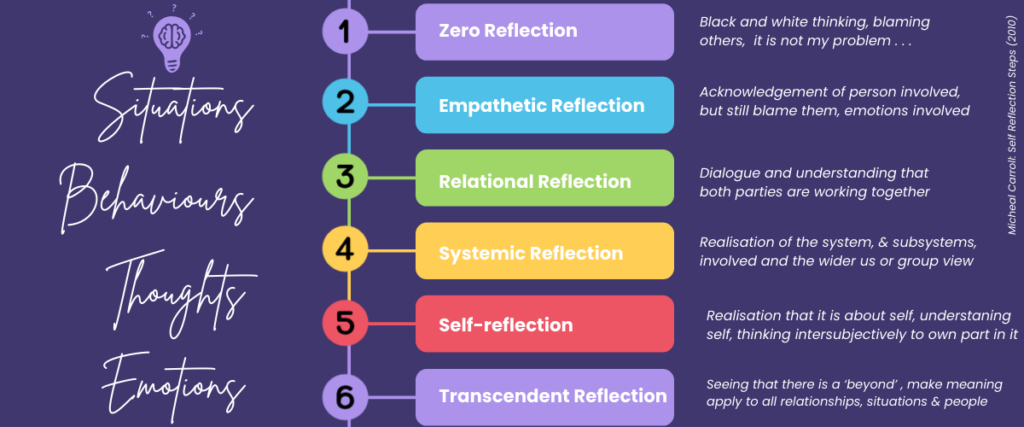
The following model, designed by Michael Carroll (2010), outlines a simplified process of the stages people typically go through when reflecting. In reality, reflection isn’t always linear. Often people jump between stages or revisit earlier steps as their understanding evolves.
Think of an iceberg.
At first glance, you see the part above the waterline, and when we’re younger, we often assume that’s all there is. But through education, experience, and the knowledge we absorb, we come to realise that the bulk of the iceberg lies hidden beneath the surface. This concept underpins a model designed by Michael Carroll2.
Level 1: Zero Reflection
At this level, an individual is not open to feedback and often exhibits black-and-white thinking. There is a tendency to blame others, with no resources or energy devoted to reflection.
This stage frequently appears at the start of a coaching journey when issues that seem irrelevant (hidden beneath the iceberg’s surface) are neither acknowledged nor discussed. At this point, individuals focus entirely on others, without any introspection.
Level 2: Empathetic Reflection
Here, a person begins to establish an emotional connection with the situation or another individual. While they may feel empathy or understanding, there’s s no link to their own actions or behaviours. Instead, they remain detached, observing from the sidelines and often attributing blame externally.
Whilst, they may recognise other perspectives or alternatives they remain firmly in their own position. For a coach, this stage involves understanding the coachee’s situation without yet forming a deep connection to the events, experiences, or emotions involved.
Time plays a significant role here. It is a journey that ICF accredited coaches are trained in. Greater sharing of information can help progress reflection, but some individuals may become stuck, shutting down further exploration. This is where a coach can be invaluable.
Level 3: Relational Reflection
This stage marks a turning point, where the perspective shifts from “I” and “You” to “Us.” Individuals begin to understand the interplay between their personal history and that of others. It’s not just about the other person or the situation but about how both sides contribute to the dynamic.
For a coach, this is often the “lightbulb moment” when the coachee realises, “It’s not just them, it is about me too, it is about how we interact or my perception of the event.” This is where genuine reflection and understanding begin to take shape, though it cannot be rushed or forced. It is a process.
Level 4: Systemic Reflection
At this level, individuals recognise the influence of broader systems and sub-systems on their understanding and actions. They realise that everything (from perceptions and behaviours to thoughts, emotions, and even physical responses is interconnected). Reflection here delves into one’s past, including history, culture, and ancestry, examining how these shape current perceptions. However, there remains an invisible barrier.
This barrier is an incomplete acceptance of one’s role in events, leaving gaps between self, the situation, and others. Coaches play a crucial role in supporting individuals to safely and progressively move beyond this barrier.
Level 5: Self-Reflection
This stage brings a profound realisation: it’s about the self. The metaphor of the iceberg becomes clear. What lies beneath the surface often dwarfs the visible tip.
Rooted in a growth mindset, this level focuses on the individual’s ability to change and the transformative power of that change. It shifts from blaming others to acknowledging personal patterns, themes, and behaviours that influence interactions and experiences.
Unlike Level 1, where the focus is entirely on the self in a defensive way, this level centres on personal growth and accountability.
Level 6: Transcendent Reflection
Reaching this stage signifies a deep understanding of the connections between self, others, situations, and life as a whole.
Individuals, teams, and organisations at this level move beyond the immediate and surface-level to grasp the bigger picture of life. At this level individuals deliberately explore beneath the surface, uncovering insights they’ve never encountered before.
At this stage, they are ready to expand their understanding and transform, moving from where they are now to new, brighter possibilities.
Reflective Practice Delivers ROI in Training
This model provides a roadmap for reflection, however it does require individuals to be willing and open to the journey.
An expert coach can guide this process, often without explicitly outlining it to the coachee. However, high levels of psychological safety are critical for success, particularly when addressing culture or team dynamics.
This model was introduced through a practical (and fun!) icebreaker activity when working with a group of hesitant employees preparing for training. Over time, Think Organisation recorded a 20% average increase in post-training behavioural changes, as reported by line managers, when this model and icebreaker were used, compared to other solutions.
With European countries investing double the amount in training compared to the UK3, we must maximise the return on our investment. If you’d like to learn more, get in touch for a free 30-minute consultation.
To know more reach out for a free 30-minute consultation.
https://cortex.clyq.co.uk/wp-content/uploads/Resilience-Reflection.png5001200Sarah Clarkehttps://cortex.clyq.co.uk/wp-content/uploads/Miscellaneous-Logo.pngSarah Clarke2025-01-20 13:19:372025-12-04 20:17:13Reflection: Psychology of Learning Proven To Improve Training ROI
Are you fed up not being able to achieve what you want in your job? Do you get annoyed with the other people? Frustration occurs when we feel annoyed that we can’t change of achieve something. So what can we do when this happens at work?
Recent research shows that almost half of us want to leave our current role (LinkedIn Workforce Confidence Report, 2024) and whilst frustration may not always be the reason, if we weren’t frustrated the chances are we would be happy to stay at our current employer.
At Think Organisation we are a great advocate of exit interviews, as it is vital to ensure people leaving your business remain strong advocates of your brand. So often, talented people move on and because of the negative experience of being off-boarded they would never consider returning to an organisation in the future – even if the right role, right rewards, right time, right location and right opportunity presented itself.
Ironically, after the so called ‘Great Resignation’ in 2021, where 47 million people changed their employers one survey suggested 80% of people regretted their decision to resign (Fast Company, 2023). Other studies delved into the reasons for the regrets, but whether it was the salary, the co-workers, or the work-life balance – it all boiled down to frustration.
So before jumping for the resignation letter lets considered how you can understand why you might be frustrated by your current job. And most importantly, ensure that if you do decide to leave, then you have done your homework and won’t live to regret your decision later. After all, the grass isn’t always greener on the other side.
The first challenge is to understand, whether it is your manager, your team, your organisation or everything which frustrates you. Whilst this may be something you can quickly say, it is important to really think about whether this is the root cause of the frustration.
For example, you may think it is the salary which frustrates you, but is it something deeper than this? And if they fixed the salary would something else frustrate you?
So grab a brew, a pen and paper or an electronic notepad and find somewhere you can concentrate and write down your answers to the following statements:
If I could change three things today to make my job better what would they be . . .
Close your eyes and describe your ideal workplace or job, really think about it and now write this down
How does your current job measure up against this ‘perfect’ job you have just described?
What are the three best things about my job today?
Whilst there are no right or wrong answers, it is important to think about things over the longer term and in context. So depending on the answers you wrote above, think back over the last six months, or year, and work out how much of the time this has been the case – or is it that you are going through a short-term bad patch?
Humans generally have a negativity bias, which means we tend to focus on the negative aspects more readily than the positive.
This bias is asymmetrical, which means for every one positive thing which we may glaze over, we are likely to spot or focus on three negative things. At times, especially when focusing on relationships, we can actually spot five negative elements for every one positive as our brain places more psychological weight against the negative events in our mind. So keeping this in mind, go back through your answers and think about what the positives are?
If you have done this and are still unsure why you may be frustrated about your job, we recommend you delve a bit deeper. It can often be useful to do this with a friend, or set aside an hour of time when you won’t be disturbed to start this process.
Step 1: Self-Reflection
Think about your current feelings towards your job. Are you feeling stressed, anxious, angry, or overwhelmed? The chances are if you are feeling happy, relaxed and content you might not still be reading this blog, so this is deliberately negative!
Track your daily experience at work for a week or two. Note when you feel frustrated, what was happening at the time, how did you react? Was it a person, an event, a situation or the time of the day?
By using a journal, you can identify patterns or specific triggers which occur and lead to your frustrations.
Step 2: Analyse your work environment
Think about where you work, when you work and how you do your work. We often work remotely, in offices, or in our cars, so it can be difficult to understand where we are most productive. Do you enjoy being in the office? Do you enjoy working from home? Where are you the most productive?
Consider your workload, think about your tasks – do you have too much or too little to do? Does what you are doing give you energy – or is it tedious? How is your workload compared to that of your peers? Do you enjoy working with others or prefer working alone?
Think about your relationships at work. How do you interact with your colleagues, managers or clients? Do you enjoy this interaction? Is there conflict, communication issues or feelings of isolation which could be contributing to your frustration?
Think about the culture where you work. This is the way things get done. Does the company culture align with your values and work style? Is it supportive or is it toxic? Do you feel safe and supported at work? Or do you feel threatened and at risk? Culture can so often be the cause of frustrations, especially when it is misaligned to a person’s goals.
Step 3: Examine your job role
Think about your current job. Is it clear what you need to do? Is it clear what you need to achieve? Have you been in your job for a long time? Are you bored in your current role? Does it excite you when you think about your job? Or does it fill you with dread? The following questions may help and can be discussed with your immediate supervisor or manager.
Are your job responsibilities and expectations clear?
Do you know how to succeed in your job?
Are you satisfied with your career progression to date?
Do you feel supported in your role?
Do you find your work meaningful and engaging?
A lack of motivation or a disconnect between your job and your personal values can often cause frustration. Feeling stuck or seeing no clear path to advancement can also lead to dissatisfaction.
Step 4: What about other factors?
Do you have a good work-life balance? Are you satisfied in other areas of your life? Do you have time to relax and take enjoyable personal time? Or are you struggling because of another stress, e.g. relationships or other factors such as life stressors?
Often people focus on their job as a source of frustration because it is easier than focusing on the ‘other stuff’. There could be financial concerns, family issues, uncertainty about where you are living or health problems which are driving feelings of frustration in your job.
Often personal challenges can exacerbate work frustrations, especially if we are not sleeping, so things that used to be ok now become increasingly frustrating.
Step 5: Talk to someone you trust
It is often good to gather feedback from others who you trust. This could be a trusted colleague or a mentor. Perhaps someone in the family or a friend can help you understand more about your frustrations. What have they noticed that you may not have noticed?
Often people will share their opinion of a situation which can be useful to gain insights and perspectives that you hadn’t previously considered, which may also help you understand more about your frustrations.
A candid conversation with your manager can also be helpful, assuming they are a supportive manager. Managers can help clarify expectations, address concerns and provide support. Plus sharing your thoughts, feelings and frustrations with them can ensure they help you overcome the challenges you are currently facing.
Step 6: Think about your longer-term goals
What was the reason you took this job? What hopes and dreams did you have when you took this job? Is this job a “means-to-an-end” job, or is it the job of your dreams? Does your current job help you get towards your long-term goals and aspirations? Or is your job compromising your personal values?
It can help to think about your aspirations, and what you want to achieve. Is this job helping you? Has it delivered what it said on the tin? Spend some time writing down your longer-term goals, even if they are dreams and aspirations, it is important to know where you want to go in the longer term.
Step 7: Take Action Against Frustration
Often frustrations can arise when we feel out of control. This can include when you want to make changes, however it is not in your power to do so. Or when you believe making changes is not in your control.
Review the list of things you have written above and start to think about where they fit on the model below? Can I really change them or could I influence a change in them? Is there something else I could do? For items in the circle of concern (which is what you can’t control) – park your thoughts about them as it is eating up time and energy, and instead focus on some of the elements you can control.
For example, frustration can arise over something that happened in the past. In reality you can’t change the past, you can only influence the future.
There are other areas which you may be able to influence, e.g. which work projects you get to work on going forward.
There are other elements which may be in your control e.g. how you respond to certain situations. For more information on this model, or to get insight from the professionals, please email sam@cortex.clyq.co.uk.
Now you have spent some time reflecting, writing and understanding more, we recommend you take some concrete steps to address any sources of frustration. These might involve keeping a journal, or seeking support from a trusted colleague. But think about three actions you are going to take in the next few weeks and write these down, commit time to them and set a reminder in your calendar to review your progress.
By taking the time to reflect, gather information, and explore solutions, you can gain a clearer understanding of what’s causing your frustration and take steps to improve your work experience.
https://cortex.clyq.co.uk/wp-content/uploads/Green-Grass-Frustrated-1200-x-500.webp5001200Sarah Clarkehttps://cortex.clyq.co.uk/wp-content/uploads/Miscellaneous-Logo.pngSarah Clarke2024-09-03 17:55:092025-12-04 20:44:53Struggling at work? Here’s How To Understand Your Frustration