
Tag Archive for: coaching

Put Your Thinking Hats On: Use De Bono’s Model To Unlock Better Ideas & Results

How we make decisions, come up with ideas, solve problems or approach challenges is all down to how we think. Imagine if you could change how you think based on the thinking hats you decide to put on your head.


Thinking defines the mental processes of generating, organising or evaluating ideas, information and experiences to understand, reason, make decisions and solve problems.


As Psychologists, we often call it cognitive processing because thinking involves functions such as perception, memory, imagination, reasoning and judgement.


Everyone’s mind manipulates information differently, whether it is words, images or abstract symbols, our minds use this information to make sense of the world and guide our behaviour. Because of this we often get asked, is there a tool or model which can help us think better, deeper or differently?

The answer is yes, because one model, in our opinion, which can help reduce the bias, emotions or rigid thinking patterns is Edward de Bono’s Six Thinking Hats. This tool is a simple framework, which when used correctly, can help transform decision making, by helping teams think more clearly and make better decisions.


What Are the Six Thinking Hats?

Developed by Dr. Edward de Bono, a pioneer in creative and lateral thinking, the Six Thinking Hats model is designed to help individuals and groups look at problems from multiple perspectives, by deliberately and systematically using each “hat” to represent a distinct mode of thinking:


    • White Hat: is all about facts & information, this hat focuses on data, evidence and objective information. Questions such as what do we know? Or what do we need to find out? What does the data show us?

    • Red Hat: is about feelings and intuition, bringing emotions and gut instincts into discussions. Questions such as how do we feel about this idea? What is our immediate reaction? Is this emotional?

    • Black Hat: is more about critical judgement, and to some extent caution. This hat identifies risks, weaknesses and potential problems it is about asking what could do wrong?

    • Yellow Hat: is about the benefits, and optimism. It is about looking at the positives, the opportunities and the positive values which could be added. Why might this work well?

    • Green Hat: is about creativity and possibilities, in terms of encouraging new ideas, alternatives and fresh perspectives. This is about seeing if there is another way of looking at this?

    • Blue Hat: focuses on process and control, in terms of the step by step process itself. This hat manages the process itself in terms of how should we organise the discussion? What is the next step?


Is There Psychology Behind The Thinking Hats?

At its core, the Six Thinking Hats approach is rooted in psychology, because it acknowledges that humans often think reactively, or emotionally, or logically.


It appreciates that people may have different preferences in terms of how they think, and that cognitive biases can distort decision-making.


Using De Bono’s model can help us separate thinking into clear, structured modes, helping people become aware of how they think, not just what they think.

Thinking about thinking, is called metacognition. This psychological shift, thinking about one’s thinking, consciously adopting different hats helps people step outside of habitual thought patterns and consider viewpoints they might otherwise dismiss.


Supporting others to utilise the hats, either as a collective, or as individuals can help foster empathy, reduce conflict, and builds psychological safety. This model is about giving permission for all perspectives, from cautious to creative, to give equal weight to different ways of thinking.


How De Bono’s Thinking Hats Can Add Value to How People Work

The Six Thinking Hats create a shared language for thinking, which can be used across teams and organisations. Instead of clashing opinions, teams explore ideas sequentially.


With a recent client, everyone wore the Yellow Hat to discuss positives, then the Black Hat to assess risks, each hat being used in turn. This structured approach help resolve personal conflicts and improves clarity. Instead of one person always being seen as critical, and another as overly positive.


This in turn helps improve decision-making quality, by removing some of the potential emotions and ensuring all perspectives are covered. It ensures no one perspective it overly focused on. and helps create more informed and balance decisions.


In boardrooms, this can he used to remove the risks of group think, which can happen when risks and opportunities are not equally considered.


A productive meeting may start and end with a blue hat, to frame and close the discussion. Using the white hat early on can help gather facts, and alternating between yellow, black, green and red hat can help balance optimism, caution, creativity and emotion.


Being able to balance free thinking, and experimentation, without immediate judgement is crucial in organisations which need increased innovation. Using the green hat to overcome a fear of failure in organisations can be extremely helpful.

Just as leaders who use the red hat intentionally, to help teams to acknowledge emotions in decision-making, can strengthen empathy, motivation and trust. It is important that when everyone knows there are different modes of thinking, they are valued, and utilised. Individuals who may have different preferences can feel safer, knowing about the different styles of thinking. And businesses can use this model to help in multiple situations such as: strategic planning, innovation workshops, conflict resolution and performance coaching.

In an era where adaptability, empathy, and critical thinking define organisational success, De Bono’s Six Thinking Hats offer more than just a brainstorming tool, they provide a psychological framework for better collaboration and smarter decisions.


By learning to wear each hat with intention, teams move beyond bias and ego, unlocking a culture of curiosity, balance, and shared purpose. Because ultimately, when people learn to think together, not just talk together, the quality of both their work and their workplace transforms.

Below are some questions which may help you utilise the thinking styles of the hats:


🎩 White Hat – Facts & Information

Focus: Data, evidence, and what is known or unknown.


Use these questions to establish the factual foundation:


    • What do we know for certain about this situation?

    • What data or evidence do we have?

    • What information is missing, and how can we get it?

    • What trends or patterns can we identify?

    • Are there any assumptions being made that need to be checked?

    • What do the numbers, reports, or research say?


❤️ Red Hat – Feelings & Intuition

Focus: Emotions, gut reactions, and instinctive responses.


Encourages people to share what they feel, not just what they think.


    • How do you feel about this idea or situation right now?

    • What’s your gut instinct telling you?

    • Does anything about this make you uncomfortable or uneasy?

    • What excites you about this possibility?

    • Are there any emotional reactions from others we should consider (e.g. staff, customers)?


Black Hat – Caution & Critical Judgment

Focus: Risks, weaknesses, and potential problems.

Helps identify pitfalls and prevent poor decisions.


    • What are the potential risks or downsides?

    • What could go wrong if we proceed this way?

    • What obstacles might we face?

    • Are there any compliance, ethical, or reputational concerns?

    • Is this idea practical and sustainable long term?

    • What evidence do we have that this might not work?


💛 Yellow Hat – Optimism & Benefits

Focus: Positives, value, and potential gains.

Balances caution by highlighting why an idea could succeed.


    • What are the benefits of this idea or decision?

    • How could this create value for the business or team?

    • Why might this approach work well?

    • What opportunities could come from this?

    • Who would benefit the most?

    • How could we make this idea even more effective?


💚 Green Hat – Creativity & Alternatives

Focus: Innovation, new ideas, and alternative approaches.

Encourages divergent thinking and brainstorming.


    • What are some new ways we could approach this issue?

    • How else could we achieve the same goal?

    • What if we had no limitations — what would we try?

    • Could we combine ideas to create something better?

    • What unconventional options haven’t we explored yet?

    • How could technology or partnerships help us innovate here?


🔵 Blue Hat – Process & Control

Focus: Managing the thinking process itself.

Used to guide the meeting, maintain structure, and summarise outcomes.


    • What is the main goal or question we’re addressing today?

    • Which hat should we be using right now?

    • Are we spending too much time on one perspective?

    • What have we learned so far?

    • What’s our decision or next step?

    • How will we track progress or follow up on this discussion?

More about Coaching

 
There’s more about Coaching in this Think Organisation Post: Coaching in Adversity

Alternatively, copy and paste this link into your browser: https://cortex.clyq.co.uk/individuals-teams-and-organisations-need-coaching-in-adversity/

How To Ensure You Have a Credible Coach

In an era where leadership is defined by agility, resilience, and strategic foresight, executive coaching has become an essential lever for transformation. Not just at a personal level, but at an organisational level. Investing in a coach is an important investment, however, how do you know you have picked the right coach for you and your organisation?


Yet not all coaches are created equal.

While anyone can call themselves a “coach,” the difference between an impactful executive partnership and a costly misstep, often comes down to one crucial factor: credibility.


So, how do you know if a coach is credible?

Many successful business leaders, who may have sold their businesses, are claiming to be expert executive coaches, with no training whatsoever. Lived experience is really important if you are a mentor, but not necessarily as a coach.

Mentoring is the act or process of helping and giving advice to a less experienced person, especially in a job or at school.

Today’s leaders can’t afford to gamble on advice disguised as coaching or well-meaning conversations. Especially not when they are paying for the privilege.


Coaches can often reinforce dependency when they are untrained. Instead, it is vital that anyone investing in coaching, for themselves or their business, must seek out qualified, experienced, and accredited coaches (particularly those certified by the International Coaching Federation (ICF) who, in our opinion and based on extensive research, bring not only gravitas but rigorous ethical standards, a scientific psychological foundation, and a commitment to ongoing personal development.


Mentoring is not coaching.

The ICF defines coaching as “partnering with clients in a thought-provoking and creative process that inspires them to maximise their personal and professional potential” and sets the global benchmark for coaching professionalism.


Coaches who are accredited by the ICF, such as at ACC, PCC, or MCC levels, have undergone a comprehensive training program, demonstrated real-world coaching hours, and passed stringent assessments and examination. As a result, and most importantly, they commit to a code of ethics and core competencies that ensure coaching is safe, structured, and results-oriented.


This matters because the stakes at the executive level are high. When a CEO or C-suite leader receives poor coaching, often based on anecdotal experience rather than proven methodology, it doesn’t just affect them. It ripples through the business: decision-making slows, confidence erodes and leadership capacity diminishes.


“Telling reinforces dependency; coaching develops capability.”
Paul Walker, CEO


More Than Experience: The Discipline Of An Executive Coach

It is important to understand that there is a growing trend of individuals calling themselves “coaches”, often based on business or role success alone. But the ability to grow a business, or be successful in a board role, doesn’t automatically translate to the ability to coach others to do the same. In fact, the most effective coaches know how to withhold advice, ask powerful questions, and challenge constructively, techniques learned through formal training, supervision, and deep personal reflection.


Often executive coaches coach you through things you don’t want to hear, help you see what you struggle to see and empower you to unlock your potential and maximise growth.


True executive coaching is a disciplined, high-impact process. It blends behavioral science, adult learning theory, and organisational psychology – to support leaders in driving change. Qualified coaches bring these tools to bear with intention and expertise – enabling transformation that sticks.


Reflective Practice and Supervision Are Non-Negotiable

Experienced executive coaches invest in supervision, which is the structured reflective practice with another qualified professional. Supervision sessions examine their work, manage bias and continuously sharpen a coach’s effectiveness. Supervision isn’t optional. It is a sign of a coach’s commitment to their clients’ success and their own development.


Without reflective practice, coaches risk projecting their own beliefs, missing critical dynamics or creating dependency rather than empowerment. With supervision, they model the kind of self-awareness and accountability they expect from their clients. It ensures client are getting the best coaching in return for their investment.


For leaders, working with a coach who is committed to supervision and CPD (continuing professional development) means entering into a partnership rooted in rigor, ethics, and excellence – not ego or improvisation.


A Coach Builds Capability, Not Dependence

One of the hallmarks of skilled executive coaching is that it develops leadership capability, not reliance. The goal isn’t for a coach to stay with a leader indefinitely, nor to become an advisor. It’s to build the executive’s ability to think more strategically, act more decisively, and lead more authentically – long after the engagement ends.


Accredited coaches are trained to contract clearly, define measurable outcomes, and structure engagements to ensure sustainability. They uphold the belief that real coaching success is when the client no longer needs them.


If you are worried you are not getting value from your coach, or that a coach may not have the credentials they claim, then reach out to us and have a free 30-minute consultation. Afterall, when organisations select ICF-accredited coaches, such as our Co-Founder Steph, who are actively learning and being supervised, they’re not just investing in a leader, they’re investing in the future health and success of their organisation.


More about Coaching

There’s more about Coaching in this Think Organisation Post: Comfort Zone – How Leaders can Foster Growth

Alternatively, copy and paste this link into your browser: https://cortex.clyq.co.uk/comfort-zone-how-organisations-can-foster-growth/

Reflection: Psychology of Learning Proven To Improve Training ROI

Have you ever been forced to attend a training course you felt was a complete waste of time? Or worked with someone who simply wouldn’t listen? Have you ever reflected on something? Deliberately? So that in hindsight, if you’d been the one who could have listened more, the situation may have become crystal clear sooner? Learning the power of reflection can help with all these challenges.


As we face a new year, budgets are being slashed, recruitment strategies are in turmoil, and business leaders are grappling with mounting pressures.


With all these demands, it’s no surprise that workplace behaviour standards can start to decline. So, what can leaders do to make a difference? How often have you invested in training only to see no change in behaviours in the workplace?


Workplace training and development is at an all-time low. Last autumn, the Government announced plans to prioritise improving skills across the UK workforce. But how much training or development have you completed in the past month? More importantly, has it led to a change in your behaviour?


On average, only 28% of employees have participated in any training or development within the last three months. For those who are self-employed or work solo, this figure drops to just 13%1. In this challenging landscape, the power of reflection and fostering a culture of self-directed learning becomes even more vital. Here’s how understanding the psychology of learning can benefit you, your team, and your organisation.


Reflection involves absorbing information, asking deep and probing questions, and challenging your understanding of situations or events.


Cultivating a reflective mindset opens the door to learning, greater understanding, and seeing things from new perspectives. While reflection can feel uncomfortable at times, like any skill or competency, practice makes it easier – until it becomes a habit and second nature. When it does, considering how to improve, gain knowledge, or grow becomes an instinctive part of who you are.


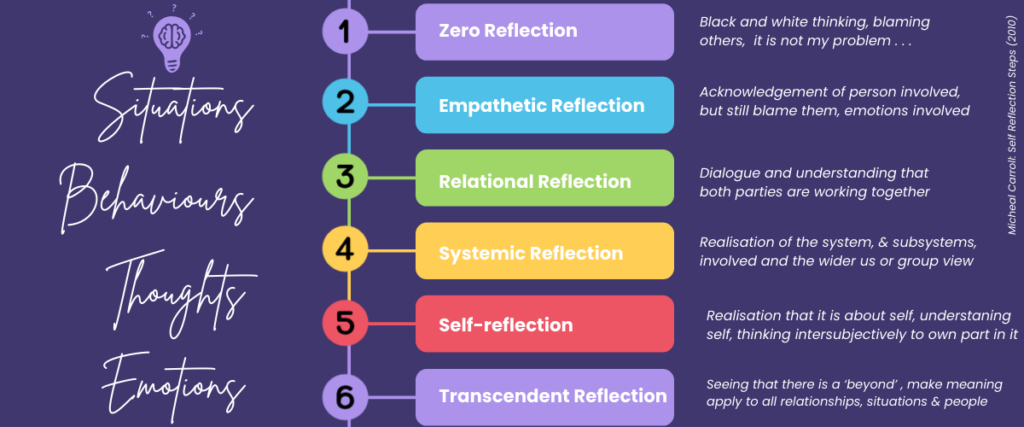
The following model, designed by Michael Carroll (2010), outlines a simplified process of the stages people typically go through when reflecting. In reality, reflection isn’t always linear. Often people jump between stages or revisit earlier steps as their understanding evolves.


Reflection Steps designed by Micheal Carroll (2010). The Six steps include situation, behaviours, thoughts and emotions and information summaries on each of the six steps of reflection.


Think of an iceberg.


At first glance, you see the part above the waterline, and when we’re younger, we often assume that’s all there is. But through education, experience, and the knowledge we absorb, we come to realise that the bulk of the iceberg lies hidden beneath the surface. This concept underpins a model designed by Michael Carroll2.


Level 1: Zero Reflection

At this level, an individual is not open to feedback and often exhibits black-and-white thinking. There is a tendency to blame others, with no resources or energy devoted to reflection.


This stage frequently appears at the start of a coaching journey when issues that seem irrelevant (hidden beneath the iceberg’s surface) are neither acknowledged nor discussed. At this point, individuals focus entirely on others, without any introspection.


Level 2: Empathetic Reflection

Here, a person begins to establish an emotional connection with the situation or another individual. While they may feel empathy or understanding, there’s s no link to their own actions or behaviours. Instead, they remain detached, observing from the sidelines and often attributing blame externally.


Whilst, they may recognise other perspectives or alternatives they remain firmly in their own position. For a coach, this stage involves understanding the coachee’s situation without yet forming a deep connection to the events, experiences, or emotions involved.


Time plays a significant role here. It is a journey that ICF accredited coaches are trained in. Greater sharing of information can help progress reflection, but some individuals may become stuck, shutting down further exploration. This is where a coach can be invaluable.


Level 3: Relational Reflection

This stage marks a turning point, where the perspective shifts from “I” and “You” to “Us.” Individuals begin to understand the interplay between their personal history and that of others. It’s not just about the other person or the situation but about how both sides contribute to the dynamic.


For a coach, this is often the “lightbulb moment” when the coachee realises, “It’s not just them, it is about me too, it is about how we interact or my perception of the event.” This is where genuine reflection and understanding begin to take shape, though it cannot be rushed or forced. It is a process.


Level 4: Systemic Reflection

At this level, individuals recognise the influence of broader systems and sub-systems on their understanding and actions. They realise that everything (from perceptions and behaviours to thoughts, emotions, and even physical responses is interconnected). Reflection here delves into one’s past, including history, culture, and ancestry, examining how these shape current perceptions. However, there remains an invisible barrier.


This barrier is an incomplete acceptance of one’s role in events, leaving gaps between self, the situation, and others. Coaches play a crucial role in supporting individuals to safely and progressively move beyond this barrier.


Level 5: Self-Reflection

This stage brings a profound realisation: it’s about the self. The metaphor of the iceberg becomes clear. What lies beneath the surface often dwarfs the visible tip.


Rooted in a growth mindset, this level focuses on the individual’s ability to change and the transformative power of that change. It shifts from blaming others to acknowledging personal patterns, themes, and behaviours that influence interactions and experiences.


Unlike Level 1, where the focus is entirely on the self in a defensive way, this level centres on personal growth and accountability.


Level 6: Transcendent Reflection

Reaching this stage signifies a deep understanding of the connections between self, others, situations, and life as a whole.


Individuals, teams, and organisations at this level move beyond the immediate and surface-level to grasp the bigger picture of life. At this level individuals deliberately explore beneath the surface, uncovering insights they’ve never encountered before.


At this stage, they are ready to expand their understanding and transform, moving from where they are now to new, brighter possibilities.


Reflective Practice Delivers ROI in Training

This model provides a roadmap for reflection, however it does require individuals to be willing and open to the journey.


An expert coach can guide this process, often without explicitly outlining it to the coachee. However, high levels of psychological safety are critical for success, particularly when addressing culture or team dynamics.


This model was introduced through a practical (and fun!) icebreaker activity when working with a group of hesitant employees preparing for training. Over time, Think Organisation recorded a 20% average increase in post-training behavioural changes, as reported by line managers, when this model and icebreaker were used, compared to other solutions.


With European countries investing double the amount in training compared to the UK3, we must maximise the return on our investment. If you’d like to learn more, get in touch for a free 30-minute consultation.


To know more reach out for a free 30-minute consultation.

  1. Institute Fiscal Studies (2023). Read here ↩︎
  2. Michael Carroll, Six Steps of Self Reflection (2010). Read here . ↩︎
  3. Learning & Work Institute (2024). Read here ↩︎


More about Workplace Psychology

There’s more about Workplace Psychology in this Think Organisation Post: Drive Profits – How To Help People Be Humans at Work

Alternatively, copy and paste this link into your browser: https://cortex.clyq.co.uk/how-to-help-people-be-humans-at-work-to-drive-profits/

Leadership Insights 2024: Building a Strong Business Culture

The last decade has shown a significant decline in employee motivation across the UK (Think Organisation, 2024). Employee engagement has also reached an all time low globally with only 1 in 4 people currently engaged (Gallup, 2023).


According to Business Leaders Today (2024) ‘leaders keep teams motivated by building a business culture that supports a positive employee experience and a cooperative work environment that is psychologically safe for all team members’.


Business culture impacts employee experience because it is the shared attitudes, beliefs, priorities and values which guide the behaviours of all employees across organisations.


Employees are significantly more likely to stay in positive cultures that support and value them, allowing them to grow through an inclusive and psychologically safe environment. The challenge is, historically, leaders focused on results often at the expense of culture which is why influencing business culture is the future of leadership.


A Case Study

A recent client had a declining sales team, despite ‘on paper’ the team having everything it needed to deliver success. Employee engagement measures showed the team was ‘engaged’. Yet it wasn’t until Think Organisation undertook a culture deep dive that the real issues became apparent. On the surface, the team appeared ok. Yet at the first workshop underlying negative behaviours quickly became apparent to our team. Ironically, this had been happening for several years and the leader had become oblivious to these behaviours – not realising the implications.


Firstly, the highest salesperson often turned up late to full team meetings, apologising profusely but often with a coffee in hand, relaxed that the leader wouldn’t challenge this behaviour, although behind the scenes the leader said they found this was frustrating.


The values of the client were respect, collaboration and compassion, so this is what our workshop focused on. When asked who was ‘the best’ salesperson the team unanimously named this highest salesperson. Yet in reality, this salesperson did not embody the values of the organisation. They were driven, cut-throat and extremely disrespectful to customers having derogatory names for them behind their backs. Motivated only by results this highest salesperson did not embody the values of the organisation.


Once our business culture measure had been rolled out it quickly became apparent the underlying issues which were undermining the culture and leading to poor performance of the other 95% of the sales team. Three months later the behaviours were changed, delivering a 40% increase in sales revenue and an employee NPS increase of 12 points.


So what is the secret?


1. Business Culture

Measure your business culture. The artefacts, the behaviours, the ways of working to understand how people think, feel and behave in your organisation. We recommend you get the experts in, Business Psychologists who understand how to scientifically measure the multiple dimensions of culture. However, questions you can ask yourself and your leaders include:


  • How do we treat each other in this organisation?
  • Do we live, breathe and sleep our vision, mission and values?
  • Could someone tell our values from how our employees behave?
  • Do our values shine through when we make difficult decisions?
  • Are we consistent, fair and transparent in how we treat infractions?


2. Compassion

Do the leaders of the organisation really care? Is being kind, caring and considerate part of our ethos and ways of working? It is important to understand compassion is about concern for others and the desire to take action, whereas empathy is the awareness of another’s emotional experiences.


Compassion lives in organisational cultures (or it doesn’t), and whilst we often measure levels of compassion in terms of thoughts, feelings and actions the following statements can help identify compassion in your organisation.


  • When people are distressed we try and help each other
  • We try not to get distracted by worrying about how people feel
  • I get fed up with people wasting time at work talking about how they feel
  • When a colleague is sad at work I try and comfort them
  • My manager can often tell if someone is sad at work, even if they don’t say anything


3. Connect

Many leaders spend time trying to manage others. Their role means leaders are often responsible for influencing the behaviours and actions of others. The challenge is that many leaders also don’t know how important it is to truly connect with their teams, at an individual and a team level.


Think about an individual who you work with daily. In your opinion:


  • What motivates this person?
  • What frustrates this person?
  • What could this person do more of to increase their success?
  • What could this person share with you to help you?
  • What could you share with this person to help them?


Now ask yourself – have you ever asked them these questions? What would they answer? What would they answer in reciprocation for you?


The importance of connections is fundamental for all leaders in 2024. High quality, authentic, two-way connections are what build strong, sustainable cultures which drive success.


4. Coach

There is no carrot and stick in leadership anymore.


Great leaders coach, create safe, supportive and appropriately challenging work environments which foster positive performance cultures.


It is vital that all employees feel psychologically safe, and coaching is the secret to this. All employees need direction and support, in different quantities at different times, and coaching can be the secret to this.


Leaders are so often time-poor, and whilst many invest in professional Executive Coaches, many of these learnings can be practised daily in the workplace to enhance the culture. Here are some high-level coaching questions which can help leaders.


  • How can we use this 121/meeting today so that it benefits you the most?
  • What excites you most about this project you are working on?
  • What scares you the most about this project you are working on?
  • What important thing have you learned about yourself recently?
  • What do you need or want from me to ensure this is a success?


5. Contribute

Many ideas, solutions and seeds of innovation come from people on the front line or doing the work, as opposed to the leaders at the top.


This is where ensuring a diverse team of people can contribute to projects and ways of working – and have the opportunity to learn from any mistakes. So often cultures are ashamed of their mistakes, hiding any less-than-perfect outcomes, that employees become scared of contributing.


Everyone has different perspectives, ideas and understandings so leaders must facilitate contributions from everyone, not just the more high-ranking officials. This can be done in several ways:


  • Facilitate design sprints with diverse groups of people focused on key organisational problems which need to be solved
  • Measure the levels of psychological safety across teams and your organisation and seek to improve it
  • Have safe spaces where people can make suggestions, chat, ask for help and informally chat over current challenges
  • Train leaders and managers in the art of coaching to ensure their behaviours and responses facilitate idea generation
  • Ensure all employees understand each other and know each other enough (e.g. through a personality or strengths profile) as this can help improve contributions


6. Celebrate

So often successes are not celebrated, and leaders miss the opportunity to congratulate team members on their achievements. When employees feel appreciated, valued and part of the team then they are more likely to be engaged.


Celebrating good work, and congratulating high performers or people who role model behaviours and values will enhance and grow your business culture.


Often we are so quick to move on to the next challenge that we forget to celebrate the successes or even the learning from the failures. This can lead to employees becoming disheartened as all humans need appreciation and a sense of achievement.


When it comes to celebrating, be mindful of:


  • Celebrating success in a way which suits the individuals or team involved
  • Small words, written cards, face to face thanks can go a long way compared to ‘big’ gestures
  • Celebrations need to be authentic, fair, consistent and transparent
  • Celebrate behaviours, approaches, progress and people overcoming adversity (not just results)
  • Congratulate people immediately, especially during projects, not just at the end


7. Change

Years ago we often talked about the BAU (business as usual) and the transformation we were planning on delivering. However, when the change became so frequent, or even a permanent state of flux, we coined the term CAU (change as usual).


Leaders need to embrace change and understand its influence on business culture. In a start-up the curve of change can take a couple of weeks, compared to six months in a FTSE 100. Understanding the speed of this cycle is crucial for all leaders.


Business culture change takes months, even years depending on the size, maturity and market the business operates in.


The following elements are fundamental:


  • What is currently urgent and who is going to work together to solve this challenge?
  • What different options do we have to solve this challenge or deliver this change?
  • How can we communicate what the solution or new world will look like after the change?
  • Who can help remove barriers to this change and deliver some quick wins?
  • How will we measure the progress of change or overcoming the challenge?


Conclusion

A successful leader in 2024 will be able to ask the following questions, to employees across their organisation, and get the following answers:


How do we really treat each other in this organisation?

In this organisation, we strive to treat each other with respect, empathy, and consideration. Our interactions are guided by a shared commitment to fostering a supportive and inclusive environment.


We listen actively to each other’s concerns and provide constructive feedback aimed at personal and professional growth. The emphasis on collaboration ensures that every team member feels valued and heard, promoting a sense of belonging and mutual respect.


This approach not only enhances individual morale but also strengthens our collective ability to achieve organisational goals.


Does everyone live, breathe and sleep our vision, mission and values?

Our vision, mission, and values are not just statements on a wall; they are at the core of our daily operations and decision-making processes.


We consistently integrate these principles into our work, ensuring that every action we take aligns with our organisational purpose and ethical standards.


By prioritising our mission in every project and initiative, we create a cohesive and unified direction for all employees. Regular workshops, meetings, and communications reinforce these ideals, making them an intrinsic part of our organisational culture that influences behaviour and choices at every level.


Could someone tell our organisational values from how our employees behave?

Someone could easily discern our values by observing our employees’ behaviour.


Our commitment to excellence, integrity, and compassion is evident in the way we conduct ourselves and interact with stakeholders.


Employees demonstrate our values through collaborative teamwork, ethical decision-making, and genuine care for one another’s well-being.


This consistent alignment between values and actions creates a transparent and trustworthy environment, where our organisational ethos is visible in everyday activities and engagements.


This visibility reinforces our culture and attracts a diverse group of like-minded individuals who share and uphold these values.


Think Performance. Think Excellence. Think Impact.

Check our Insights page for more valuable information.

More about Culture

There’s more about Culture in this Think Organisation Post: Unlock Productivity By Understanding Social Identity

Alternatively, copy and paste this link into your browser: https://cortex.clyq.co.uk/can-understanding-social-identity-unlock-productivity-in-your-team/
Are you ready to

start your joruney?

Take the first step to transform your workplace.

Call us on 07123 456 789
Email us at sarah@cortexworx.com

© Copyright Cortex Worx LTD. All rights reserved. | Website by Clyq