Tag Archive for: psychological safety

How To Manage High Performance at Work

Have you ever asked the question in your workplace – what do we mean by high performance?


High performance is defined as ‘able to operate to a high standard or at a high speed’ (Cambridge, 2025) but what does this look like in the workplace?


Last week, we shared a story about a well-known coffee shop, reflecting on how the employees worked together to problem solve.


This led us to consider:

  • When is high performance enough?
  • When does it become over-servicing?
  • Can high-performance reduce productivity?


Can the very definition of high performance actually lead to poor customer service? After all, receiving a coffee at high speed and to a high standard – is that high performance? Or is the experience, the conversation, and the feeling of connection the real measure of high performance in a coffee shop? It all depends on the customer’s purpose in visiting the coffee shop in the first place.


Think about your favourite coffee shop—whether a local boutique, a large chain, or, like my friend, your own home coffee station. What does high performance look like to you as the customer?


The Performance Curve: Balancing Challenge & Support
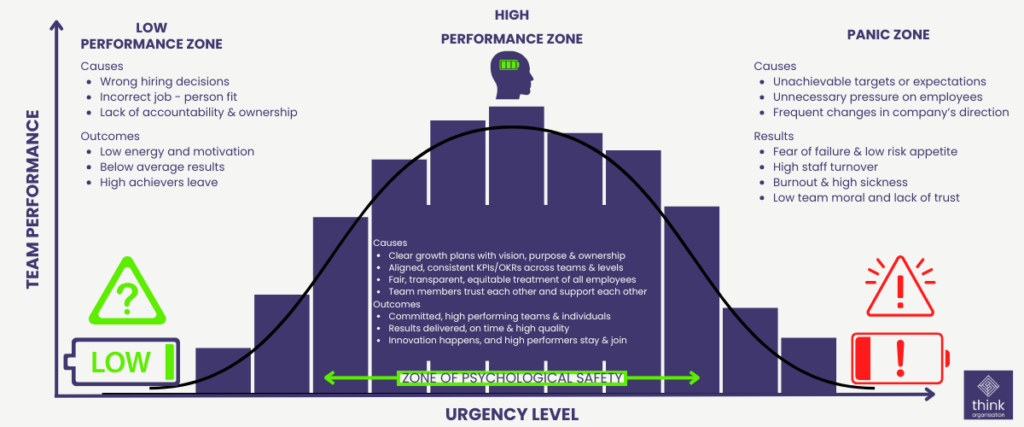
 

Performance Curve


Psychological theory tells us that performance follows a curve (which is often referred to as the Yerkes-Dodson Law – shown above). This principle suggests that moderate levels of stress and challenge can enhance performance, but too much pressure leads to diminishing returns and, in some cases, eventual burnout.


A high-performing team needs to operate at an optimal point on this curve, where there is sufficient challenge to drive motivation but not so much pressure that it leads to disengagement or exhaustion. Leaders play a key role in balancing these factors, ensuring their teams are stimulated but not overwhelmed.


The Role of Psychological Safety in Sustained Performance


For high performance to be sustainable, psychological safety is critical. Psychological safety, as defined by Amy Edmondson, is the belief that one can take risks, make mistakes, and express ideas without fear of humiliation or punishment. When employees feel psychologically safe, they are more likely to contribute ideas, collaborate effectively, and recover quickly from setbacks.


Without psychological safety, teams may hesitate to challenge poor decisions, leading to group-think and stagnation. Conversely, fostering an environment where diverse thoughts are encouraged ensures innovation and resilience, which are both crucial elements for long-term success.


Defining High Performance in Your Workplace

As psychologists, we often work to understand the lens through which people view performance and success. Assumptions, biases, and habitual thinking all shape the way human decisions are made – some are practical, some emotional, some time-bound, and others context-specific. In many cases, there is no conscious thought process involved in decision-making.


Think back to the last time you were in a coffee shop, what was the process of your decision-making about what your ordered? Can you write it down in detail? Explaining all the options you discounted?


If I asked you to explain why the person standing next to you made their decision about their coffee choices – what would you say? Would you know? You may if you knew them well, or you may not have any idea. But imagine if their definition of success was different to yours?


To define high performance for your team, consider these key questions:


  1. What does success look like for our team? – Is it efficiency, creativity, collaboration, or something else entirely?
  2. What is critical to our success? – Are there key behaviours, skills, or processes that underpin high performance?
  3. What behaviours or ways of working are crucial to our success? – Do we prioritise speed, precision, customer experience, or continuous improvement?
  4. What does failure look like for our team? – Understanding what ineffective performance looks like helps avoid missteps and course-correct effectively. Whilst it is important not to dwell on the negative looking at the opposite of success can be extremely helpful and insightful.


Rethinking High Performance: It’s More Than Just Speed

Going back to our coffee shop analogy. . .


High performance is not just about fast service. It’s about the right service, at the right time, in the right way.


In the workplace, high performance isn’t just about productivity metrics. High performance at work is about sustainable, meaningful, and impactful ways-of-working that align with organisational goals, whilst ensuring employees thrive and grow.


By considering the performance curve and psychological safety, organisations can redefine what high performance truly means which benefits everyone.


Organisations who create environments where both individuals and teams thrive, are proven to be more profitable. Repeatably, time and time again after all – Money Matters But People Matter More.


More about Workplace Psychology

There’s more about Workplace Psychology in this Think Organisation Post: Integrate Psychology Into Training to Deliver Optimal Results

Alternatively, copy and paste this link into your browser: https://cortex.clyq.co.uk/how-to-integrate-psychology-into-training-to-deliver-optimal-results/

Reflection: Psychology of Learning Proven To Improve Training ROI

Have you ever been forced to attend a training course you felt was a complete waste of time? Or worked with someone who simply wouldn’t listen? Have you ever reflected on something? Deliberately? So that in hindsight, if you’d been the one who could have listened more, the situation may have become crystal clear sooner? Learning the power of reflection can help with all these challenges.


As we face a new year, budgets are being slashed, recruitment strategies are in turmoil, and business leaders are grappling with mounting pressures.


With all these demands, it’s no surprise that workplace behaviour standards can start to decline. So, what can leaders do to make a difference? How often have you invested in training only to see no change in behaviours in the workplace?


Workplace training and development is at an all-time low. Last autumn, the Government announced plans to prioritise improving skills across the UK workforce. But how much training or development have you completed in the past month? More importantly, has it led to a change in your behaviour?


On average, only 28% of employees have participated in any training or development within the last three months. For those who are self-employed or work solo, this figure drops to just 13%1. In this challenging landscape, the power of reflection and fostering a culture of self-directed learning becomes even more vital. Here’s how understanding the psychology of learning can benefit you, your team, and your organisation.


Reflection involves absorbing information, asking deep and probing questions, and challenging your understanding of situations or events.


Cultivating a reflective mindset opens the door to learning, greater understanding, and seeing things from new perspectives. While reflection can feel uncomfortable at times, like any skill or competency, practice makes it easier – until it becomes a habit and second nature. When it does, considering how to improve, gain knowledge, or grow becomes an instinctive part of who you are.


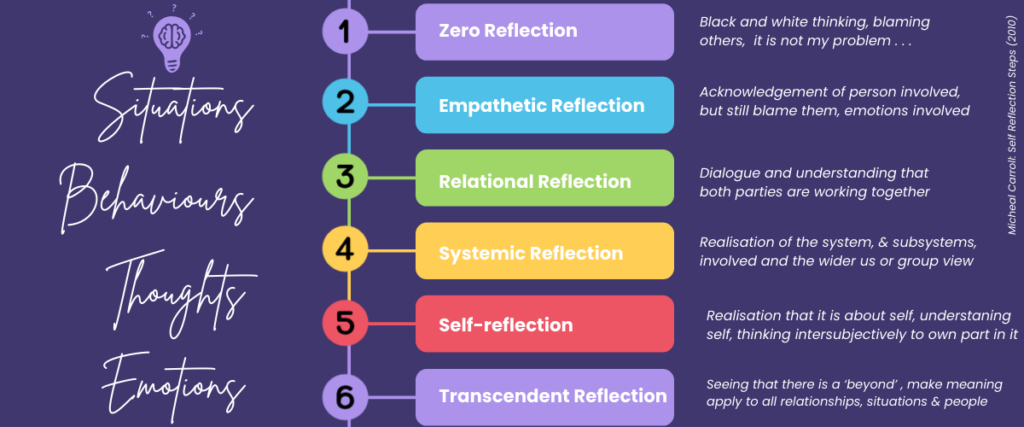
The following model, designed by Michael Carroll (2010), outlines a simplified process of the stages people typically go through when reflecting. In reality, reflection isn’t always linear. Often people jump between stages or revisit earlier steps as their understanding evolves.


Reflection Steps designed by Micheal Carroll (2010). The Six steps include situation, behaviours, thoughts and emotions and information summaries on each of the six steps of reflection.


Think of an iceberg.


At first glance, you see the part above the waterline, and when we’re younger, we often assume that’s all there is. But through education, experience, and the knowledge we absorb, we come to realise that the bulk of the iceberg lies hidden beneath the surface. This concept underpins a model designed by Michael Carroll2.


Level 1: Zero Reflection

At this level, an individual is not open to feedback and often exhibits black-and-white thinking. There is a tendency to blame others, with no resources or energy devoted to reflection.


This stage frequently appears at the start of a coaching journey when issues that seem irrelevant (hidden beneath the iceberg’s surface) are neither acknowledged nor discussed. At this point, individuals focus entirely on others, without any introspection.


Level 2: Empathetic Reflection

Here, a person begins to establish an emotional connection with the situation or another individual. While they may feel empathy or understanding, there’s s no link to their own actions or behaviours. Instead, they remain detached, observing from the sidelines and often attributing blame externally.


Whilst, they may recognise other perspectives or alternatives they remain firmly in their own position. For a coach, this stage involves understanding the coachee’s situation without yet forming a deep connection to the events, experiences, or emotions involved.


Time plays a significant role here. It is a journey that ICF accredited coaches are trained in. Greater sharing of information can help progress reflection, but some individuals may become stuck, shutting down further exploration. This is where a coach can be invaluable.


Level 3: Relational Reflection

This stage marks a turning point, where the perspective shifts from “I” and “You” to “Us.” Individuals begin to understand the interplay between their personal history and that of others. It’s not just about the other person or the situation but about how both sides contribute to the dynamic.


For a coach, this is often the “lightbulb moment” when the coachee realises, “It’s not just them, it is about me too, it is about how we interact or my perception of the event.” This is where genuine reflection and understanding begin to take shape, though it cannot be rushed or forced. It is a process.


Level 4: Systemic Reflection

At this level, individuals recognise the influence of broader systems and sub-systems on their understanding and actions. They realise that everything (from perceptions and behaviours to thoughts, emotions, and even physical responses is interconnected). Reflection here delves into one’s past, including history, culture, and ancestry, examining how these shape current perceptions. However, there remains an invisible barrier.


This barrier is an incomplete acceptance of one’s role in events, leaving gaps between self, the situation, and others. Coaches play a crucial role in supporting individuals to safely and progressively move beyond this barrier.


Level 5: Self-Reflection

This stage brings a profound realisation: it’s about the self. The metaphor of the iceberg becomes clear. What lies beneath the surface often dwarfs the visible tip.


Rooted in a growth mindset, this level focuses on the individual’s ability to change and the transformative power of that change. It shifts from blaming others to acknowledging personal patterns, themes, and behaviours that influence interactions and experiences.


Unlike Level 1, where the focus is entirely on the self in a defensive way, this level centres on personal growth and accountability.


Level 6: Transcendent Reflection

Reaching this stage signifies a deep understanding of the connections between self, others, situations, and life as a whole.


Individuals, teams, and organisations at this level move beyond the immediate and surface-level to grasp the bigger picture of life. At this level individuals deliberately explore beneath the surface, uncovering insights they’ve never encountered before.


At this stage, they are ready to expand their understanding and transform, moving from where they are now to new, brighter possibilities.


Reflective Practice Delivers ROI in Training

This model provides a roadmap for reflection, however it does require individuals to be willing and open to the journey.


An expert coach can guide this process, often without explicitly outlining it to the coachee. However, high levels of psychological safety are critical for success, particularly when addressing culture or team dynamics.


This model was introduced through a practical (and fun!) icebreaker activity when working with a group of hesitant employees preparing for training. Over time, Think Organisation recorded a 20% average increase in post-training behavioural changes, as reported by line managers, when this model and icebreaker were used, compared to other solutions.


With European countries investing double the amount in training compared to the UK3, we must maximise the return on our investment. If you’d like to learn more, get in touch for a free 30-minute consultation.


To know more reach out for a free 30-minute consultation.

  1. Institute Fiscal Studies (2023). Read here ↩︎
  2. Michael Carroll, Six Steps of Self Reflection (2010). Read here . ↩︎
  3. Learning & Work Institute (2024). Read here ↩︎


More about Workplace Psychology

There’s more about Workplace Psychology in this Think Organisation Post: Drive Profits – How To Help People Be Humans at Work

Alternatively, copy and paste this link into your browser: https://cortex.clyq.co.uk/how-to-help-people-be-humans-at-work-to-drive-profits/

Five Steps to Fix A Toxic Culture

A negative workplace culture is an environment dominated by practices, policies and management styles that perpetuate unhealthy habits and conflicts.


In a negative culture, employees experience dissatisfaction, and low morale and are much less productive. Extremely negative cultures are often referred to as toxic.


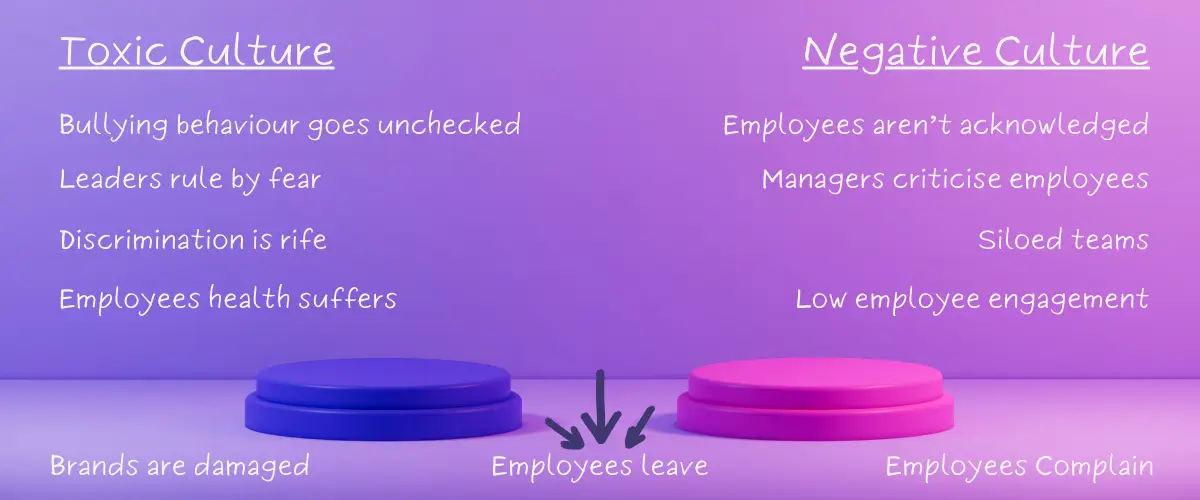
However, it is important to understand the difference between negative and toxic cultures. A toxic culture is an extremely serious, potentially brand-damaging, company-ending culture which is detrimentally impacting employees and society.


From our own experience, working as culture consultants for over twenty years this is how we would define the difference between negative and toxic cultures.


Two buttons showing toxic and negative cultures word lists.


Whilst negative or toxic cultures often overlap, when a company is truly toxic the approach to improve the culture is very different to how we would recommend a negative culture is improved. This is because a toxic culture needs a full reset.


There are dangerous, discriminatory behaviours occurring which have often been left unchecked for years. It is therefore paramount that the toxicity is neutralised safely, with the correct support and guidance provided to ensure all employees come out of the experience as safely as possible.


In standard cultures, with a survey of over 1,000 employees, 29% of employees reported taking time off due to the impact of behaviours such as discrimination, sexual misconduct or harassment. In a toxic culture, this percentage can be 80-90%, which is why the approach needs to be led by a professional.


Below are our recommended steps to fix a toxic organisational culture.


Identify the signs which indicate a toxic culture


Toxic cultures have signs that may indicate the serious problems infecting the current culture.


For example, individuals who compete with each other as opposed to working as a team, or missed goals with high levels of blame. If there is a lack of recognition for high performers, or disrespect goes unchallenged and it is more important to deliver the numbers, no matter what the costs, then this could indicate high levels of toxicity.


Many toxic cultures have high employee turnover, but not always, as some toxic cultures incur limited employee turnover due to the negative impacts the culture has on individuals. Employees feel trapped, unhappy and lack confidence to move on. Their health may have been impacted, and they work such long hours to meet the increasingly negative demands of the culture they don’t have time to look for new roles.


Leaders of toxic cultures can often manipulate people into feeling so valued, at critical times, that people struggle to leave despite the toxic environment.


Toxic cultures are the worst level. They do not just emerge over night. And, in our opinion, there is often not ‘one person’ to blame. It is a way of working, which has been allowed to fester, grow in negativity but on some level may be achieving whatever arbitrary performance metrics the company is chasing.


Toxic cultures have been ignored for some time, even years, which is what has allowed the toxicity to grow, fester and continue to take over the culture increasing the scale of negativity as people fail to improve the culture in a positive way.


Understand the depth & scale of the toxicity


There is a huge difference between negative culture and a toxic culture. In some organisations there can be pockets of poor culture, or areas where there is positive culture and overall whilst the culture may not be helping deliver success it may not be so negative it is toxic.


A toxic culture perpetuates unhealthy behaviours and conflict between employees. A toxic manager can create negativity and toxicity in a certain area of a business, and can be easily remedied – if dealt with promptly. Again the HR data will indicate this, if there is psychological safety for people to provide open and honest feedback.


If the toxicity is across the business, with unhealthy and negative behaviours consistently going unchallenged, or even encouraged then you have a toxic culture.


Often organisations cultures come to light when there is a crisis. Perhaps, an employment tribunal or a negative press story about the state of the business.


Recently there have been multiple high-profile stories about negative cultures e.g. the Post Office.


The lack of trust, the way people were treated and the lack of listening from the leadership teams created such a toxic culture that many people lost their jobs, livelihoods and even lives to the toxicity of the culture. If the organisation had invested in Culture Consultants earlier, this could have been identified years ahead of the scandals which now continually plague them.


Ultimately, an early intervention could have saved the Post Office significant sums of money and safeguarded it against its current spiral of decline.


Create the Vision & Values of the Future


Many organisations with toxic cultures may not have defined values or behaviours. Others may have elaborate, clearly defined values and behaviours – but maybe they do not live by them. Often they adorn walls, are promoted externally but employees fail to live by them. They can become a source of amusement, and at times disrespect.


Many toxic cultures have a clear ‘this is what we say to follow what we should say’ and an undercurrent of reality in terms of ‘this is how we really do things’.


The leaders must inspire the new vision and values of the future. Everyone needs to be involved in creating them, owning them and most importantly ensuring everyone abides by them, supporting each other to achieve them and continuously improve. At times, toxic cultures can still be prolific but the leaders can be unaware of the situation. This is usually the case when a company’s performance has declined, leading to ineffective toxic leaders being replaced, but then employees continue to behave unethically. Often undercutting leaders, talking in hushed tones behind backs and ensuring that unhelpful behaviours continue to manifest across the organisation. And all of this despite leaders’ attempts to improve the culture.


Imagine a lake of salt water. It will remain at a level of saltiness until a certain combination of fresh water, seawater and/or rain is added to tip the PH balance. This is the same for culture, and when it is achieved it needs to be maintained and managed but culture grows over time so it cannot be changed by a few leaders at the top.


Unfortunately, many leaders become disillusioned, burnt out or ill when trying to transform a toxic culture because of the challenge which is before them. This is why it is vital to get the experts in when a culture is toxic. The other element is to ensure all leaders, managers and employees buy-in to the value of culture.


Ensure ALL Leadership buy-in to the Value of Culture


Scepticism, lack of trust, and short-sighted quick wins for individuals and not the collective good are all signs that leaders don’t truly buy into the importance of culture.


There will be no change to a toxic culture without leadership truly understanding its value. Many culture changes often start with leaders being removed, which instills fear. When people are scared this enflames negative behaviours further – especially in a toxic culture which has rewarded unhealthy behaviours historically.


Leaders who have been disrespectful, non-inclusive, unethical, cutthroat or abusive must be held to account whilst a culture of transparency, openness and fairness is created.


There does need to be opportunities and hope for all leaders.


Communication is Key


Communication of the culture strategy is key, as words will breed behaviours but difficult conversations will be plentiful. Role modelling becomes vital. New standards and expectations need to be communicated, with everyone set up for success. Support, positive reinforcement, and opportunities to learn are crucial.


Many employees, especially if they joined the toxic culture early in their careers may not know there are other ways of working and behaving. Hence, it is important to present people with the opportunities to improve.


Create a Culture of Psychological Safety


Toxic culture transformations often fail because of the fear which can be instilled during the transformation. Employees fear for their jobs, may be ashamed of how they have behaved or may prefer the culture how it was. This culture is what feels familiar to them. It is ‘how we do things here’.


Psychological safety is when people feel safe taking interpersonal risks, speaking up or voicing ideas or concerns. It is a feeling so can’t be mandated. Often some people feel psychologically safe, whereas others may not. In a toxic culture the majority of employees do not feel psychologically safe. They daren’t speak up, voice concerns or ideas and there is a culture where people may be ridiculed for speaking up. Often this leaders to people preferring to be silent, as this is easier and safer.


Think about when you have mustered the courage to speak up in a meeting. How did people react? How did people respond? Was there positive support? Did you get ridiculed? Did people say what they really thought? Or were you dismissed? Did people listen to you? Or were you scared? If people have a positive experience when they voice their opinions or speak up they are more likely to do it again. However, if people are ignored, dismissed or made to feel uncomfortable, then they are unlikely to speak up again. There is also no psychological safety.


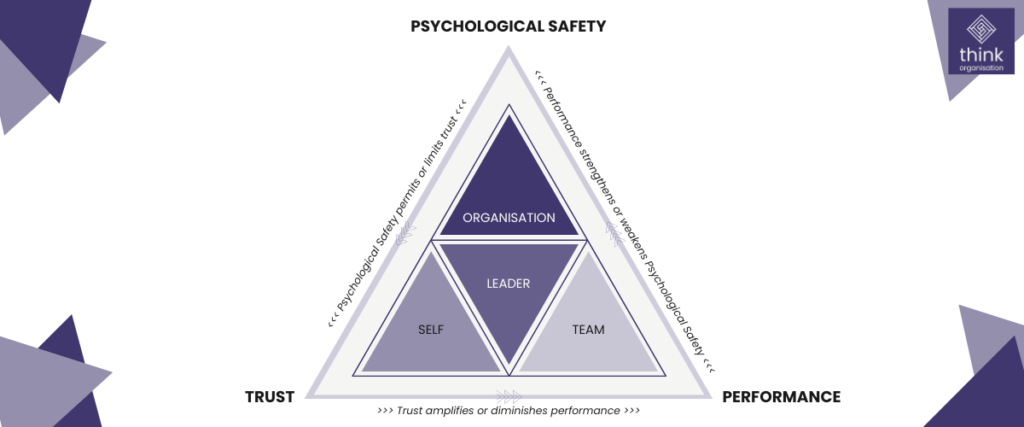
As shown below, creating psychological safety is critical to fueling trust and performance. If you would like a free individual measure of psychological safety please click here.


Whilst this article has focused on toxic cultures, successful organisations have positive cultures which drive organisational success. If you have noticed any of the items discussed in this article we recommend you contact our team of Culture Consultants at Think Organisation for a free 30-minute consultation conversation to discuss how to get your organisational culture assessed.


More about Culture

There’s more about Culture in this Think Organisation Post: Is Toxic Culture Affecting Your Wellbeing


Alternatively, copy and paste this link into your browser: https://cortex.clyq.co.uk/is-your-toxic-culture-affecting-your-well-being

Motivation: Understanding What Drives People at Work

The reason a person acts or decides to behave in a certain way is usually down to motivation. Motivation itself is not visible. It is an internal process. Motivation is the driving force behind human actions that initiates, guides and maintains goal-oriented behaviours.


With over 18 million references to motivation on Google it is easy to become lost in the complexities of motivation. So what do you need to know about motivation at work?


The future is intrinsic motivation.

Work is an activity which someone undertakes to gain a benefit or achieve a purpose. Years ago, the majority of work consisted of tasks which needed to be undertaken (often physical e.g. ploughing).


Workers would be skilled in their task (e.g. a farrier) and this would become their profession. Workers would often get promoted to the role of manager or supervisor. Their task would be to ensure that all workers completed their tasks on time, on budget and to the required quality.


Think about a task you have completed at work recently. Did you feel a sense of accomplishment when you’d finished? Did you lose track of time as you were completing it? Or did you rush to complete it focusing on when you would be paid? Were you bored or uninterested when you completed the task? Depending on your responses will depend on whether you were intrinsically or extrinsically motivated.


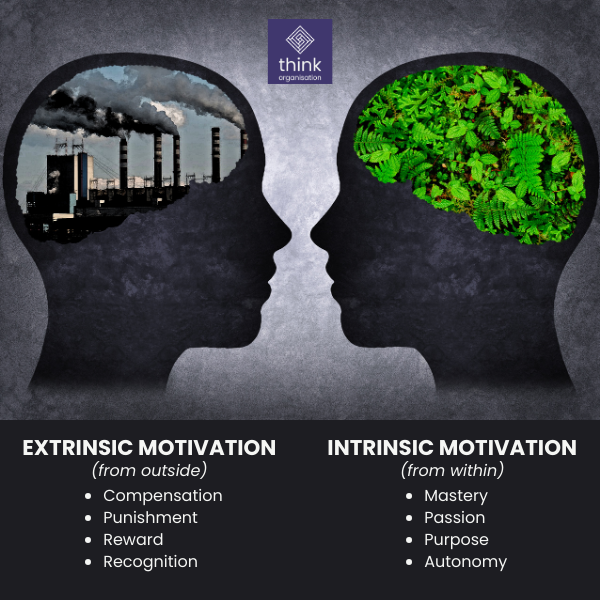
Motivation is complex and many tasks fit into both extrinsic and intrinsic – if you would like to discuss motivation book a free 30-minute consultation here.


This image shows the two sides to motivation - extrinsic and intrinsic.


Everyone has basic needs.

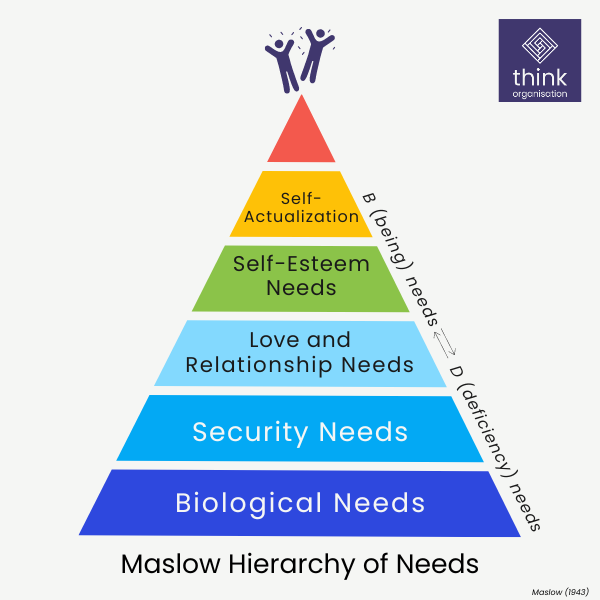
Abraham Maslow designed the Hierarchy of Needs to explain motivation in the 1940’s and it is still helpful today – especially when at work.


Think Organisation often works with clients to utilise individual, team and organisational hierarchy of need models to revolutionise employee engagement and productivity as part of our culture transformation projects.


Have a look at the model below and ask yourself what are your needs at each of the different levels?


So often organisations focus on the higher needs, such as providing development opportunities, especially when the basic needs of a salary commensurate with the role are not being delivered. The other challenge is this model is unique for every employee, and employees will only share their true thoughts, feelings and motivations if they feel psychologically safe in their team.


Psychological Safety is key.

When an employee feels, and thinks, they are psychologically safe then they will share their true thoughts, ideas, feelings, concerns and suggestions. Psychological safety is multi-faceted and arises as a result of the experiences, reactions and behaviours of others. It is not something you can tell people to be. To understand your perception of psychological safety in your organisation our free measure.


Think about when someone at work, like your Manager, has asked you to explain what you think, or what you need. Have you felt safe being open and honest? Or have you said what you thought you should say? What fitted in with the expectations of what you should say? Humans need to feel like they belong so will often say things to help this, avoiding confrontation and conflict.


Authentic environment.

The environment is the conditions and surroundings in which a person lives or operates. It has a huge impact on how humans behave. Have you ever tried to tell someone to be motivated? The surroundings we find ourselves in impact our motivation.


At times, our environment is a product of our motivations, effort and talents. Linked to the first few levels of the hierarchy of needs, humans have physical requirements such as warmth, shelter and somewhere to work effectively. At work, the environment needs to be authentic, stable and safe.


When this is not the case people’s motivations focus on creating a safe, stable environment they can influence or control. This often leads to negative behaviours as a result of the environment being inauthentic.


Ken Blanchard (2013) designed a model where trust is created when people demonstrate competence (are able), act with integrity (are believable), care about others (are connected) and behave reliably (are dependable). In many ways, this applies to environments as well.


Clear purpose.

Many organisations focus on their purpose, investing significant sums in purpose identification, strategies and marketing communication plans to communicate it effectively. This builds on the need for an environment to be authentic.


Without this focusing on purpose can be detrimental to businesses. History is plagued with scandals where people’s actions and behaviours have been misaligned to the publicly professed purpose of an organisation. People will know if there is any degree of misalignment and the depth and breadth of this can significantly impact the motivation of all employees.


To understand more about what drives you, and others, at work then please subscribe to our LinkedIn page.


Conclusions

How does intrinsic motivation play a critical role in enhancing employee engagement and productivity at work, compared to extrinsic motivation?


Intrinsic motivation is pivotal in enhancing employee engagement and productivity because it stems from within the individual, driven by personal interest, enjoyment, and a sense of accomplishment in the work itself. Unlike extrinsic motivation, which relies on external rewards such as money, promotions, or recognition, intrinsic motivation fosters a deeper commitment to the task.


Employees who are intrinsically motivated are more likely to experience job satisfaction, exhibit creativity, and persist in the face of challenges. This internal drive encourages a more meaningful connection to their work, leading to sustained effort and higher-quality performance.


In contrast, extrinsic motivators can sometimes undermine intrinsic interest, especially if overemphasised, potentially leading to reduced motivation once the external rewards are removed (e.g. bonuses).


What strategies can organisations implement to ensure psychological safety among employees, fostering an environment where they feel comfortable sharing their true thoughts and ideas?


Organisations can ensure psychological safety by implementing several key strategies that promote openness and trust. First, leaders should role model inclusive behaviour, actively listening to and valuing all employees’ input without judgement. Establishing clear communication channels and regular feedback loops allows employees to voice concerns and suggestions safely.


Experiential programmes on active listening and empathy can equip managers with the skills needed to foster a supportive atmosphere.


Additionally, recognising and rewarding vulnerability and honest communication can reinforce a culture where employees feel safe to express their true thoughts. Creating diverse and inclusive teams also contributes to psychological safety, encouraging different perspectives.


Addressing any instances of behaviour which are detrimental to psychological safety need to be dealt with swiftly and transparently. This helps maintain a respectful and trusting workplace environment.


How can organisations align their stated purpose and values with their employees’ experiences and the overall work environment to avoid misalignment and maintain high levels of motivation and trust?


Organisations can align their stated purpose and values with employees’ experiences by ensuring that their actions consistently reflect their professed ideals. This alignment starts with transparent and authentic leadership that exemplifies the company’s values in everyday decisions and interactions.


Regularly communicating the organisation’s purpose and demonstrating how it translates into concrete policies and practices helps reinforce this alignment.


Involving employees in the development and refinement of the organisation’s mission can also foster a sense of ownership and connection and ensure authenticity.


Once basic needs are met, opportunities for professional growth, recognising achievements that align with the individual’s values, and creating a supportive and inclusive work environment are crucial. By maintaining this alignment, organisations can build trust and help employees be motivated.


Over time, as employees see that their work contributes to a greater, consistent purpose, this enhances overall engagement and loyalty fourfold.


Think Performance. Think Excellence. Think Impact.


Check our Insights page for more valuable information.

More about Motivation

There’s more about Motivation in this Think Organisation Post: How Can Leaders Improve Motivation in their Workplace Culture

Alternatively, copy and paste this link into your browser: https://cortex.clyq.co.uk/how-can-leaders-improve-motivation-in-their-workplace-culture/
Are you ready to

start your joruney?

Take the first step to transform your workplace.

Call us on 07123 456 789
Email us at sarah@cortexworx.com

© Copyright Cortex Worx LTD. All rights reserved. | Website by Clyq